Facts
The petitioner, appointed as a Sainik in the Home Guards in 2006, was posted at Korba when a complaint under Section 376 IPC was lodged against him in March 2022.
Source reference: para. 2, pp. 2–3He was arrested on 29 March 2022, suspended retrospectively from that date, and terminated from service on 30 March 2022.
Source reference: para. 2, pp. 2–3After his acquittal by the competent criminal court, he was reinstated on 22 June 2023.
Source reference: para. 2, p. 3He claimed salary, back wages, and consequential benefits for the period from 28 March 2022 to 22 June 2023.
Source reference: para. 2, p. 3The petitioner had earlier approached the High Court in W.P.(S) No. 174 of 2023 and was granted liberty to approach the competent authority.
Source reference: para. 2, p. 3Pursuant thereto, he submitted his claim, which was rejected by orders dated 17 December 2025 and 1 April 2026.
Source reference: para. 2, p. 3The State defended the orders, contending that the claim had been duly considered in accordance with the applicable rules and that no illegality was established.
Source reference: para. 3, p. 3Issues
Whether the petitioner was entitled to back wages and consequential monetary benefits for the period during which he remained out of service because of his arrest, notwithstanding his subsequent acquittal?
Source reference: paras. 5–8, pp. 4–5Whether the orders dated 17 December 2025 and 1 April 2026 rejecting the petitioner’s claim warranted interference in writ jurisdiction?
Source reference: paras. 9–10, p. 6Law Applied
The Court applied the principle of “no work, no pay,” holding that an employee who did not actually discharge official duties during the relevant period cannot ordinarily claim wages for that period.
Source reference: para. 5, p. 4It relied on State Bank of India v. Mohammed Abdul Rahim, (2013) 11 SCC 67, which held that a subsequent acquittal does not retrospectively erase the legal consequences arising during the period of conviction or incarceration and does not automatically create an entitlement to back wages.
Source reference: para. 7, pp. 4–5The Court also referred to Ranchhodji Chaturji Thakore v. Superintendent Engineer, Gujarat Electricity Board, (1996) 11 SCC 603; Union of India v. Jaipal Singh, (2004) 1 SCC 121; and Baldev Singh v. Union of India, (2005) 8 SCC 747.
Source reference: para. 7, p. 4Further, relying on Ram Prasad Nayak v. State of Chhattisgarh & Others, W.P.(S) No. 1473 of 2021, decided on 15 April 2025, it reiterated that an employee who becomes unavailable for service because of involvement in a criminal case or incarceration is not entitled to back wages merely because he is subsequently acquitted.
Source reference: para. 8, p. 5Reasoning
The Court held that the petitioner’s removal from service was occasioned by his arrest and was, at the relevant time, a valid administrative action.
Source reference: para. 5, p. 4Although his subsequent acquittal justified his reinstatement, it did not automatically confer a retrospective right to salary for the period during which he neither worked nor discharged official duties.
Source reference: paras. 5–6, p. 4Applying the “no work, no pay” principle and the rule stated in Mohammed Abdul Rahim, the Court found that the acquittal did not retrospectively invalidate the consequences of the petitioner’s arrest or establish that the department had unlawfully prevented him from working.
Source reference: paras. 6–7, pp. 4–5Since the competent authority had considered and rejected the claim, and the petitioner failed to demonstrate illegality, violation of applicable rules, or other grounds for judicial interference, the impugned orders were upheld.
Source reference: para. 9, p. 6Holding
The Court answered the issues against the petitioner.
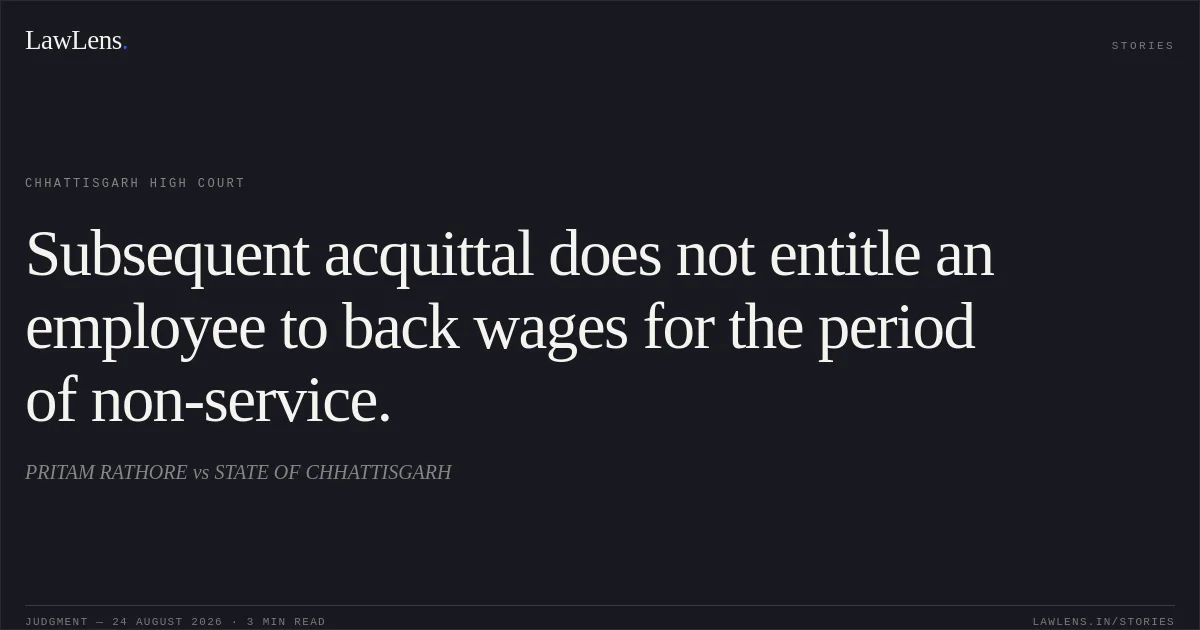
It held that the petitioner was not entitled to back wages or salary for the period from 28 March 2022 to 22 June 2023, merely on account of his subsequent acquittal, because he had not rendered service during that period.
Source reference: paras. 5–8, pp. 4–5The orders dated 17 December 2025 and 1 April 2026 rejecting his claim were found to be lawful and were not interfered with.
Source reference: para. 9, p. 6The writ petition was accordingly dismissed as devoid of merit.
Source reference: para. 10, p. 6Acts & Sections Cited
1 provisions across 1 statute referred to in this judgment. Each provision opens on LawLens.
Indian Penal Code, 18601
Original Court PDF
PRITAM RATHOREvsSTATE OF CHHATTISGARH
Click to open original judgment
Original judgment, available to read, download and summarize on LawLens.in
![Courts will not interfere with transfers absent mala fides or violation of statutory rules.. M Ramya vs EMPLOYEES STATE INSURANCE CORPORATION (ESIC). CAT - ['Chennai']. LawLens](/stories/thumbnails/courts-will-not-interfere-with-transfers-absent-mala-fides-or-violation-of-statutory-rules-a6845e9ca6f548fca284c51c8351957f.webp)
![Courts cannot direct one-time recruitment age relaxation absent authority in the governing rules or advertisement.. UT OF PUDUCHERRY vs M ANDAL. CAT - ['Chennai']. LawLens](/stories/thumbnails/courts-cannot-direct-one-time-recruitment-age-relaxation-absent-authority-in-the-governing-895d78fde47143e2a8ed0207c4b6a44f.webp)
![A review cannot correct an allegedly erroneous decision absent an error apparent on the record.. Ajit Kumar Jha vs RAILWAY BOARD. CAT - ['Delhi']. LawLens](/stories/thumbnails/a-review-cannot-correct-an-allegedly-erroneous-decision-absent-an-error-apparent-on-the-re-8ac952fd4eba470c92f7da20af72a220.webp)