01Facts
The petitioner, an English teacher, was suspended after a criminal case was registered against him. He was convicted by the Sessions Court, but the High Court subsequently allowed his criminal appeal and acquitted him; he was then reinstated in service
¶ 7On his request for payment for the suspension period, the second respondent first issued an endorsement dated 25 August 2025 indicating entitlement to subsistence allowance, but later issued an endorsement dated 7 August 2026 rejecting his claim for wages for that period
¶ 7The petitioner challenged both endorsements under Articles 226 and 227 of the Constitution and sought payment for the suspension period
¶ 1–202Issues
i.Whether the petitioner, having been acquitted and reinstated, was entitled to wages or subsistence allowance for the suspension period arising from the criminal proceedings
¶ 2, 7, 12ii.Whether the second respondent could issue a later endorsement correcting its earlier decision, or whether doing so amounted to an impermissible review
¶ 3–4, 1303Law Applied
Under Ranchhodji Chaturji Thakore v. Superintendent Engineer, Gujarat Electricity Board, subsequent acquittal does not, by itself, entitle an employee to back wages where the employee’s involvement in criminal proceedings and resulting inability to work—not an unlawful act of the employer—kept the employee out of service; the circumstances of each case must be considered.
¶ 10Union of India v. Jaipal Singh, as discussed through Raj Narain v. Union of India in Sri Rakhesh B. v. Karnataka Power Transmission Corporation Ltd., similarly distinguishes criminal proceedings from an employer’s wrongful exclusion of an employee, while recognising that a different consideration may arise where prosecution is malicious or vexatious.
¶ 11The principle of “no work, no pay” does not apply where the employer unlawfully prevents an employee from working, but may apply where the employee’s own circumstances—not attributable to the employer—result in the employee being out of service.
¶ 11The back-wage principles in Deepali Gundu Surwase v. Kranti Junior Adhyapak Mahavidyalaya concern wrongful termination and did not govern this case.
¶ 8–9The Court also treated the later endorsement as an administrative correction of an earlier decision, rather than an impermissible review.
¶ 13Provisions in the judgment · 3 · Linked ones open on LawLens
Indian Penal Code, 1860 Section 302Section 307Section 34
04Reasoning
The Court found that the petitioner’s suspension followed the criminal case and that his subsequent acquittal did not establish that the employer had wrongfully kept him out of service.
¶ 7, 12–13It therefore applied Ranchhodji Chaturji Thakore and the related authorities, holding that the petitioner’s circumstances did not warrant payment for the suspension period under the “no work, no pay” principle.
¶ 10–12The Court distinguished Deepali Gundu Surwase because that case concerned wrongful termination.
¶ 9It further held that the first endorsement had been issued without considering the relevant legal position and that the authority could correct it through the later administrative endorsement.
¶ 1305Holding
The Court held that the petitioner was not entitled to wages or subsistence allowance for the suspension period and found no ground to interfere with the endorsement dated 7 August 2026.
¶ 12It rejected the challenge that the authority had impermissibly reviewed its earlier decision and dismissed the writ petition as devoid of merit.
¶ 13–14Original Court PDF
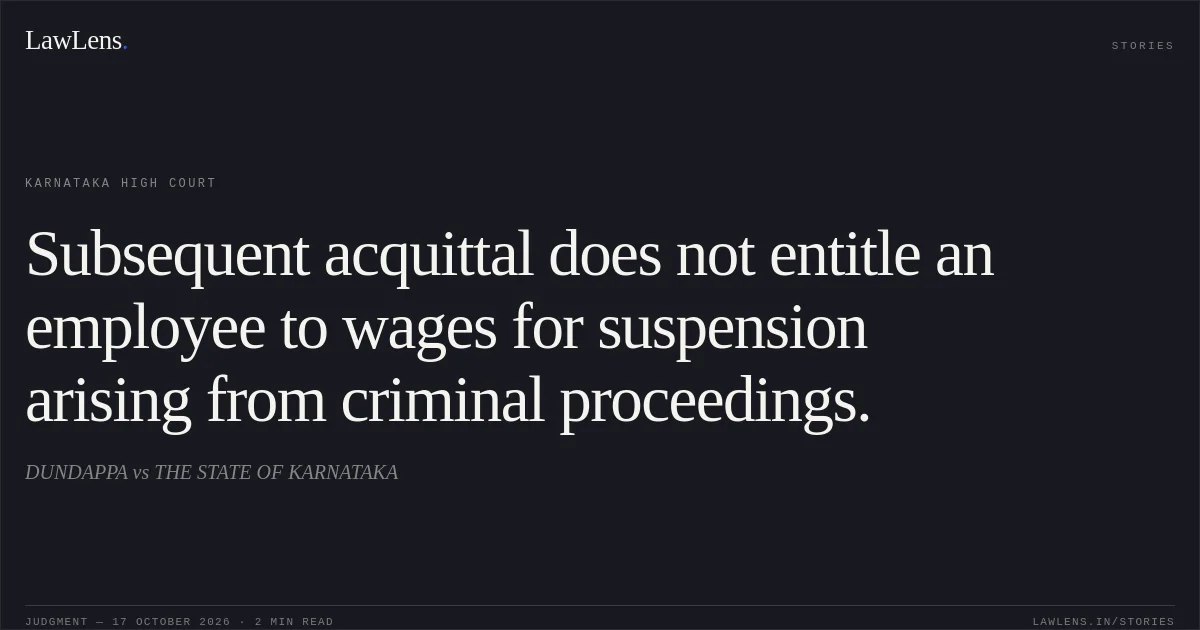
DUNDAPPAvsTHE STATE OF KARNATAKA
Click to open original judgment
Original judgment, available to read, download and summarize on LawLens.in