Facts
The petitioner, a Class III employee initially appointed as Assistant Grade III, was granted a second time scale of pay under the Government circular dated 24.01.2008.
Source reference: pp. 1–3Upon subsequent scrutiny, the respondents found that she had not passed the prescribed accounts-training examination, which was treated as a qualification for promotion to the relevant higher post and, consequently, for grant of the second time scale.
Source reference: pp. 1–3The authorities withdrew the benefit and ordered recovery of ₹2,43,888 through orders dated 12.03.2018, 20.03.2018, 09.04.2018 and 11.09.2018.
Source reference: pp. 1–3The petitioner challenged those orders under Article 226, contending that no show-cause notice or hearing had been provided, that she had made no misrepresentation, and that the amendment dated 04.09.2017 to Rule 15(1)(b) of the Madhya Pradesh Class IV Ministerial Forest Service Recruitment Rules, 2000, removed the qualification-related objection.
Source reference: pp. 1–3The respondents defended the recovery on the basis that the benefit had been granted contrary to the applicable eligibility conditions and submitted that the petitioner had sought deductions of ₹20,000 per month towards recovery.
Source reference: pp. 1–3Issues
1. Whether the petitioner was substantively entitled to the second time scale of pay despite not having passed the prescribed accounts-training examination
Source reference: pp. 3–52. Whether the amendment dated 04.09.2017 could operate retrospectively to validate the petitioner’s earlier grant of the second time scale
Source reference: p. 43. Whether recovery of the excess payment was impermissible because the petitioner had made no misrepresentation or fraud and had not been afforded a prior show-cause notice and hearing
Source reference: pp. 1–3, 54. Whether the impugned orders suffered from jurisdictional error, perversity or manifest illegality warranting interference under Article 226
Source reference: pp. 5–6Law Applied
The Court exercised its supervisory jurisdiction under Article 226 of the Constitution of India.
Source reference: pp. 1, 5–6It applied the principle that a benefit granted under executive instructions cannot create an indefeasible right where the employee does not satisfy the eligibility conditions prescribed by the governing service rules or binding Government instructions.
Source reference: pp. 3–4The Court relied on the Government circular dated 24.01.2008, under which grant of the time scale was subject to fulfillment of the qualifications prescribed for promotion to the relevant post.
Source reference: p. 3It further held that a subsequent statutory amendment ordinarily operates prospectively unless it is expressly or by necessary implication retrospective, and cannot reopen concluded pay-fixation decisions absent such retrospective intention.
Source reference: p. 4The Court distinguished substantive entitlement from recovery of an erroneous payment and observed that absence of fraud or misrepresentation is relevant to the equities of recovery but does not establish entitlement to an otherwise inadmissible benefit.
Source reference: p. 3It also referred to Chandi Prasad v. State of Uttarakhand, (2012) 8 SCC 417, cited by the respondents in support of recovery of payments to which an employee was not legally entitled.
Source reference: p. 2Reasoning
The Court found that the second time scale was conditional upon compliance with the applicable qualification requirements and that the petitioner had not passed the accounts-training examination prescribed for promotion to the relevant post.
Source reference: pp. 3–5The initial administrative grant could not override the service rules or convert an erroneous payment into a vested entitlement; therefore, the petitioner could not claim continuation of the benefit merely because the error originated with the department.
Source reference: p. 3The amendment dated 04.09.2017 was subsequent to the relevant period, and the petitioner produced no material showing that it was retrospective or intended to validate past cases.
Source reference: p. 4Similarly, the circular dated 31.03.2016 could regulate the manner of recovery but could not confer substantive entitlement to the second time scale.
Source reference: p. 4Although the Court acknowledged that there was no allegation of fraud or misrepresentation, it treated that circumstance as relevant only to the equities of recovery and not as a basis for declaring the original benefit lawful.
Source reference: p. 3On the material before it, the Court found no jurisdictional error, perversity or manifest illegality in the impugned orders.
Source reference: pp. 5–6Holding
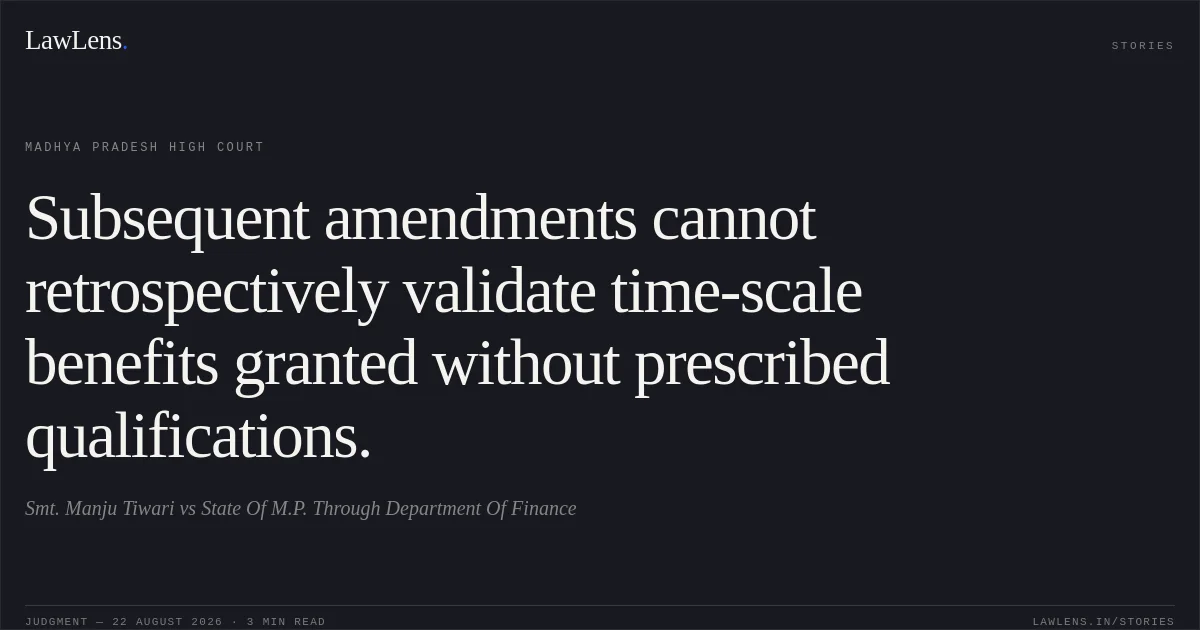
The Court held that the petitioner was not substantively entitled to the second time scale because she had not fulfilled the prescribed qualification, and that the 04.09.2017 amendment did not retrospectively validate the earlier grant.
The challenge to the recovery of ₹2,43,888 and to the orders dated 12.03.2018, 20.03.2018, 09.04.2018 and 11.09.2018 was rejected.
Source reference: pp. 5–6The writ petition was accordingly dismissed.
Source reference: pp. 5–6Original Court PDF
Smt. Manju TiwarivsState Of M.P. Through Department Of Finance
Click to open original judgment
Original judgment, available to read, download and summarize on LawLens.in