Facts
Respondent No. 3, a Police Inspector working in the Criminal Investigation Department, Bengaluru, and holding additional charge at Byadarahalli Police Station, was transferred to Byadarahalli Police Station by order dated 10.05.2026.
Source reference: para. 2He was relieved from the CID on 11.05.2026 and reported at Byadarahalli Police Station the same day.
Source reference: para. 5By a subsequent order dated 14.05.2026, respondent No. 3 was transferred from Byadarahalli to Karnataka Lokayukta Police Station, while the petitioner was posted to Byadarahalli Police Station; the petitioner reported there on 14.05.2026.
Source reference: para. 3Respondent No. 3 challenged the subsequent transfer before the Karnataka State Administrative Tribunal, contending that it amounted to a premature transfer in violation of Sections 20B and 20F of the Karnataka Police Act, 1963, and had not been approved by the Police Establishment Board.
Source reference: para. 4The Tribunal quashed the transfer order dated 14.05.2026 and directed implementation of the earlier order dated 10.05.2026.
Source reference: paras. 5–7The petitioner challenged the Tribunal’s order before the High Court under Article 226 of the Constitution.
Source reference: para. 1Issues
Whether the transfer of respondent No. 3 from Byadarahalli Police Station to Karnataka Lokayukta Police Station within four days of joining Byadarahalli constituted a premature transfer prohibited by Section 20F of the Karnataka Police Act, 1963?
Source reference: para. 8Whether the absence of prior approval from the Police Establishment Board invalidated the transfer order dated 14.05.2026, notwithstanding its subsequent approval by the Board?
Source reference: paras. 8–13Whether the Tribunal’s order quashing the transfer warranted interference under Article 226 of the Constitution?
Source reference: paras. 1, 8, 16–17Law Applied
Section 20B of the Karnataka Police Act, 1963, vests the Police Establishment Board with authority to decide transfers and postings of police officers of and below the rank of Deputy Superintendent of Police, including Police Inspectors.
Source reference: para. 10Section 20F prescribes a minimum one-year tenure for officers in operational duties but permits transfer before expiry of that period in specified circumstances; the provision does not create an indefeasible right to remain in a post for one year.
Source reference: paras. 10–11.1A procedural defect arising from lack of prior approval may be cured by subsequent ratification where the ratifying authority itself possesses statutory jurisdiction over the subject matter; the Supreme Court’s decision in National Institute of Technology v. Pannalal Choudhury, (2015) 11 SCC 669, recognises that ratification retrospectively validates an act already performed.
Source reference: para. 13Transfer is ordinarily an incident of service, and judicial interference is justified only where the order is vitiated by mala fides, violates a statutory provision, or is passed by an incompetent authority, as held in Union of India v. S.L. Abbas, (1993) 4 SCC 357.
Source reference: para. 14Transfers and postings of police personnel ordinarily lie within the discretion of the competent administrative authorities and should not be interfered with unless clearly illegal, as held in State of Haryana v. Kashmir Singh, (2010) 13 SCC 306.
Source reference: para. 15Reasoning
The High Court held that respondent No. 3’s joining at Byadarahalli on 11.05.2026 did not confer an absolute right to remain there for one year, since Section 20F itself permits transfers before completion of the minimum tenure in specified circumstances.
Source reference: para. 11.1The mere short interval between the orders dated 10.05.2026 and 14.05.2026 therefore did not, by itself, make the latter order an unlawful premature transfer.
Source reference: para. 11.1Although the Police Establishment Board was the competent authority under Section 20B, the modification made by the order dated 14.05.2026 was subsequently placed before and approved by the Board on 08.06.2026.
Source reference: para. 11This post facto approval was treated as a curable procedural defect rather than a jurisdictional nullity, because the approval came from the very statutory authority competent to decide the transfer.
Source reference: paras. 12–13The Court also found no material indicating mala fides, statutory prohibition, or lack of authority, and held that administrative discretion concerning police transfers warranted judicial restraint.
Source reference: para. 16Holding
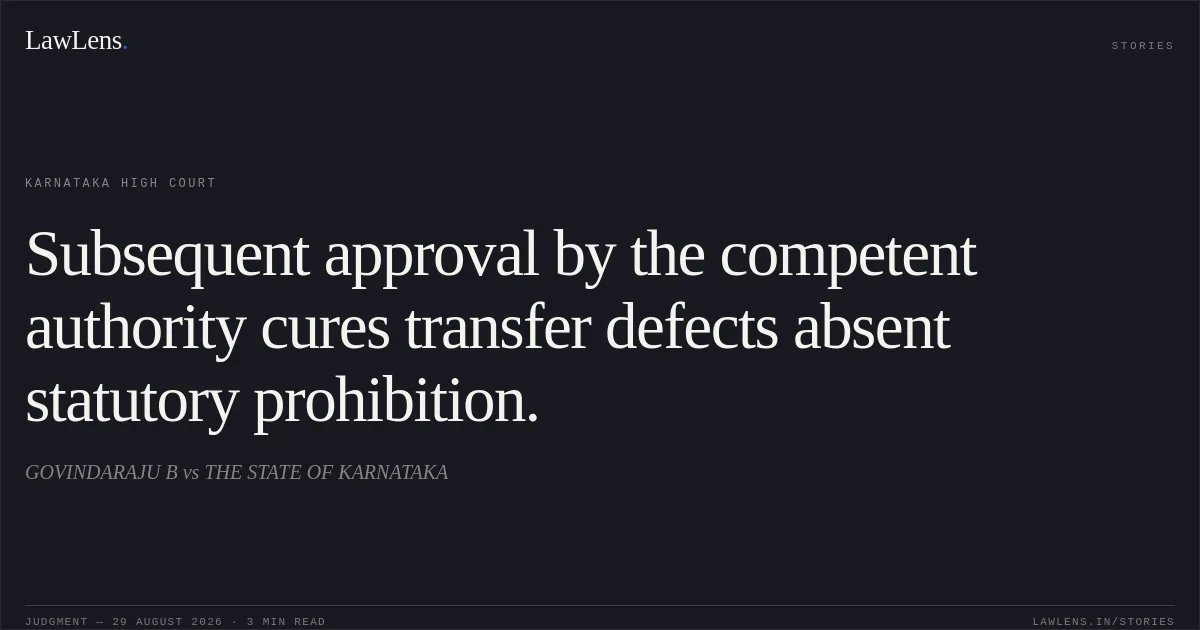
The High Court answered the issues in favour of the petitioner.
It held that the transfer dated 14.05.2026 was not invalid merely because respondent No. 3 had joined Byadarahalli four days earlier, and that the subsequent approval of the Police Establishment Board cured the absence of prior approval.
Source reference: paras. 11.1–13The Tribunal had therefore erred in quashing the transfer order.
Source reference: para. 17The writ petition was allowed, the Tribunal’s order dated 16.07.2026 in Application No. 2617/2026 was set aside, and the transfer order dated 14.05.2026 was restored.
Source reference: para. 17Pending interlocutory applications were disposed of as having become unnecessary.
Source reference: para. 18Acts & Sections Cited
2 provisions across 1 statute referred to in this judgment. Linked provisions open on LawLens.
Karnataka Police Act, 19632
Original Court PDF
GOVINDARAJU BvsTHE STATE OF KARNATAKA
Click to open original judgment
Original judgment, available to read, download and summarize on LawLens.in
![A police constable cannot be removed for unauthorized absence without a Rule 359-compliant inquiry.. Mohammad Sidiq Khan vs D/o Home Ut Of Jammu & Kashmir. CAT - ['Srinagar']. LawLens](/stories/thumbnails/a-police-constable-cannot-be-removed-for-unauthorized-absence-without-a-rule-359-compliant-7b43fc316bd94f22a62676153bbc9d54.webp)
![A Review DPC lacks authority to determine or alter inter se seniority.. SAURABH KUMAR vs REVENUE. CAT - ['Patna']. LawLens](/stories/thumbnails/a-review-dpc-lacks-authority-to-determine-or-alter-inter-se-seniority-4b21640f20af46fcabdfc8273d2ce959.webp)