Facts
The plaintiff (Respondent No. 1) filed a partition suit in O.S.No.1633/2006.
Source reference: no citationOn 16.04.2010, the parties entered into a compromise decree where defendants agreed to pay ₹15,00,000 via cash and six post-dated cheques.
Source reference: p. 5A specific clause in the compromise barred parties from seeking cancellation of the decree due to non-payment, providing instead for recovery through due process of law.
Source reference: p. 5Subsequently, the cheques were dishonored. After a failed miscellaneous petition by Defendant No. 1 to cancel the decree, the plaintiffs filed an application under Section 151 of the CPC in 2021 (eleven years later) to set aside the compromise and restore the suit.
Source reference: p. 6, 18-19The Trial Court allowed the application and restored the suit on the grounds that the cheques belonged to third parties and their dishonor left the plaintiff remediless.
Source reference: p. 17-18Issues
1. Whether a compromise decree lawfully passed under Order XXIII Rule 3 of CPC can be set aside on the grounds that the parties to the compromise committed a breach of its terms and conditions?
Source reference: p. 11-12 / para. 8Law Applied
Order XXIII Rule 3 of the CPC, which mandates the recording of "lawful" agreements, and Rule 3A, which bars separate suits to set aside compromise decrees.
Source reference: p. 12The principle that a compromise decree is a contract with the imprimatur of the court.
Source reference: p. 12-13Lakshmamma v. T.H. Ramegowda (ILR 2015 KAR 4024), establishing that while a court can entertain an application under Section 151 to challenge a compromise’s legality (e.g., fraud or lack of consensus), it must decide if the compromise was void or voidable at the time of entry.
Source reference: p. 8-10Krishna Kumar Ojha v. Jitendra Chaudhary, noting that delays may be overlooked only where the compromise itself was inherently unlawful or fraudulent from inception.
Source reference: p. 15-17Reasoning
The High Court reasoned that a compromise decree comprises a voluntary contract merged into a court order, intended to ensure finality.
Source reference: p. 12-13The legality of a compromise must be judged based on the facts existing on the date the court recorded it.
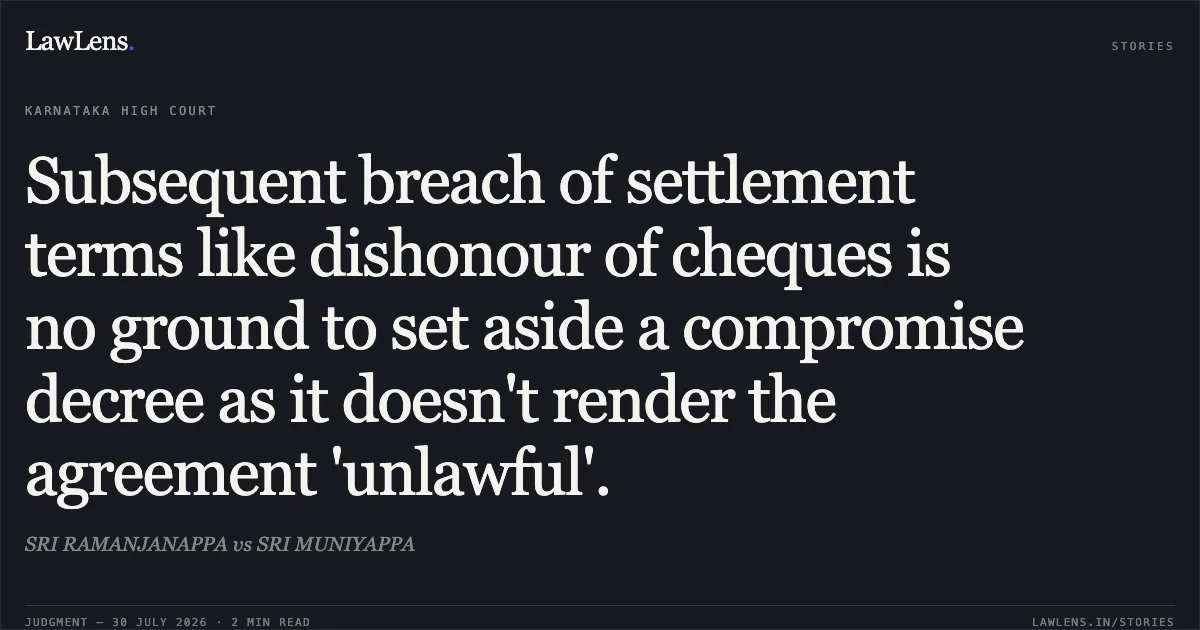
Source reference: p. 14The Court found that the Trial Court erroneously equated a "breach of contract" (dishonor of cheques) with "invalidity" of the compromise.
Source reference: p. 19Since the plaintiffs accepted the third-party cheques in the presence of counsel in 2010, the subsequent default did not retrospectively make the consent involuntary or the agreement unlawful.
Source reference: p. 19The Court observed that Clause 7 of the agreement specifically provided for an execution remedy in case of default; therefore, the plaintiffs should have filed execution proceedings under Order XXI CPC or initiated proceedings under the Negotiable Instruments Act.
Source reference: p. 15, 21Holding
The Court answered the issue in the negative, holding that a subsequent breach of terms does not render a compromise "unlawful" under Order XXIII Rule 3.
The Trial Court’s order dated 12.01.2026 was set aside, and the compromise decree dated 16.04.2010 was restored. The respondents were granted liberty to execute the decree in accordance with the law. The Civil Revision Petition was allowed.
Source reference: p. 21Original Court PDF
SRI RAMANJANAPPAvsSRI MUNIYAPPA
Click to open original judgment
Original judgment, available to read, download and summarize on LawLens.in