Facts
The State Government referred an industrial dispute regarding a "charter of demands" to the Industrial Tribunal in 2005.
Source reference: para. 4The dispute was raised by Respondent No. 2, which was a registered Trade Union at the time of the reference.
Source reference: para. 29-30During the stage of arguments on 20.07.2023, the registration of Respondent No. 2 was cancelled by the competent authority.
Source reference: para. 7, 30The petitioner (employer) filed applications before the Tribunal arguing that the case was no longer maintainable due to the union's de-registration.
Source reference: para. 7On 02.02.2026, the Tribunal passed an order holding that subsequent de-registration does not affect the validity of the ongoing proceedings.
Source reference: para. 2The petitioner challenged this order before the High Court via a writ petition.
Source reference: para. 1, 9Issues
1. Whether an industrial dispute properly referred to a Tribunal lapses or becomes unmaintainable upon the subsequent de-registration of the sponsoring Trade Union.
Source reference: para. 2, 112. Whether an unregistered trade union can continue to represent workmen in a judicial proceeding under Section 36 of the Industrial Disputes Act, 1947.
Source reference: para. 11, 41Law Applied
The court applied Section 2(qq) of the Industrial Disputes Act, 1947, which defines a "Trade Union" as one registered under the Trade Unions Act, 1926.
Source reference: para. 11, 15Section 36 of the ID Act stipulates that workmen are to be represented by officers of a registered trade union.
Source reference: para. 15, 42The court relied on State of Bihar v. D.N. Ganguly (AIR 1958 SC 1018) to establish that once a reference is made, the government cannot cancel it.
Source reference: para. 36the court applied the principle from Polypharma Pvt. Ltd. v. Kamgar Sabha [(2006) ILLJ620BOM], which holds that the character of a dispute is determined at the date of reference and subsequent withdrawal of support or change in union status does not divest the Tribunal of jurisdiction.
Source reference: para. 46Reasoning
The Court reasoned that while de-registration impacts the union’s status as a "corporate body" and its statutory right to formally represent workers under Section 36, it does not result in the "civil death" of the underlying industrial dispute.
Source reference: para. 42-43, 38-39Since the reference was validly made when the union was registered, the Tribunal became seized of the matter.
Source reference: para. 37The Court distinguished between the existence of the dispute and the mode of representation.
Source reference: no citationIt noted that the dispute fundamentally concerns the substantive rights of the workmen, and the reference survives because the referring government lacks the power to supersede it once initiated.
Source reference: para. 36, 39However, since Section 2(qq) and Section 36 strictly require registration for a union to act as a legal representative, Respondent No. 2 cannot continue to participate in its capacity as an unregistered entity.
Source reference: para. 41, 48Nevertheless, the Court observed that the workmen themselves—being the real parties in interest—retain the right to pursue the dispute through alternative representation.
Source reference: para. 40, 44, 49Holding
The Court held that the subsequent cancellation of registration does not render the reference infructuous.
It ordered that Respondent No. 2, being currently unregistered, cannot participate further in the proceedings. However, it directed that the reference remains valid and the substantial number of workmen involved are at liberty to appear and pursue the dispute directly or through other authorized modes until the union is re-registered or the reference is adjudicated. The Tribunal was directed to consider the evidence already on record.
Source reference: para. 48, 49The writ petition was disposed of accordingly.
Source reference: para. 50Acts & Sections Cited
11 provisions across 3 statutes referred to in this judgment. Linked provisions open on LawLens.
Industrial Disputes Act, 19475
Trade Unions Act, 19263
Code of Criminal Procedure, 18983
Original Court PDF
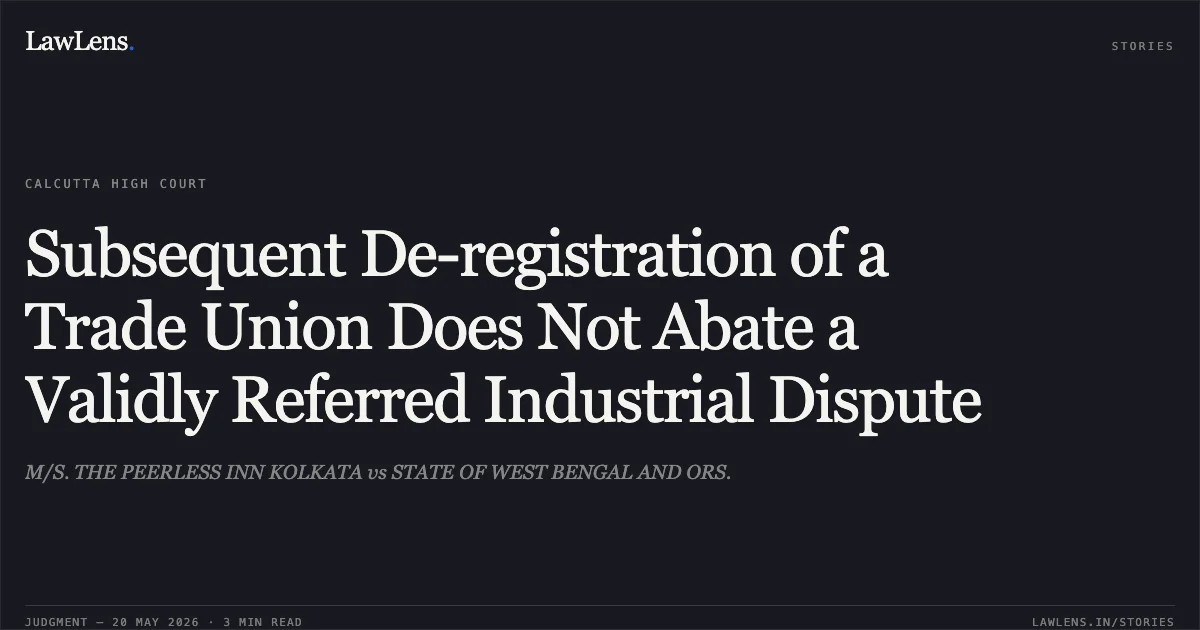
M/S. THE PEERLESS INN KOLKATAvsSTATE OF WEST BENGAL AND ORS.
Click to open original judgment
Original judgment, available to read, download and summarize on LawLens.in