Facts
The appellant filed a miscellaneous appeal against an award dated 30 August 2022 after a delay of approximately 1,334 days, stated in the order as three years and eight months.
Source reference: para. 4He sought condonation of delay under Section 5 of the Limitation Act through I.A. No. 16654/2026.
Source reference: para. 1The appellant contended that he became aware of the execution proceedings only after repeated notices from the Executing Court.
Source reference: para. 2He further submitted that he had deposited his share of the awarded compensation, together with interest, on 27 June 2025 in Execution Case No. MJC-16/2023, but recovery notices were subsequently issued.
Source reference: para. 2He claimed to have obtained copies of the execution proceedings in July 2026 and thereafter filed the appeal.
Source reference: para. 2Issues
Whether the appellant had established “sufficient cause” under Section 5 of the Limitation Act for condonation of the delay of approximately 1,334 days in filing the appeal?
Source reference: paras. 1, 4, 7Whether the appellant’s subsequent knowledge of, and participation in, execution proceedings could extend or revive the limitation period for challenging the original award?
Source reference: para. 4Law Applied
The Court applied Section 5 of the Limitation Act, under which delay may be condoned only where the applicant establishes sufficient cause explaining the delay for the entire period.
Source reference: paras. 4, 7It relied on Pundlik Jalam Patil v. Executive Engineer, Jalgaon Medium Project, (2008) 17 SCC 448, for the principles that stale and belated claims cannot ordinarily be entertained on grounds of equity, that “delay defeats equity,” and that courts assist vigilant litigants rather than those who sleep over their rights.
Source reference: para. 5The Court also relied on Majji Sannemma @ Sanyasirao v. Reddy Sridevi & Others, AIR 2022 SC 332, which followed the same approach.
Source reference: para. 5Further, relying on Shivamma (Dead) by LRs v. Karnataka Housing Board & Others, Civil Appeal No. 11794/2025, the Court reiterated that negligence, lethargy, and lack of vigilance do not constitute sufficient cause and that limitation serves the objective of finality in litigation.
Source reference: para. 6Reasoning
The Court found that the appellant had not satisfactorily explained the entire period of delay.
Source reference: para. 4The award had been passed on 30 August 2022, while the appeal was filed only after approximately three years and eight months.
Source reference: para. 4The appellant’s own conduct—particularly depositing his share of the compensation with interest before the Executing Court on 27 June 2025—demonstrated that he had knowledge of both the award and the execution proceedings.
Source reference: para. 4Despite that knowledge, he did not approach the High Court within a reasonable time.
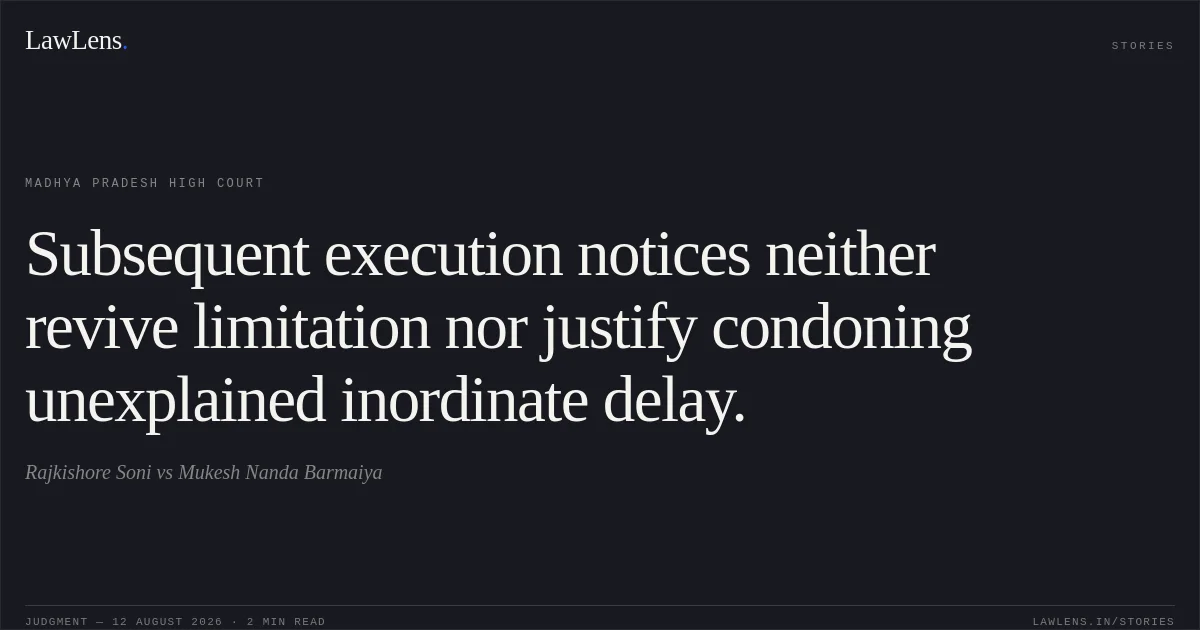
Source reference: para. 4The later issuance of recovery notices could not create a fresh cause of action or extend the limitation period for challenging the original award.
Source reference: para. 4Applying the requirement of due diligence under Section 5 and the principles against condoning stale claims, the Court held that the explanation reflected negligence rather than circumstances beyond the appellant’s control.
Source reference: paras. 4–7Holding
The Court held that the appellant had failed to establish sufficient cause for condoning the delay of approximately 1,334 days.
I.A. No. 16654/2026 seeking condonation of delay was accordingly dismissed, and, as a consequence, Misc. Appeal No. 6395 of 2026 was also dismissed.
Source reference: paras. 7–8Original Court PDF
Rajkishore SonivsMukesh Nanda Barmaiya
Click to open original judgment
Original judgment, available to read, download and summarize on LawLens.in