Facts
The Appellant (Plaintiff No. 1) is a co-landlord and co-owner of "Memorare Building" in Mumbai
Source reference: para. 3, 44In 1993, she filed an eviction suit under the Bombay Rents, Hotel and Lodging House Rates Control Act, 1947, against the legal heirs of the original sub-tenant, Mr. Augustine Lacerda
Source reference: para. 4, 6The grounds for eviction included bona fide requirement (Section 13(1)(g)), acquisition of alternative accommodation by the tenants (Section 13(1)(l)), and change of user (Section 13(1)(k))
Source reference: para. 6The Trial Court and Appellate Bench of the Small Causes Court concurrently decreed the eviction in favor of the Appellant
Source reference: para. 9-10However, in 2025, the High Court of Bombay set aside these findings in revision, dismissing the suit and ordering restoration of possession to the Respondent
Source reference: para. 2, 11The High Court’s decision was primarily based on the purported lack of specific pleadings regarding the Appellant’s status as landlord and the "family arrangement" that allegedly distributed the flats
Source reference: para. 16, 19Issues
1. What constitutes a "pleading" and what is the distinction between "pleading" and "proof" in civil litigation?
Source reference: para. 252. Whether the Appellant satisfied the tests of pleading and proof regarding her status as a landlord and her bona fide requirement for the suit premises.
Source reference: para. 253. Whether a court can take cognizance of subsequent events (like a family arrangement or a death) that occur after the institution of an eviction suit.
Source reference: para. 47Law Applied
Order VI Rules 1, 2, and 4 of the Code of Civil Procedure (CPC), which mandate that pleadings must state material facts (facta probanda) but not the evidence (facta probantia) by which they are to be proved
Source reference: para. 27-32Section 5(3) of the Bombay Rent Act, 1947, which defines a "landlord" as anyone entitled to receive rent
Source reference: para. 45Virender Nath Gautam v. Satpal Singh regarding the distinction between material facts and evidence
Source reference: para. 32Ram Sarup Gupta v. Bishun Narain Inter College, which held that technical deficiencies in pleadings cannot be raised in appeal if the parties were aware of the issues and led evidence at trial
Source reference: para. 41Section 8 of the Transfer of Property Act, 1882, establishing that interest in land includes buildings attached to it
Source reference: para. 42Principle from Pasupuleti Venkateswarlu v. Motor & General Traders allowing courts to consider subsequent developments to ensure justice
Source reference: para. 47Reasoning
The Supreme Court found that the Appellant’s plaint sufficiently alleged her status as a co-landlord—a material fact (facta probanda)—while the specific share certificates and oral family arrangements provided during trial were evidence (facta probantia) intended to prove that status
Source reference: para. 39-40The Court held that the High Court erred in requiring the Appellant to plead internal family arrangements in the 1993 plaint, especially since those arrangements evolved after the death of her father in 1994
Source reference: para. 18, 46Regarding bona fide need, the Court noted the Appellant had no other residence in Mumbai and her temporary stay in other family flats (Nos. 5 & 6) did not negate her need, as those flats were earmarked for her brothers under a valid oral family settlement
Source reference: para. 50-53On the issue of comparative hardship, the Court observed that the tenants (Respondents) had acquired multiple alternative properties, some of which were sold during litigation to defeat the suit, whereas the Appellant remained without exclusive accommodation
Source reference: para. 56-60Holding
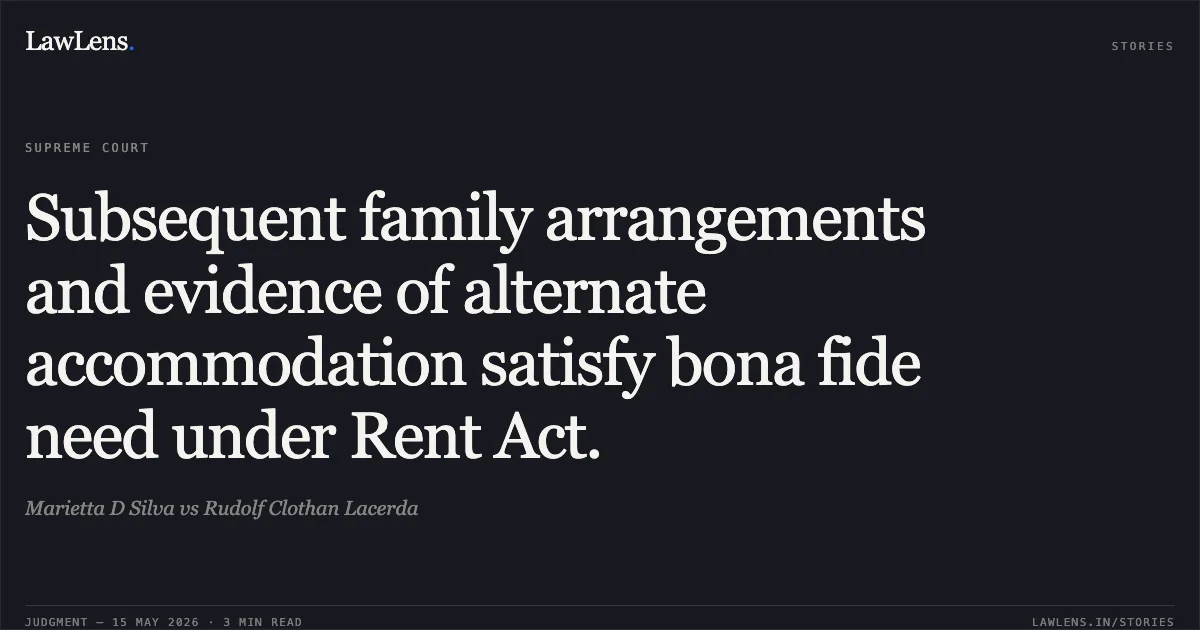
The Court answered the issues in the affirmative for the Appellant. It held that the Appellant was a "landlord" as defined under the Act and had successfully pleaded and proved both bona fide requirement and the availability of alternative accommodation for the tenants
The Supreme Court allowed the appeal, set aside the High Court’s judgment, and restored the eviction decree passed by the Small Causes Court. The Appellant’s right to seek eviction as a co-owner/landlord was upheld regardless of any formal partition, based on the equitable principles governing family arrangements and the established facts of the case
Source reference: para. 50, 61Acts & Sections Cited
2 provisions across 1 statute referred to in this judgment. Each provision opens on LawLens.
Original Court PDF
Marietta D SilvavsRudolf Clothan Lacerda
Click to open original judgment
Original judgment, available to read, download and summarize on LawLens.in