Facts
The petitioner was first convicted in Sessions Case No. 100/2006 on April 29, 2008, for kidnapping and rape (Sections 363, 376, 506 IPC) and sentenced to seven years of rigorous imprisonment
Source reference: para. 5He was subsequently convicted in Sessions Case No. 04/2007 on June 17, 2008, for the murder and rape of a six-year-old girl (Sections 302, 363, 364, 376, 201 IPC) and sentenced to life imprisonment
Source reference: para. 6This second conviction was confirmed on appeal in 2010
Source reference: para. 7The petitioner approached the High Court seeking a writ of mandamus to treat both sentences as running concurrently under Section 427(2) of the Cr.P.C., arguing he had already undergone over 19 years of imprisonment
Source reference: para. 2, 9Issues
1. Whether a petitioner who was first awarded a term sentence in a previous trial is entitled to the benefit of running that sentence concurrently with a sentence of life imprisonment awarded in a subsequent trial under Section 427(2) of the Cr.P.C.
Source reference: para. 3Law Applied
The court primarily interpreted Section 427 of the Cr.P.C. regarding sentences for offenders already sentenced for another offence
Source reference: para. 12Section 427(1) mandates that a subsequent sentence commences after the expiration of a previous term sentence unless the court directs concurrency
Source reference: para. 13Section 427(2) is an exception, providing that if a person already undergoing life imprisonment is subsequently sentenced to a term or life imprisonment, the sentences shall run concurrently
Source reference: para. 13, 16The court relied on Mutthuramlingam v. State (2016) 8 SCC 313, which clarifies that a court may direct a prisoner to first undergo a term sentence before the commencement of a life sentence
Source reference: para. 18It further cited Mohd. Zahid v. State through NCB (2022) 12 SCC 426, establishing that concurrent sentences are generally not awarded for different transactions and different crime numbers unless specifically directed
Source reference: para. 20Reasoning
The court found that the petitioner’s case falls under Section 427(1), not Section 427(2), because he was not "already undergoing life imprisonment" when the subsequent sentence was passed; rather, he was undergoing a fixed-term sentence
Source reference: para. 13, 21Under Section 427(1), the default rule is consecutive sentencing unless the trial or appellate court specifically directs concurrency, which was absent in this case
Source reference: para. 21The court distinguished the petitioner's cited precedents (Benson, Vicky, and Mahadev Sillode) noting they either involved two-term sentences or situations where life imprisonment was the first sentence imposed
Source reference: para. 14-17Furthermore, the court emphasized the "gruesome and brutal nature" of the offences—the rape and murder of a minor—as a factor in declining to exercise discretionary power under Article 226 to grant concurrency
Source reference: para. 19, 22Holding
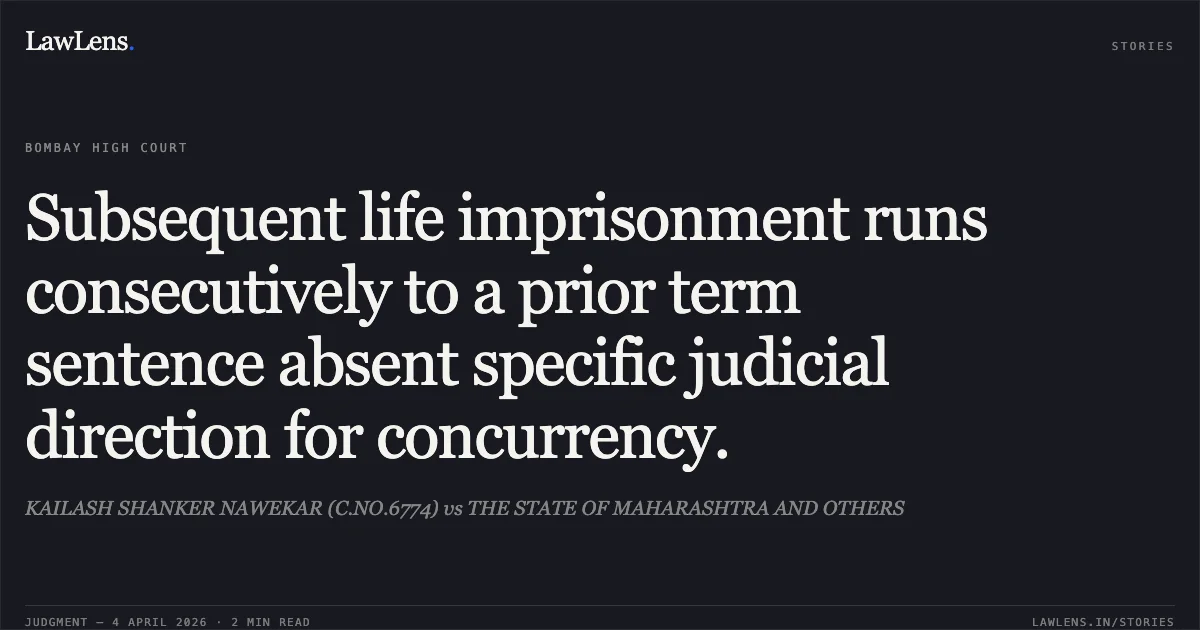
The court held that the petitioner is not entitled to the benefit of Section 427(2) of the Cr.P.C. and must first undergo the seven-year term sentence followed by the life imprisonment sentence
The High Court declined to exercise its jurisdiction under Article 226 of the Constitution, finding the petition devoid of substance. The Writ Petition was dismissed, and the rule was discharged
Source reference: para. 22-23Acts & Sections Cited
13 provisions across 2 statutes referred to in this judgment. Each provision opens on LawLens.
Code of Criminal Procedure, 19734
Original Court PDF
KAILASH SHANKER NAWEKAR (C.NO.6774)vsTHE STATE OF MAHARASHTRA AND OTHERS
Click to open original judgment
Original judgment, available to read, download and summarize on LawLens.in


