Facts
Respondent No. 2 (the father of Appellant No. 2) filed an FIR on June 1, 2020, alleging that Appellant No. 1 had enticed and kidnapped his 17-year-old daughter, Appellant No. 2
Source reference: para 3Consequently, Appellant No. 1 was charge-sheeted under Sections 363, 368, and 376(2)(d) of the IPC, and Sections 5(8) and 6 of the POCSO Act
Source reference: para 3.1The Appellants, who are of the same religion, asserted they were in a long-term relationship and married as per Muslim rites on September 25, 2020, following which they had a child
Source reference: paras 3.4, 5In a statement under Section 164 of the Cr.PC, Appellant No. 2 affirmed she married of her own volition and was an adult
Source reference: para 5.1Appellant No. 1 moved the High Court of Uttarakhand under Section 482 of the Cr.PC to quash the proceedings, but the High Court dismissed the application on June 19, 2025, reasoning that the victim’s minority and other factual submissions required a trial
Source reference: paras 2.1, 3.3The Appellants subsequently approached the Supreme Court via a joint appeal
Source reference: para 3.4Issues
1. Whether criminal proceedings under the IPC and POCSO Act should be quashed when the accused and the victim have entered into a voluntary marriage and are living happily as a family
Source reference: paras 5.2, 62. Whether the technicality of the victim being a minor at the time of the alleged offence necessitates the continuation of a trial despite subsequent matrimonial stability
Source reference: paras 6, 8Law Applied
The Court primarily exercised its inherent powers under Section 482 of the Cr.PC to prevent the abuse of the process of law and to secure the ends of justice
Source reference: para 6It relied on the principle that the "final cause of law is the welfare of society," as articulated by Benjamin N. Cardozo and adopted in K. Kirubakaran v. State of Tamil Nadu
Source reference: paras 7, 8The Court balanced the statutory rigors of the IPC (Sections 363, 376) and the POCSO Act against the substantive justice required to preserve a functional matrimonial unit
Source reference: paras 5.3, 6Reasoning
The Court reasoned that while fleeing with a minor is technically an offence under law, the overarching aim of legal proceedings is to arrive at substantive justice
Source reference: paras 1, 6It observed that the Appellants had been living in a stable matrimonial relationship for nearly six years and had a child
Source reference: paras 5, 5.3The Court noted that Appellant No. 2’s Section 164 statement clearly indicated her voluntary participation and happiness in the marriage
Source reference: para 5.1The Bench found that the High Court erred by focusing solely on the victim's age at the time of the incident while ignoring the "subsequent development" of a happy marriage
Source reference: paras 6, 6.1The Court emphasized that continuing criminal proceedings would constitute "painful interference" and a "burdensome" uncertainty for the couple, thereby amounting to an abuse of the legal process
Source reference: paras 6, 6.1Consequently, the interest of the society and the welfare of the specific family unit outweighed the need to take the criminal charges to their logical conclusion
Source reference: para 8Holding
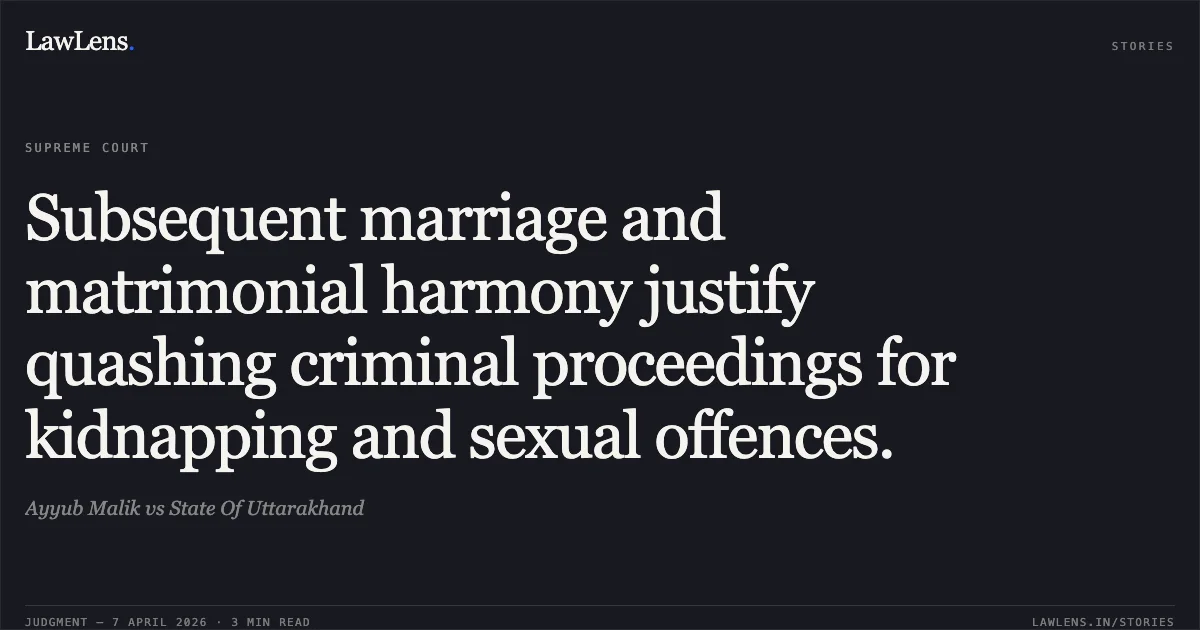
The Supreme Court allowed the appeal and set aside the High Court’s order dated June 19, 2025
The Court held that in the interest of rendering complete justice, the criminal case must be terminated to protect the parties’ matrimonial life
Source reference: para 8It quashed the proceedings of Criminal Case No. 10 of 2021 pending before the Court of Additional District & Sessions Judge, Haridwar, along with all incidental orders
Source reference: para 9No conditions were imposed on Appellant No. 1, with the Court expressing the earnest hope that the family would continue to live peacefully
Source reference: para 8Acts & Sections Cited
7 provisions across 3 statutes referred to in this judgment. Each provision opens on LawLens.
Code of Criminal Procedure, 19732
Indian Penal Code, 18603
Original Court PDF
Ayyub MalikvsState Of Uttarakhand
Click to open original judgment
Original judgment, available to read, download and summarize on LawLens.in