Facts
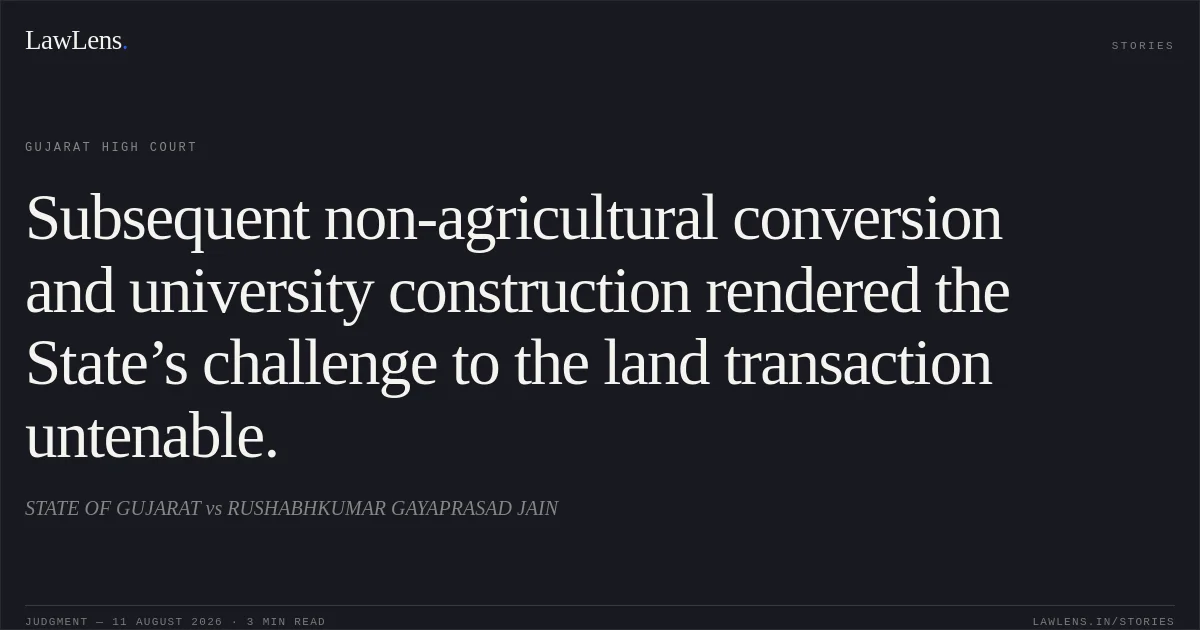
The private respondents claimed ownership of agricultural land bequeathed to them under a registered Will executed by the original landowner in 1991. Pursuant to the Will, Entry No. 4120 was mutated and certified in the revenue records in respect of land situated at Village Sertha. Relying on their recorded status, the respondents subsequently purchased other land situated at Adalaj through registered sale deeds, and the corresponding revenue entries were also certified.
Source reference: paras. 3, 8–9; pp. 3–4, 8–9Proceedings under Section 84C of the Bombay Tenancy and Agricultural Lands Act, 1948, were initiated on the allegation that the respondents were not agriculturists and that the transactions breached Section 63. The Mamlatdar and Agricultural Lands Tribunal dropped the proceedings. The Deputy Collector thereafter initiated suo motu proceedings, issued notice, and remanded the matter to the Mamlatdar and ALT.
Source reference: paras. 4, 9; pp. 4, 9The Gujarat Revenue Tribunal subsequently allowed the respondents’ revision application and set aside the Deputy Collector’s order. The State challenged the Tribunal’s decision under Articles 226 and 227 of the Constitution.
Source reference: paras. 1, 3–4; pp. 1–4During the pendency of the writ petition, the land was converted to non-agricultural use pursuant to permission granted by the Collector, Gandhinagar, subject to the outcome of the petition. A university had been constructed on the land and educational activities were being conducted thereon. The Collector had considered, inter alia, an affidavit of the legal heirs of the testator and a Memorandum of Understanding concerning the university.
Source reference: paras. 5, 7, 10; pp. 5–7, 10An earlier decision concerning the Sertha land, including the removal of a restriction on transactions based on the revenue entry, had attained finality as it was not challenged by the State.
Source reference: paras. 3, 6, 8–11; pp. 3, 5–6, 8–10Issues
1. Whether the Gujarat Revenue Tribunal was justified in setting aside the Deputy Collector’s order remanding the Section 84C proceedings for reconsideration.
Source reference: paras. 1, 3–4, 9; pp. 1–4, 92. Whether the respondents’ acquisition of agriculturist status on the basis of a Will, despite allegedly not being agriculturists by birth, rendered the subsequent land transactions contrary to Section 63 and liable to action under Section 84C of the Bombay Tenancy and Agricultural Lands Act, 1948.
Source reference: paras. 6, 8, 11; pp. 5–6, 8, 103. Whether the subsequent conversion of the land to non-agricultural use and construction of a university affected the State’s entitlement to the relief sought in the writ petition.
Source reference: para. 10; p. 10Law Applied
The Court exercised its jurisdiction under Articles 226 and 227 of the Constitution to examine the legality of the Gujarat Revenue Tribunal’s order.
Source reference: para. 1; p. 1The statutory framework comprised Section 63 of the applicable revenue/tenancy law, which restricts transfers of agricultural land to non-agriculturists, and Section 84C of the Bombay Tenancy and Agricultural Lands Act, 1948, which authorises inquiry and consequential action in respect of transfers alleged to contravene the Act.
Source reference: paras. 3–4, 6, 8–9; pp. 3–6, 8–9The State relied on the principle that agricultural land cannot be transferred or bequeathed to a non-agriculturist in breach of the statutory scheme; however, the Court expressly declined to decide the respondents’ status on the basis of the Will, particularly in view of the finality of the earlier proceedings and the subsequent conversion of the land to non-agricultural use.
Source reference: paras. 6, 11; pp. 5–6, 10Reasoning
The Court noted that the respondents’ names had been mutated and their entries certified on the basis of the Will, after which the subsequent sale transactions were also recorded and certified.
Source reference: paras. 8–9; pp. 8–9Although the State contended that the respondents could not acquire agriculturist status through a Will and that the transactions therefore attracted Section 84C, the Court did not finally adjudicate that substantive question.
Source reference: paras. 6, 8, 11; pp. 5–6, 8, 10Instead, it considered the subsequent factual developments: the land had been converted to non-agricultural use with the Collector’s permission, a university had been constructed, and educational activities were being carried on.
Source reference: para. 10; p. 10The permission was granted after consideration of relevant materials, including the heirs’ affidavit and the MoU relating to the university.
Source reference: para. 10; p. 10In these circumstances, the Court held that the State’s requested relief against the Tribunal’s order could not be granted. It also took into account that the earlier decision concerning the Sertha transaction had attained finality and therefore refrained from reopening or commenting upon the underlying agriculturist-status issue.
Source reference: para. 11; p. 10Holding
The High Court rejected the State’s petition and declined to interfere with the Gujarat Revenue Tribunal’s order allowing the respondents’ revision application.
The Court did not determine, as an operative holding, whether a non-agriculturist can acquire agriculturist status through a Will.
Source reference: para. 12; p. 11The petition was dismissed, and the notice was discharged.
Source reference: para. 12; p. 11Acts & Sections Cited
2 provisions across 2 statutes referred to in this judgment. Linked provisions open on LawLens.
Bombay Tenancy and Agricultural Lands Act, 19481
Bombay Land Revenue Code, 18791
Original Court PDF
STATE OF GUJARATvsRUSHABHKUMAR GAYAPRASAD JAIN
Click to open original judgment
Original judgment, available to read, download and summarize on LawLens.in