Facts
In July 1983, the Collector Shahdol permitted Western Coal Field Ltd. to develop an existing kachha (raw) track into a pakka (paved) road, noting no objections were received and directing mutual settlement if private land was involved
Source reference: para. 2The petitioner’s wife purchased a portion of the land (Survey No. 831/898) in 1991, at which time the road already existed
Source reference: para. 4Following her death in 2009, the petitioner’s sons were recorded as Bhumi Swami. One son, Vijay Kumar, previously filed WP No. 12206/2009 seeking compensation and employment under state policy; however, the respondent company rejected his representation on 20.02.2012, asserting the land was never formally acquired but used under government orders
Source reference: para. 3The petitioner, the husband of the deceased owner, filed the present writ petition seeking to quash the 2012 order and claiming rent, compensation, and family employment
Source reference: para. 1, 4Issues
1. Whether the petitioner has the locus standi to challenge an order passed on a representation submitted by his son regarding land for which the petitioner is not the recorded Bhumi Swami?
Source reference: para. 4, 62. Whether the development of a pre-existing road on orders of the Collector, without formal acquisition, entitles subsequent purchasers to compensation and employment benefits under the Land Acquisition Act, 1894?
Source reference: para. 3, 6Law Applied
The Court applied the principles of locus standi in writ jurisdiction, requiring the petitioner to be the aggrieved party or the legal titleholder (Bhumi Swami)
Source reference: para. 6It further considered the Land Acquisition Act, 1894, and the relevant State Government Policy (Document No. 6815/2026) regarding compensation and employment, which necessitate a formal "acquisition" or vesting of land in the State/Company as a prerequisite for relief
Source reference: para. 3, 6The court also relied on the principle that a purchaser of land already encumbered by a public utility (where the predecessor-in-title waived objections) cannot subsequently claim compensation unless such specific rights were transferred via the sale deed
Source reference: para. 6Reasoning
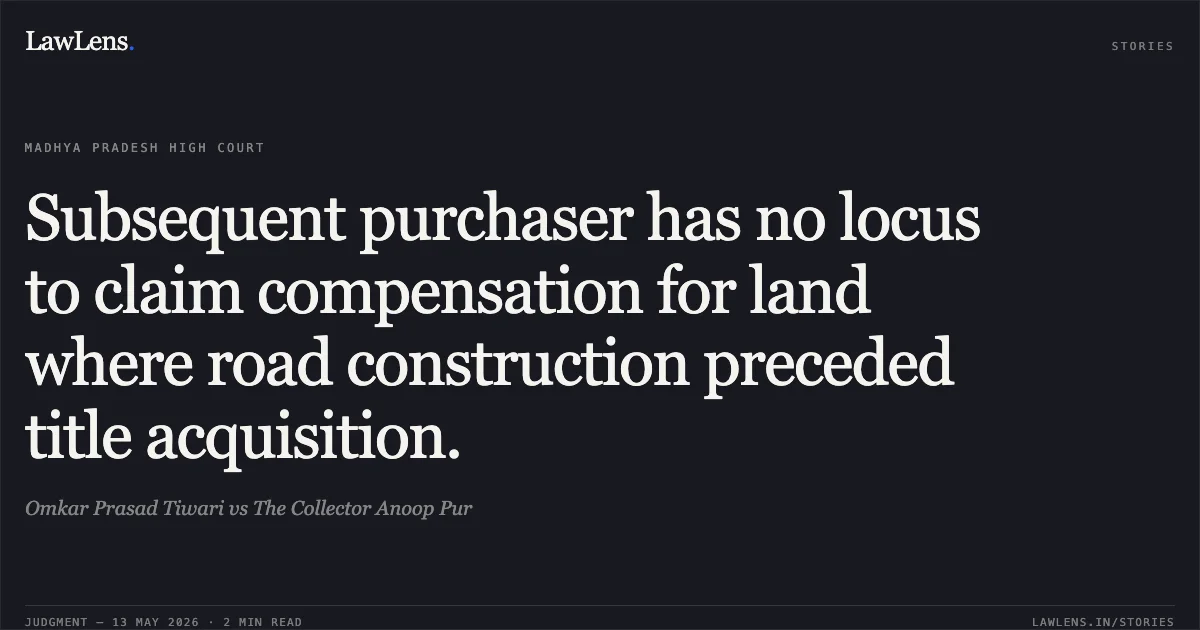
The Court reasoned that the petitioner lacked locus standi because he was neither the recorded owner (Bhumi Swami) nor the person who made the underlying representation; the title had passed from the petitioner’s wife directly to the sons
Source reference: para. 6Furthermore, the court found that the road was constructed in 1983, eight years before the petitioner’s family purchased the land
Source reference: para. 4Since the predecessor-in-title never objected to the road despite public notice, and the 1991 sale deed (Annexure P/1) did not explicitly transfer any right to sue for past compensation, the petitioner held no actionable claim
Source reference: para. 6On merits, the court held that since there was no formal acquisition or vesting of land—merely the upgrading of an existing track by order of the revenue authorities—the statutory triggers for compensation and employment were not met
Source reference: para. 6Holding
The Court held that the petitioner had no standing to challenge the order and that no right to compensation or employment existed in the absence of a formal land acquisition
The petition was dismissed as being devoid of merit
Source reference: para. 7Acts & Sections Cited
1 provisions across 1 statute referred to in this judgment. Linked provisions open on LawLens.
Land Acquisition Act, 18941
Original Court PDF
Omkar Prasad TiwarivsThe Collector Anoop Pur
Click to open original judgment
Original judgment, available to read, download and summarize on LawLens.in


