Facts
The applicant, along with his mother and elder brother, was charge-sheeted for offences under Sections 34, 323, 504, 506, and 307 of the Indian Penal Code (IPC).
Source reference: para 2During the trial, P.W.-1 (the wife of the applicant’s elder brother) was examined on 16.09.2021. At that time, she was living separately from her husband due to matrimonial discord.
Source reference: para 2Following a subsequent reconciliation and resumption of cohabitation, the applicant moved an application on 07.08.2025 under Section 311 of the Code of Criminal Procedure (Cr.P.C.) to recall P.W.-1 for further examination, contending that her previous testimony was influenced by the then-existing matrimonial strain.
Source reference: para 2The Trial Court rejected this application on 09.09.2025.
Source reference: para 2The applicant challenged this rejection before the High Court.
Source reference: para 2Issues
1. Whether the subsequent reconciliation of a witness with a co-accused constitutes a "material change in circumstances" sufficient to warrant the recall of said witness under Section 311 Cr.P.C.
Source reference: para 3 & 42. Whether the Trial Court’s refusal to recall P.W.-1 amounted to a failure to exercise jurisdiction or an error in law/discretion.
Source reference: para 3 & 6Law Applied
Section 311 of the Cr.P.C., which grants discretionary power to the court to summon or recall witnesses if their evidence is "essential for the just decision of the case".
Source reference: para 4Mohanlal Shamji Soni vs. Union of India (AIR 1991 SC 1346), which established that while the power under Section 311 is wide, it must be used sparingly, judicially (not capriciously), and only for eliciting material facts to reach the truth.
Source reference: para 5The power cannot be invoked to fill lacunae in the case of either the prosecution or the defence, nor to allow a disguise for a retrial.
Source reference: para 4 & 5Reasoning
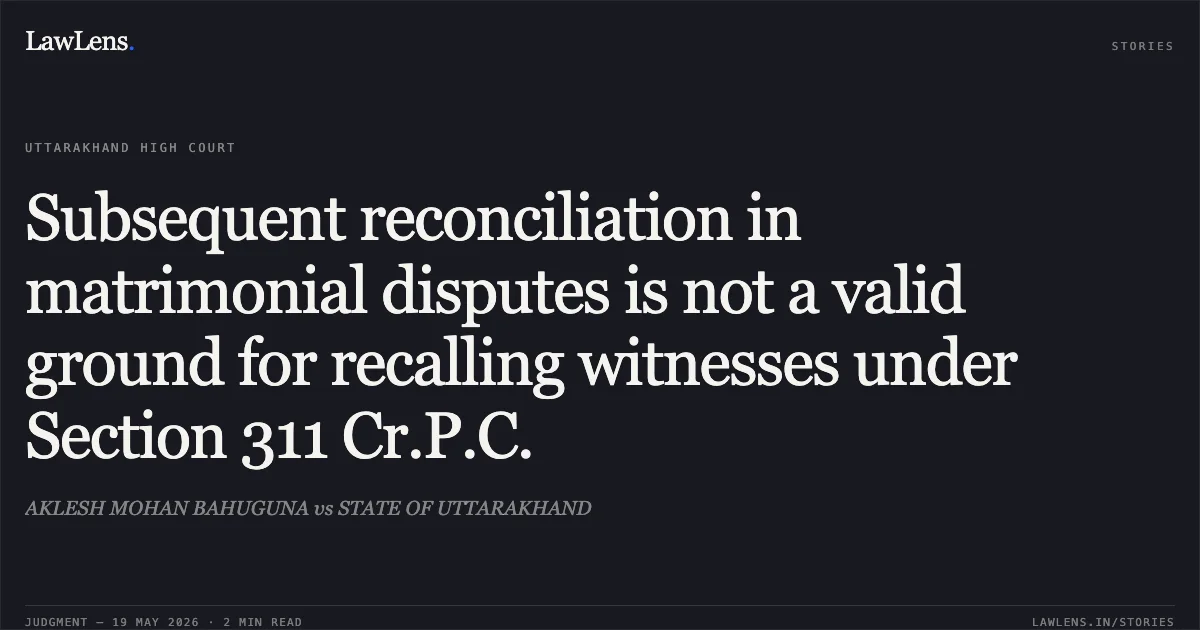
The Court observed that the sole ground for the recall was the settlement of a matrimonial dispute between P.W.-1 and the applicant's brother.
Source reference: para 4The Court reasoned that Section 311 Cr.P.C. is intended for the just adjudication of the case, not to accommodate changes in the personal relationships of witnesses after their testimony has been legally recorded and cross-examined.
Source reference: para 4The Court found that the subsequent reconciliation does not ipso facto render earlier testimony unreliable or necessitate a de novo examination.
Source reference: para 4Applying the principles from Mohanlal Shamji Soni, the Court determined that allowing the recall in this instance would be an improper exercise of discretion, as it would effectively permit the defence to fill a lacuna and cause unnecessary prejudice to the prosecution and delay the trial.
Source reference: para 6Holding
The High Court answered the issues in the negative, holding that no exceptional circumstances existed to interfere with the Trial Court’s order.
The Court concluded that the Trial Court had correctly exercised its discretion and found no perversity or illegality in the impugned order.
Source reference: para 6Consequently, the Criminal Miscellaneous Application was dismissed.
Source reference: para 7Acts & Sections Cited
7 provisions across 2 statutes referred to in this judgment. Each provision opens on LawLens.
Indian Penal Code, 18606
Code of Criminal Procedure, 19731
Original Court PDF
AKLESH MOHAN BAHUGUNAvsSTATE OF UTTARAKHAND
Click to open original judgment
Original judgment, available to read, download and summarize on LawLens.in


