Facts
The parties married on April 20, 2022. On July 17, 2023, the applicant/husband filed a divorce petition (RCSHM No. 53/2023) under Section 13 of the Hindu Marriage Act (HMA) at the District Court, Lavkushnagar.
Source reference: para. 1, 2Subsequently, in 2024, the respondent/wife filed a petition for restitution of conjugal rights under Section 9 of the HMA and a maintenance petition under Section 125 Cr.P.C. before the Family Court, Chhatarpur.
Source reference: para. 1-2Additionally, a dowry harassment FIR was filed at PS Chandla, triable at Lavkushnagar.
Source reference: para. 2The husband sought the transfer of the Section 9 proceedings from Chhatarpur to Lavkushnagar, arguing that the wife's original residence is Lavkushnagar and that Section 21-A of the HMA mandates transfer to the court where the first matrimonial petition was filed.
Source reference: para. 4The wife opposed the transfer, citing her residence in Chhatarpur for competitive exam preparation and the inconvenience of travel.
Source reference: para. 5Issues
1. Whether a petition under Section 9 of the HMA can be transferred to the court where a previously instituted divorce petition is pending under Section 21-A of the HMA.
Source reference: para. 10-112. Whether the inconvenience of a female litigant is the sole/overriding criterion for deciding transfer petitions in matrimonial disputes.
Source reference: para. 12-16Law Applied
The court applied Section 21-A of the Hindu Marriage Act, 1955, which specifies that if petitions under the Act are filed in different district courts, the later petition shall be transferred to the court where the earlier petition was presented.
Source reference: para. 10It relied on Balbir Singh Gurjar v. Nitu (2015) to hold that Section 21-A encompasses Section 9 petitions.
Source reference: para. 11Regarding the "convenience" doctrine, the court cited Anindita Das v. Srijit Das (2006) and Preeti Sharma v. Manjit Sharma (2005), which establish that leniency toward women must not be misused and that travel inconveniences can be mitigated by paying expenses rather than denying transfer.
Source reference: para. 12-13Reasoning
The court found it undisputed that the husband filed the first matrimonial case (divorce) at Lavkushnagar in 2023, whereas the wife’s Section 9 petition followed in 2024.
Source reference: para. 2, 8The court noted that the wife is originally a resident of Lavkushnagar and her temporary stay in a rented house at Chhatarpur for exams does not constitute a valid hardship, especially since she is already contesting the divorce petition at Lavkushnagar.
Source reference: para. 9Applying the "trend of striking a balance," the court observed that distance alone is not the criteria for leniency.
Source reference: para. 12, 16It reasoned that since the Section 9 and Section 13 proceedings have a direct bearing on each other, they must be tried together to serve the interests of justice and avoid conflicting findings.
Source reference: para. 4, 18Holding
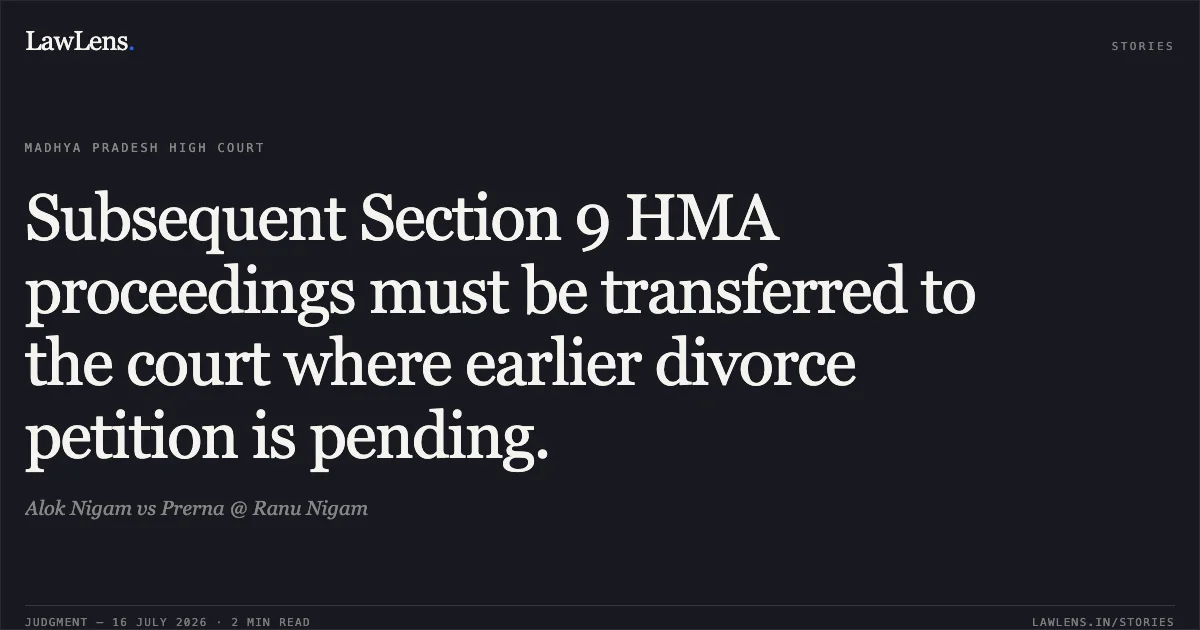
The court allowed the application and transferred RCSHM No. 223/2024 (Section 9 HMA) from the Family Court, Chhatarpur, to the Court of District and Additional Sessions Judge, Lavkushnagar.
The court ordered that both the divorce and restitution petitions be tried together by the same Judge with identical dates. To balance conveniences, the respondent/wife was granted liberty to appear via video conferencing where feasible, subject to the trial court's discretion to require physical presence if imperative.
Source reference: para. 19-21Acts & Sections Cited
6 provisions across 3 statutes referred to in this judgment. Each provision opens on LawLens.
Code of Civil Procedure, 19081
Code of Criminal Procedure, 19731
Hindu Marriage Act, 19554
Original Court PDF
Alok NigamvsPrerna @ Ranu Nigam
Click to open original judgment
Original judgment, available to read, download and summarize on LawLens.in