Facts
The petitioner sought quashing of FIR No. 132 dated 27.01.2026, registered at Police Station Civil Line, Sirsa, under Section 209 of the Bharatiya Nyaya Sanhita, 2023 (“BNS”), corresponding to Section 174-A IPC, along with the order dated 25.08.2025 declaring him a proclaimed person.
Source reference: p.1, para.1The FIR arose from the petitioner’s non-appearance in proceedings under Section 138 of the Negotiable Instruments Act, 1881, concerning dishonour of a cheque for ₹25,398/-.
Source reference: p.2, para.2During the pendency of the proceedings, the parties settled the underlying monetary dispute for ₹32,000/-, which was paid to the complainant through UPI on 07.08.2026. The complainant thereafter issued a Receipt and No-Dues Certificate dated 03.09.2026 acknowledging full satisfaction and absence of any surviving claim.
Source reference: p.2, para.2The petitioner contended that the settlement eliminated the substratum of the proceedings under Section 209 BNS and that his non-appearance was neither deliberate nor intentional.
Source reference: p.2, para.2Issues
1. Whether the subsequent settlement of the underlying proceedings under Section 138 of the Negotiable Instruments Act and issuance of a No-Dues Certificate justified quashing the FIR registered under Section 209 BNS and the consequential proceedings?
Source reference: pp.1–3, paras.1–3.12. Whether the High Court could quash or otherwise nullify the consequences of the petitioner’s declaration as a proclaimed person without the petitioner first submitting to the jurisdiction of the Trial Court and seeking recall or setting aside of the proclamation order?
Source reference: p.3, paras.3–3.2Law Applied
The Court considered its inherent jurisdiction under Section 528 of the Bharatiya Nagarik Suraksha Sanhita, 2023 (“BNSS”), corresponding to Section 482 Cr.P.C., and the statutory consequences of non-appearance under Section 209 BNS, corresponding to Section 174-A IPC.
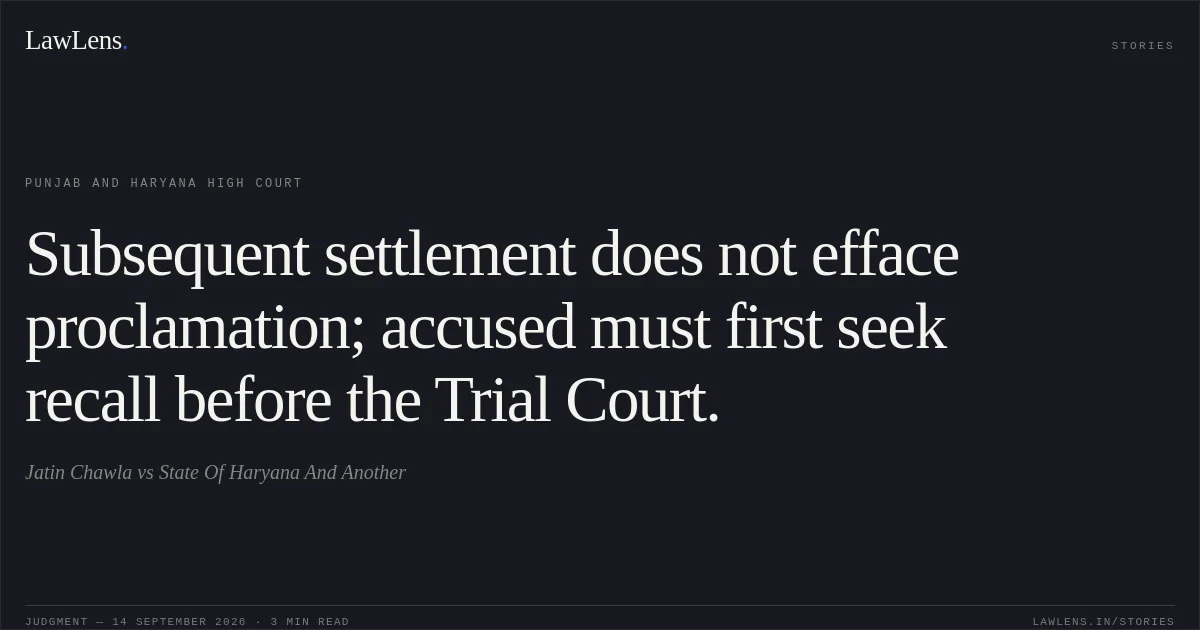
Source reference: p.1, para.1It applied the principle that once an accused has been declared a proclaimed person, a subsequent compromise of the underlying dispute does not, by itself, efface the proclamation or justify quashing the proceedings arising from the accused’s non-appearance; the accused must first approach the Trial Court for recall or setting aside of the proclamation in accordance with law.
Source reference: p.3, para.3The Court also considered Ashok Madan v. State of Haryana, 2020(4) RCR (Criminal) 87, Sunil Kumar v. State of Haryana, CRM-M-15534-2023, decided on 20.07.2023, and State of Haryana v. Bhajan Lal, 1992 Supp. (1) SCC 335, but held that these authorities did not mandate interference in the present factual and procedural circumstances.
Source reference: p.2, para.2; p.3, para.3.1The Court noted that the offence under Section 138 of the Negotiable Instruments Act is compoundable in accordance with law.
Source reference: p.3, para.3.2Reasoning
The Court held that the settlement and No-Dues Certificate were relevant to the substantive cheque-dishonour proceedings but did not automatically invalidate the petitioner’s prior non-appearance or the resulting proclamation order.
Source reference: p.3, para.3Since the petitioner had been declared a proclaimed person, he was required first to submit to the jurisdiction of the Trial Court and seek recall or setting aside of that order through the appropriate procedure.
Source reference: p.3, para.3The Court found no exceptional circumstance warranting exercise of its inherent jurisdiction under Section 528 BNSS to quash the FIR merely on the basis of the subsequent compromise.
Source reference: p.3, paras.3–3.1The authorities relied upon by the petitioner were distinguished as turning on their own factual and procedural settings and as not dispensing with the requirement of seeking appropriate relief against the proclamation before the Trial Court.
Source reference: p.3, para.3.1Holding
The petition was dismissed.
The petitioner was directed to appear before the Trial Court and move an appropriate application for recall or setting aside of the order declaring him a proclaimed person. He was thereafter permitted to seek regular bail and/or appropriate relief for compounding the offence under Section 138 of the Negotiable Instruments Act.
Source reference: p.3, para.3.2The Trial Court was directed to consider and decide such applications expeditiously, preferably within seven days of their filing.
Source reference: p.3, para.3.2All pending miscellaneous applications were disposed of as infructuous following the final adjudication of the principal petition.
Source reference: p.4, para.4Acts & Sections Cited
4 provisions across 4 statutes referred to in this judgment. Each provision opens on LawLens.
Bharatiya Nagarik Suraksha Sanhita, 20231
Code of Criminal Procedure, 19731
Bharatiya Nyaya Sanhita, 20231
Negotiable Instruments Act, 18811
Original Court PDF
Jatin ChawlavsState Of Haryana And Another
Click to open original judgment
Original judgment, available to read, download and summarize on LawLens.in
![Employees actually discharging higher-post duties may claim corresponding pay differences despite lacking formal promotion.. Dinesh Kumar Yadav vs M/o Railways. CAT - ['Allahabad']. LawLens](/stories/thumbnails/employees-actually-discharging-higher-post-duties-may-claim-corresponding-pay-differences-2188bef35b6a44a194c0614c616fb4a5.webp)
![Termination for criminal-case concealment cannot stand where the applicant’s name was deleted during investigation.. RAVI PAL vs POST UP CIRCLE. CAT - ['Allahabad']. LawLens](/stories/thumbnails/termination-for-criminal-case-concealment-cannot-stand-where-the-applicants-name-was-delet-3cc583ec9b6c4386912498527c678eb3.webp)