Facts
In September 2012, Terrascope Ventures Ltd (the Company) issued a notice for an Extraordinary General Meeting (EoGM) to raise funds through preferential allotment, stating the objects as capital expenditure, acquisitions, and working capital
Source reference: para. 3Between October and November 2012, the Company raised ₹15.87 crores but immediately diverted the funds to purchase shares of other companies and grant unsecured loans to entities connected to a common promoter
Source reference: paras. 4, 7, 13The Company amended its Memorandum of Association (MoA) post-facto in 2014 and passed a shareholder resolution in 2017 to ratify the diversion
Source reference: paras. 8, 10While the SEBI Whole Time Member (WTM) restrained the respondents from the market for over four years, the Adjudicating Officer (AO) separately imposed monetary penalties totaling ₹1 crore on the Company and ₹25 lakhs each on its directors for violating PFUTP Regulations and the Securities Contracts (Regulation) Act (SCRA)
Source reference: paras. 12, 16The Securities Appellate Tribunal (SAT) set aside the AO's penalties, holding that the 2017 shareholder ratification validated the Company’s acts
Source reference: para. 22SEBI appealed to the Supreme Court.
Source reference: no citationIssues
1. Whether the SAT was justified in reversing the AO’s order on the ground that subsequent shareholder ratification legitimized the fraudulent diversion of funds
Source reference: para. 322. Whether an illegal act violating SEBI Regulations and impacting public interest can be cured by a private resolution of ratification
Source reference: para. 653. Whether the AO had the jurisdiction to impose penalties while parallel proceedings on the same facts were conducted by the WTM
Source reference: para. 67Law Applied
The Court applied Regulations 3 and 4 of the SEBI (Prohibition of Fraudulent and Unfair Trade Practices) Regulations, 2003, which prohibit manipulative, deceptive, or fraudulent devices in connection with the issue of securities
Source reference: para. 35It relied on the broad definition of "fraud" under Regulation 2(1)(c), as interpreted in SEBI v. Kanaiyalal Baldevbhai Patel, which includes acts committed even without deceit if they induce dealings in securities
Source reference: para. 41The Court also applied Section 21 of the SCRA regarding compliance with listing conditions (specifically Clause 43 of the Listing Agreement)
Source reference: para. 47the principle from Shri Lachoo Mal v. Shri Radhey Shyam that statutory provisions intended for public policy or public interest cannot be waived or ratified
Source reference: para. 59Reasoning
The Court observed that the diversion of funds occurred almost immediately after receipt, indicating a pre-conceived intention to disregard the objects disclosed in the EoGM notice
Source reference: para. 50Such conduct constitutes fraud under PFUTP Regulations because the disclosure of objects is a statutory mandate designed to protect the integrity of the market and inform investor decisions
Source reference: paras. 45, 49The Court rejected the applicability of Section 27 of the Companies Act, noting it applies to prospectuses and not private placements; furthermore, even Section 27 prohibits using proceeds to trade in shares of other listed companies
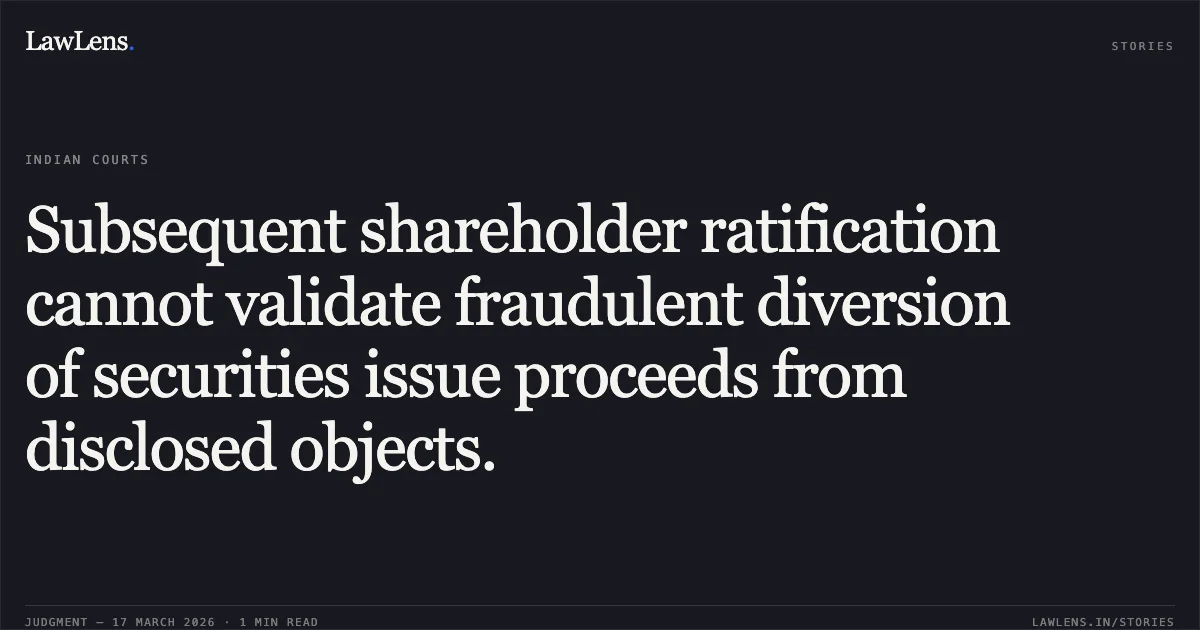
Source reference: paras. 55-57Crucially, the Court held that while a company may ratify an irregular act, it cannot ratify an illegal act that violates public law or SEBI regulations, as these involve public interest and multiple stakeholders beyond just the current shareholders
Source reference: paras. 60-66Regarding the parallel proceedings, the Court clarified that the WTM’s powers under Section 11B (remedial) and the AO’s powers under Section 15HA (punitive) operated in separate fields at the material time; thus, the WTM’s decision not to impose further "restrained access" did not preclude the AO from imposing statutory monetary penalties
Source reference: paras. 72-75Holding
The Supreme Court set aside the SAT’s order and restored the Adjudicating Officer’s order imposing penalties
(i) the diversion of funds was a fraudulent practice under PFUTP Regulations as it involved misrepresentation of objects to stakeholders
Source reference: para. 43(ii) shareholder ratification cannot cure a violation of SEBI Regulations or public policy
Source reference: para. 66(iii) the AO and WTM exercised distinct statutory functions, making the AO's penalty valid despite the WTM’s prior adjudication
Source reference: para. 75Acts & Sections Cited
7 provisions across 2 statutes referred to in this judgment. Each provision opens on LawLens.
Securities and Exchange Board of India Act, 19923
Companies Act, 20134
Original Court PDF
Securities And Exchange Board Of IndiavsTerrascope Ventures Limited Etc. Etc.
Click to open original judgment
Original judgment, available to read, download and summarize on LawLens.in