Facts
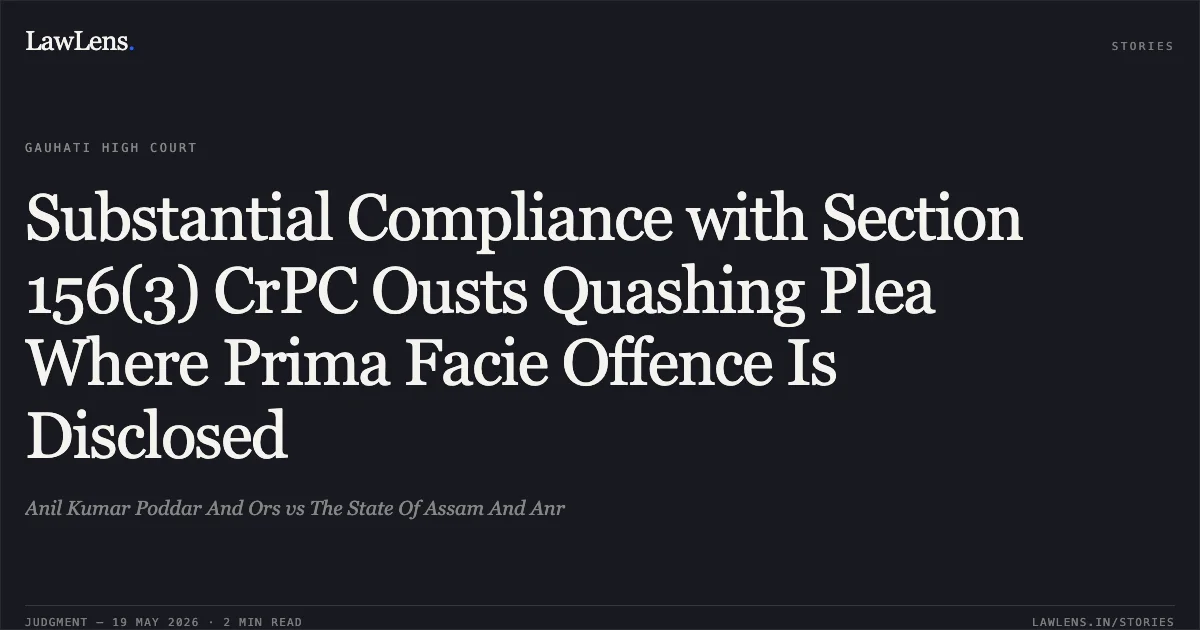
The petitioners, members of a charitable society, sought to quash Charge Sheet No. 154/2024 and an order of cognizance dated 11.07.2024 for offences under Sections 120(B)/200/420/294/506/34 of the IPC
Source reference: p.2The dispute arose following a complaint by a Chartered Accountant against Respondent No. 2, which was later retracted. Respondent No. 2 subsequently filed a complaint (C.R. Case No. 10/2023) alleging the petitioners orchestrated the CA’s actions to malign him
Source reference: p.4On 21.01.2023, the CJM, Dibrugarh, directed the police to investigate under Section 156(3) Cr.PC
Source reference: p.5The petitioners challenged this on grounds of procedural non-compliance with Section 154 Cr.PC and the absence of a proper supporting affidavit
Source reference: p.6Issues
1. Whether the order directing investigation under Section 156(3) Cr.PC was vitiated due to non-compliance with the statutory mandates of Section 154(1) and 154(3) Cr.PC and the absence of a valid affidavit
Source reference: p.5-6, para. 8-102. Whether the allegations in the FIR and Charge Sheet, taken at face value, disclose a prima facie case against the petitioners
Source reference: p.6-7, para. 12Law Applied
Section 528 of the BNSS (corresponding to Section 482 Cr.PC) regarding inherent powers to quash proceedings
Source reference: p.2Sections 154(1), 154(3), and 156(3) of the Cr.PC regarding the registration of FIRs and Magisterial directions for investigation
Source reference: p.6State of Haryana v. Bhajan Lal, which established categories for quashing FIRs
Source reference: p.15-16Priyanka Srivastava v. State of U.P. (as referenced in arguments regarding the necessity of a supporting affidavit)
Source reference: p.13Sadiq B. Hanchinmani v. State of Karnataka, holding that a Magistrate has the discretion to order investigation if a cognizable offence is disclosed
Source reference: p.11-12Reasoning
The Court found that Respondent No. 2 had sufficiently complied with procedural requirements by approaching the police and the Superintendent of Police before filing the complaint, noting that those authorities failed to act
Source reference: p.14, para. 21Regarding the affidavit requirement, the Court observed that although a separate affidavit was not filed, the complaint was duly supported by a sworn affidavit integrated within the petition, which satisfied the legal necessity
Source reference: p.14, para. 21The Court determined that the CJM did not act mechanically; the order dated 21.01.2023 reflected a finding that investigation was necessary to unearth the facts
Source reference: p.15, para. 22Applying the Bhajan Lal standards, the Court concluded that the FIR contained specific allegations that prima facie constituted the charged offences, precluding the exercise of inherent powers to quash at a pre-trial stage
Source reference: p.15-17, para. 23-24Holding
The Court held that the procedural requirements of Section 156(3) Cr.PC were met as the complaint was supported by a sworn statement and prior attempts to lodge an FIR were documented
The Court dismissed the petition, refusing to quash the Charge Sheet or the order of cognizance
Source reference: p.17, para. 25The Court ruled that there was no illegality in the Trial Court's orders and that the petitioners had the opportunity to raise their grievances during the hearing on the discharge/framing of charges
Source reference: p.17, para. 24Acts & Sections Cited
15 provisions across 3 statutes referred to in this judgment. Each provision opens on LawLens.
Bharatiya Nagarik Suraksha Sanhita, 20232
Code of Criminal Procedure, 19738
Indian Penal Code, 18605
Original Court PDF
Anil Kumar Poddar And OrsvsThe State Of Assam And Anr
Click to open original judgment
Original judgment, available to read, download and summarize on LawLens.in


