Facts
During an audit for September 2007 to September 2010, the respondent was found to have availed Cenvat Credit of ₹68,99,570 on capital goods on the basis of photocopies/zerox copies of invoices. Upon being pointed out, the respondent reversed the entire credit.
Source reference: para. 2It subsequently filed refund claims of ₹56,16,500 and ₹9,40,499, which were proposed to be rejected through separate show-cause notices.
Source reference: paras. 3–4The adjudicating authority accepted the respondent’s explanation regarding the loss or non-availability of the original invoices and sanctioned a refund of ₹65,56,999, holding that the respondent was otherwise eligible for the credit.
Source reference: para. 5The Commissioner (Appeals) upheld that order, finding that the capital goods were duty-paid, received and used by the respondent, and that substantive credit could not be denied merely for non-production of the original invoices.
Source reference: para. 6The Revenue appealed to the CESTAT.
Source reference: para. 7Issues
1. Whether refund of Cenvat Credit earlier reversed by the respondent could be denied solely because the original invoices were unavailable and the credit had been supported by photocopies of invoices.
Source reference: para. 112. Whether the respondent’s substantive entitlement to Cenvat Credit was established despite non-compliance with the documentary requirement under Rule 9 of the Cenvat Credit Rules, 2004.
Source reference: paras. 12–183. Whether the absence of an earlier appellate order directing restoration of the reversed credit rendered the refund claim inadmissible.
Source reference: para. 21Law Applied
The Court applied Rule 9 of the Cenvat Credit Rules, 2004, which prescribes the documents on the basis of which Cenvat Credit may be availed and serves to establish payment of duty, receipt and identity of the goods, and to prevent duplicate or fraudulent claims.
Source reference: para. 12However, the Court held that non-production of an original document does not invariably extinguish substantive credit where the reason for its absence is explained and the underlying transaction, duty payment, receipt, use of the goods and eligibility for credit are independently verified.
Source reference: paras. 13, 17–19The Court considered the principles in Mihir Textiles Ltd. v. Collector of Customs, Bombay, 1997 (92) E.L.T. 9 (S.C.), that mandatory conditions governing fiscal concessions must ordinarily be complied with; Commissioner of Central Excise, Chandigarh v. Chandra Laxmi Tempered Glass Co. Pvt. Ltd., 2009 (234) E.L.T. 245 (H.P.), concerning the importance of document-related safeguards; and Dhampur/DSM Sugar Mills Ltd. v. Commissioner of Central Excise, Meerut-II, 2013 (287) E.L.T. 236 (Tri.-Del.), Century Rayon v. Commissioner of Central Excise, 2014 (309) E.L.T. 524 (Tri.-Mumbai), and Fertilizers and Chemicals Travancore Ltd. v. Commissioner of Central Excise, Customs and Service Tax, Cochin, 2017 (6) TMI 100 (CESTAT Bangalore), concerning credit claimed on photocopies.
Source reference: paras. 9, 15It also recognised that, depending on the facts, credit may be allowed on a copy of the prescribed document where authenticity and the underlying transaction are satisfactorily verified, as illustrated by Rallis India Ltd.
Source reference: para. 16Reasoning
The Tribunal accepted that Rule 9 ordinarily requires prescribed duty-paying documents, but held that the requirement must be applied in the context of the purpose it serves—verification of the genuine, duty-paid transaction and prevention of duplicate credit.
Source reference: paras. 12–13, 17In the present case, the authorities had concurrently found a reasonable explanation for the absence of the original invoices, while the Revenue did not dispute receipt and use of the capital goods, payment of duty, the respondent’s eligibility for credit, or the authenticity of the photocopies.
Source reference: paras. 13–14There was also no evidence of fabrication, manipulation or availment of credit by another person or unit.
Source reference: para. 14The Tribunal distinguished cases where credit was claimed merely on photocopies in circumstances raising a real possibility of multiple availment, holding that those decisions could not be mechanically applied where the transaction had been independently verified.
Source reference: para. 15It further held that the respondent’s initial reversal during audit was not a final adjudication that the credit was inadmissible, and that the refund claim had to be examined on its own merits.
Source reference: para. 20Since the Revenue produced no material showing that the concurrent factual findings were perverse or incorrect, denial of credit would elevate a documentary formality over an otherwise established substantive entitlement.
Source reference: paras. 18–19, 22Holding
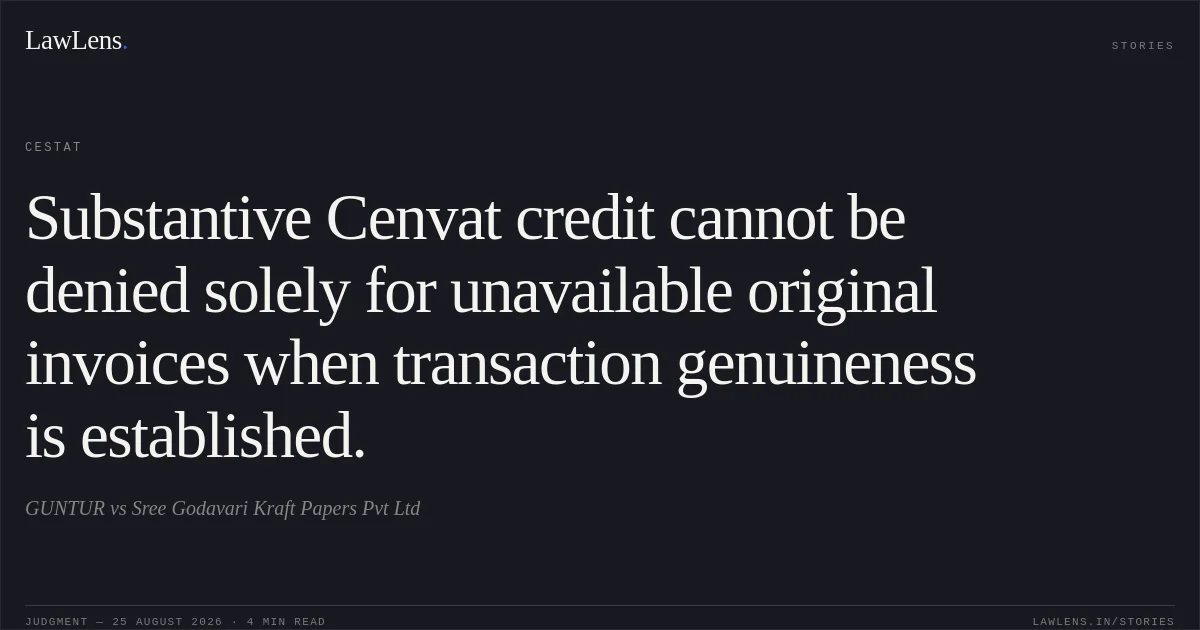
The Tribunal held that refund of otherwise admissible Cenvat Credit could not be denied merely because the original invoices were unavailable, where the duty-paid nature, receipt and use of the capital goods, genuineness of the transaction, and absence of duplicate or fraudulent credit were satisfactorily established.
It also held that the absence of a prior appellate order directing restoration of the credit did not, by itself, make the refund claim inadmissible.
Source reference: para. 21Finding no legal infirmity in the Commissioner (Appeals)’s order, the Tribunal dismissed the Revenue’s appeal.
Source reference: paras. 23–24Original Court PDF
GUNTURvsSree Godavari Kraft Papers Pvt Ltd
Click to open original judgment
Original judgment, available to read, download and summarize on LawLens.in