Facts
On 25 August 2007, following an altercation near a government hand pump, the informant alleged that the accused persons formed an unlawful assembly and assaulted him, his brother, wife, and mother with lathis, dandas, and a garasa.
Source reference: para. 3, p. 2The informant suffered a forearm fracture, characterised as grievous injury.
Source reference: para. 3, p. 2A police case was registered under Sections 341, 325, 504 and 34 of the Indian Penal Code, and the investigation resulted in a charge-sheet under Sections 147, 148, 149, 341, 323, 325, 307 and 504 IPC.
Source reference: para. 4, p. 2The petitioners were ultimately convicted under Sections 148 and 325/149 IPC by the trial court and sentenced to one year’s simple imprisonment under Section 148 IPC and three years’ simple imprisonment under Section 325/149 IPC, along with a fine of ₹500 each.
Source reference: para. 2, p. 1The appellate court affirmed the conviction and sentence.
Source reference: no citationIn revision, the petitioners did not challenge the merits of the conviction and sought only the benefit of Section 4 of the Probation of Offenders Act, 1958, contending that they were first-time offenders with no previous convictions.
Source reference: para. 8, p. 3The State acknowledged that there was no previous conviction against them.
Source reference: para. 9, p. 3Issues
Whether the concurrent findings convicting the petitioners under Sections 148 and 325/149 IPC suffered from any legal or factual error warranting interference in revision.
Source reference: paras. 10–12, pp. 3–4Whether, having regard to the petitioners’ status as first-time offenders, their age, antecedents, character, and the circumstances of the occurrence, they were entitled to release on probation under Section 4 of the Probation of Offenders Act, 1958, instead of undergoing substantive imprisonment.
Source reference: paras. 8, 13–15, pp. 3–4Law Applied
The Court applied Sections 148 and 325/149 of the Indian Penal Code: Section 148 penalises rioting while armed with a deadly weapon, while Section 325 read with Section 149 imposes liability for voluntarily causing grievous hurt in prosecution of the common object of an unlawful assembly.
Source reference: paras. 2, 4, p. 1–2The Court also applied Section 4 of the Probation of Offenders Act, 1958, which permits release of an offender on probation of good conduct, instead of imposing substantive imprisonment, after considering the nature of the offence, the offender’s character, antecedents, and the circumstances of the case.
Source reference: paras. 13–15, pp. 3–4The sentencing court must give appropriate reasons where the plea for probation, particularly by a first-time offender, is considered and rejected.
Source reference: para. 13, p. 4Reasoning
The Court found that the informant’s testimony remained consistent during examination-in-chief and cross-examination, and was corroborated by the evidence of PW-3, who had also sustained injuries.
Source reference: para. 11, p. 3The grievous forearm fracture and the surrounding evidence established the commission of the offences under Sections 148 and 325/149 IPC; consequently, the concurrent conviction did not disclose any error warranting interference.
Source reference: para. 12, p. 4However, the record showed that the petitioners had no previous conviction or criminal antecedent, and the trial court had rejected the plea for probation without recording special reasons.
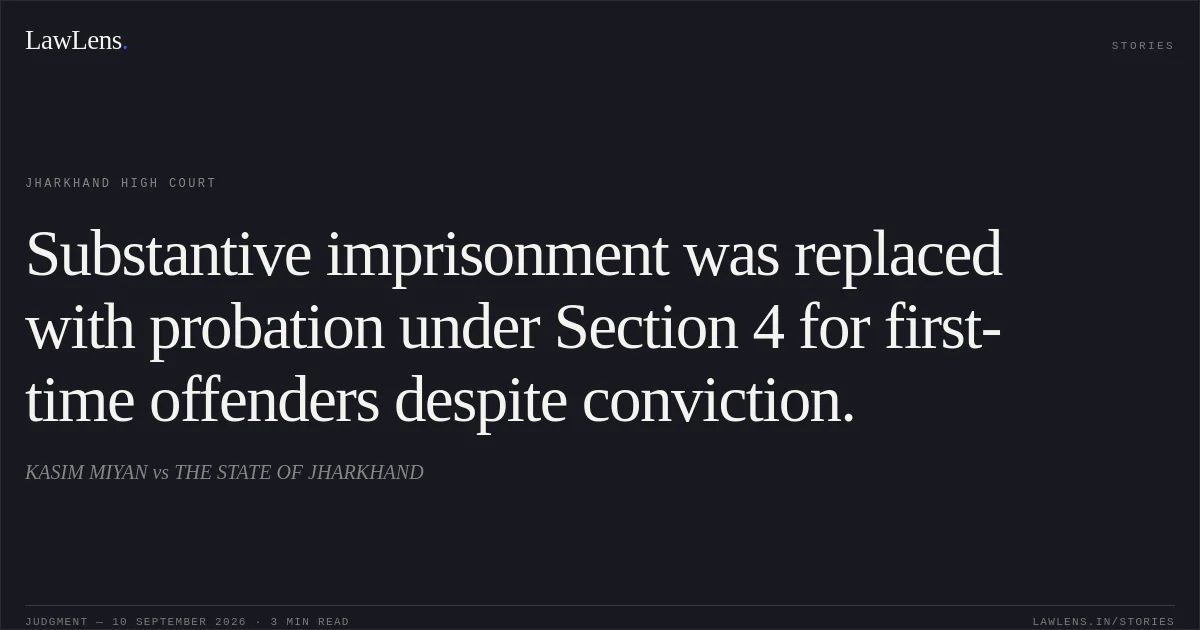
Source reference: para. 13, p. 4Considering the nature and genesis of the occurrence, the petitioners’ age, antecedents, and character, the High Court held that the ends of justice would be served by extending the benefit of Section 4 of the Probation of Offenders Act rather than requiring them to undergo substantive imprisonment.
Source reference: para. 14, p. 4Holding
The criminal revisions were dismissed on merits insofar as the conviction was concerned.
The sentence was modified: instead of undergoing the substantive terms of imprisonment, the petitioners were directed to be released under Section 4 of the Probation of Offenders Act, 1958, on furnishing a bond of ₹5,000 each with one surety of like amount, to maintain peace and be of good behaviour for one year from the date of furnishing the bond.
Source reference: para. 15, p. 4If the bonds were not furnished within two months, the trial court was directed to secure the petitioners’ attendance for that purpose; breach of the bond conditions would result in their being called upon to serve the sentences originally imposed.
Source reference: paras. 16–17, p. 4Jashim Mian and Bablu Mian, who were in custody, were ordered to be released forthwith upon furnishing the bond, provided they were not wanted in any other case.
Source reference: para. 18, p. 4Acts & Sections Cited
10 provisions across 2 statutes referred to in this judgment. Each provision opens on LawLens.
Indian Penal Code, 1860
Probation of Offenders Act, 19581
Original Court PDF
KASIM MIYANvsTHE STATE OF JHARKHAND
Click to open original judgment
Original judgment, available to read, download and summarize on LawLens.in