Facts
The petitioner (CBI) filed a Criminal Miscellaneous Petition under Section 378(3) of the CrPC, 1973, seeking leave to appeal against the trial court’s judgment dated 31.05.2007, which acquitted Respondent No. 1 (Amit Jogi) of charges involving a criminal conspiracy to murder a political rival, while convicting 19 other co-accused
Source reference: para. 2The State of Chhattisgarh and the de facto complainant had previously challenged the acquittal, but the Supreme Court, in its judgment dated 06.11.2025, clarified that in cases investigated by the CBI, the power to appeal vests exclusively with the Central Government
Source reference: para. 3, 19The Supreme Court condoned a 1373-day delay in the CBI’s application, citing the gravity of the offense, and remitted the matter to the High Court for a fresh merit-based consideration of the leave to appeal
Source reference: para. 4, 30, 33Issues
1. Whether leave to appeal against the judgment of acquittal should be granted under Section 378(3) of the CrPC in light of the Supreme Court's remand directions
Source reference: para. 5-82. Whether the de facto complainant must be impleaded as a party respondent in the appeal proceedings
Source reference: para. 12-13Law Applied
The court primarily relied on Section 378 of the CrPC, 1973, distinguishing between sub-section (1) regarding State Government appeals and sub-section (2) regarding Central Government/CBI appeals
Source reference: para. 18It applied the principle from Lalu Prasad Yadav v. State of Bihar (2010) 5 SCC 1, which establishes that the authority of the State to appeal is excluded in cases investigated by the Delhi Special Police Establishment (CBI)
Source reference: para. 18-19Furthermore, it noted the limitation of the victim’s right to appeal under the proviso to Section 372 CrPC, referencing Mallikarjun Kodagali v. State of Karnataka, which held that such rights only apply to acquittal orders passed after 31.12.2009
Source reference: para. 28Reasoning
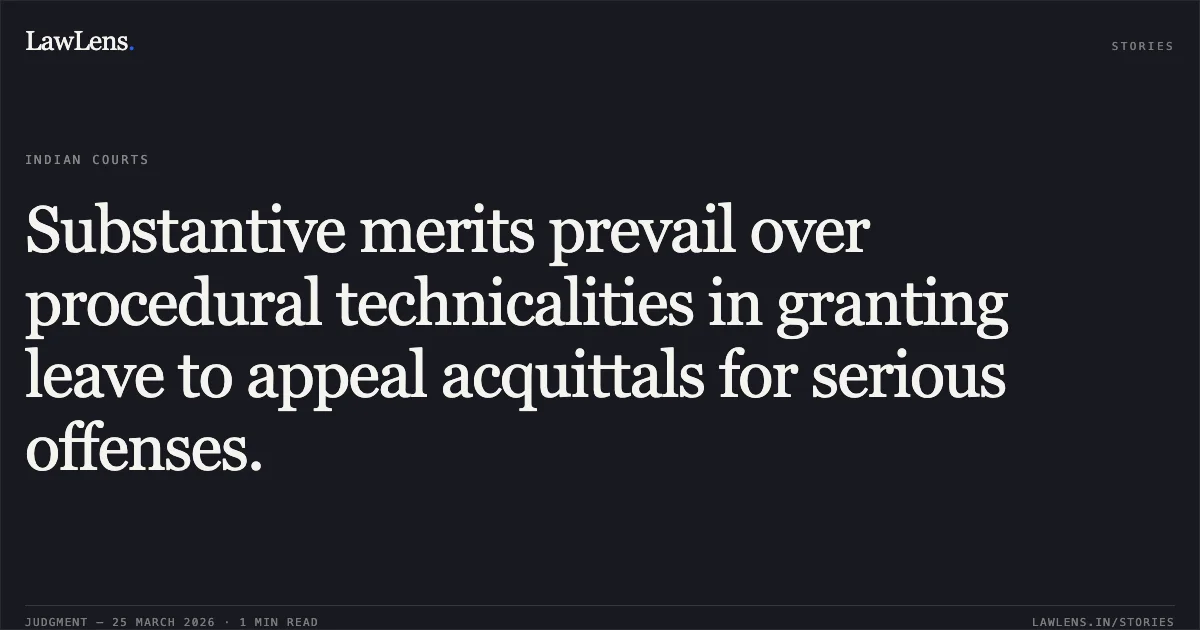
The High Court observed that it was bound by the authoritative mandate of the Supreme Court, which emphasized that serious criminal allegations should not be defeated by technicalities such as delay
Source reference: para. 5-6The court noted that the Supreme Court had already examined the statutory framework and determined that while the State’s independent appeal was not maintainable, the CBI's application must be heard on its substantive merits
Source reference: para. 20, 26Regarding procedure, the Court criticized the CBI’s failure to formally move an application to implead the de facto complainant despite specific Supreme Court directions
Source reference: para. 12However, to ensure "faithful compliance" with the Apex Court's mandate and avoid further delay, the Court exercised its discretion to waive the requirement for a formal application and directed the CBI to implead the de facto complainant during the course of the day
Source reference: para. 13Holding
The High Court allowed CRMP No. 495/2011 and granted leave to appeal under Section 378(3) of the CrPC
The Registry was directed to register the matter as an "Acquittal Appeal" and admit it for hearing
Source reference: para. 9The Court ordered the impleadment of the de facto complainant and directed Respondent No. 1 to furnish bail bonds and sureties before the trial court by 31.03.2026
Source reference: para. 13, 16The final hearing for the acquittal appeal was scheduled for 01.04.2026
Source reference: para. 18Acts & Sections Cited
2 provisions across 1 statute referred to in this judgment. Each provision opens on LawLens.
Code of Criminal Procedure, 19732
Original Court PDF
C.B.I.vsAMIT JOGI and ANOTHER
Click to open original judgment
Original judgment, available to read, download and summarize on LawLens.in