Facts
The Petitioner, a transgender woman, filed a writ petition seeking to quash a State Government notification dated January 12, 2023, which added the transgender community to the list of Other Backward Classes (OBC) at serial number 92
Source reference: para. 8.1, 9.7The Petitioner contended that simply classifying transgenders (TGs) as OBC without providing horizontal reservation is a "mere facade" and fails to comply with the Supreme Court's mandate in NALSA v. Union of India
Source reference: para. 9.1, 12.1Procedurally, this followed a 2021 petition where the High Court directed the State to work out reservations for TGs within four months
Source reference: para. 9.5The State argued that the OBC classification fulfilled the NALSA requirement to treat TGs as Socially and Educationally Backward Classes (SEBC) and that specific reservation structures are matters of policy
Source reference: para. 10.1, 10.2Issues
1. Whether the State notification dated 12.01.2023, which classifies all transgender persons as OBC, provides a meaningful and tangible reservation benefit in accordance with constitutional mandates
Source reference: para. 18, 272. Whether the lack of horizontal reservation for transgender persons across various vertical categories (SC/ST/OBC/General) violates the principles of substantive equality and the directions issued in NALSA v. Union of India
Source reference: para. 8.2, 30Law Applied
The court primarily relied on the Supreme Court’s landmark judgment in NALSA v. Union of India (2014), which recognized transgender persons as the "third gender" and directed the State to extend "all kinds of reservation" for public appointments and education
Source reference: para. 2, 8.2It also applied the Transgender Persons (Protection of Rights) Act, 2019, specifically Section 8, which mandates the government to ensure effective participation and inclusion of TGs through welfare schemes
Source reference: para. 20, 20.1The court invoked the constitutional guarantees of dignity, autonomy, and equality under Articles 14, 15, 16, and 21
Source reference: para. 2, 21Reasoning
The court found that the 2023 notification was an "eyewash" because it conferred no tangible benefit and created an anomalous dichotomy
Source reference: para. 27, 30If a TG person is born into an SC or ST family, they are forced to choose between their birth-based quota and the OBC-TG quota; if they choose the latter, they may lose more beneficial protections, and if they choose the former, they receive no additional affirmative benefit for their TG identity
Source reference: para. 28, 29The court noted that since the notification's issuance, not a single TG person has benefited from it
Source reference: para. 20While the court agreed that horizontal reservation for a minuscule population (0.024% of the State) could be administratively difficult to implement via a roster system, it held that the State had abdicated its obligation to provide "tangible" measures
Source reference: para. 24, 25.1, 31The court referenced the "Karnataka model," where 1% horizontal reservation is provided across all vertical categories, as a potential legislative solution
Source reference: para. 34.1Holding
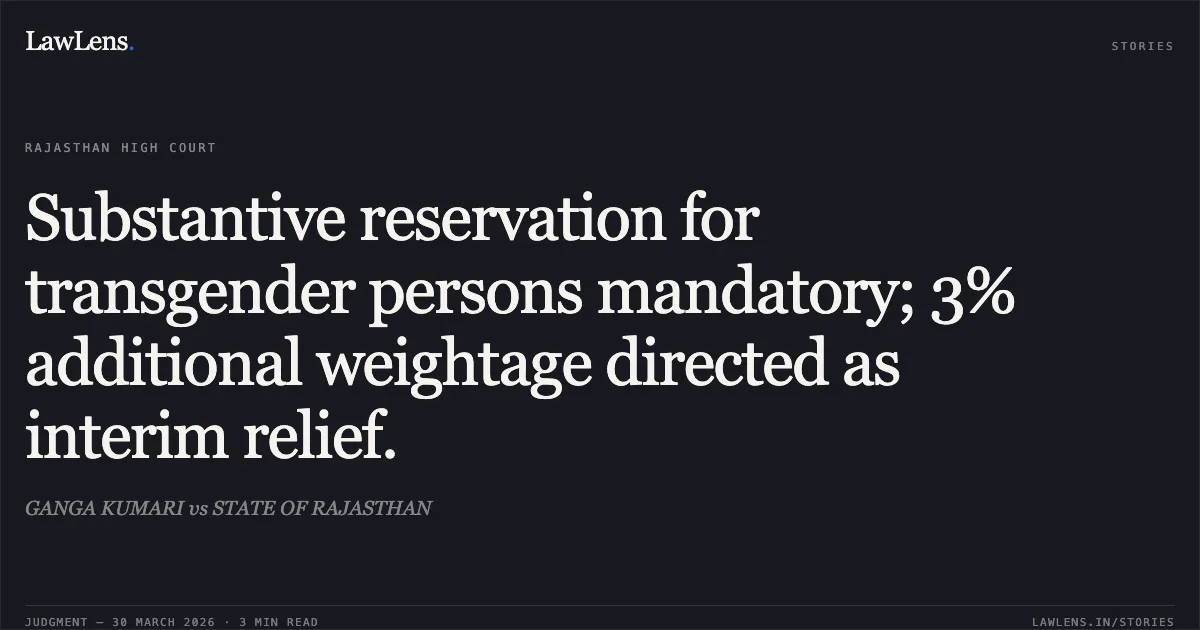
The court disposed of the petition by holding that the current OBC classification was insufficient to meet the mandate of the law
It directed the State to: (a) constitute a Committee headed by the Principal Secretary of Social Welfare to recommend a workable framework to address the "aggravated marginalization" of TGs; and (b) as an interim measure, grant transgender persons 3% additional weightage in the maximum marks for selection in public employment and admission to educational institutions
Source reference: para. 33(a), 33(b)An epilogue noted that recent legislative amendments (2026 Bill) regarding self-identification must still be implemented in harmony with constitutional guarantees of personhood
Source reference: Epilogue para. 3-5Acts & Sections Cited
3 provisions across 1 statute referred to in this judgment. Each provision opens on LawLens.
Original Court PDF
GANGA KUMARIvsSTATE OF RAJASTHAN
Click to open original judgment
Original judgment, available to read, download and summarize on LawLens.in


