Facts
The applicant, a retail trader, was accused of selling sub-standard groundnut oil.
Source reference: p. 2A Food Inspector collected samples from a packed tin purchased by the applicant from Hansraj Oil Mills.
Source reference: p. 2On 12.04.2002, the Judicial Magistrate First Class (Muni) Court, Surat, in PFA Case No. 34 of 2000, convicted the applicant under Sections 7 and 16 of the Prevention of Food Adulteration Act (PFA Act), sentencing him to two years of simple imprisonment and a fine of ₹25,000.
Source reference: p. 2This conviction was upheld by the 6th Additional District & Sessions Judge, Surat, in Criminal Appeal No. 17 of 2002 on 30.01.2009.
Source reference: p. 2The applicant moved the High Court in revision, arguing that as a retailer, he was not responsible for the contents of a sealed tin and that subsequent legislative changes favored a more lenient punishment.
Source reference: p. 2-3Issues
1. Whether the sentence of imprisonment imposed under the PFA Act should be modified in light of the subsequent enactment of the Food Safety and Standards Act, 2006, regarding "sub-standard" food.
Source reference: p. 32. Whether a fine is a sufficient penalty for the offense of selling sub-standard goods under the current legal framework.
Source reference: p. 4Law Applied
Sections 7 and 16 of the Prevention of Food Adulteration Act, 1954, which mandated imprisonment for food-related offenses.
Source reference: p. 2Restorative principles found in Sections 51 and 52 of the Food Safety and Standards Act (FSSA), 2006, which substituted imprisonment with monetary penalties for "sub-standard" food.
Source reference: p. 3Precedents set by the Supreme Court of India in Nemi Chand v. State of Rajasthan (2018) 17 SCC 448 and Triloki Chand v. State of Himachal Pradesh (2020) 10 SCC 763, which established that if an article is found to be sub-standard, the sentence may be limited to a fine.
Source reference: p. 4Reasoning
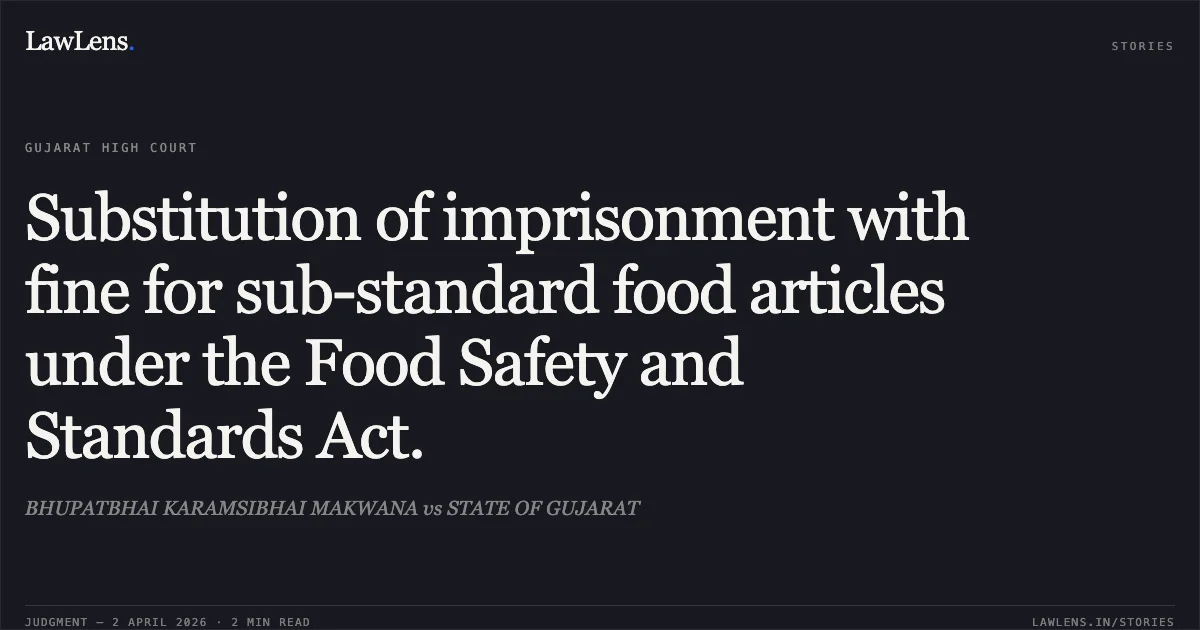
The Court observed that the charge against the applicant was specifically for the "sub-standardization" of goods rather than injurious adulteration.
Source reference: p. 3While the conviction was originally handed down under the PFA Act, the Court took judicial notice of the legislative shift introduced by the FSSA, 2006, where Sections 51 and 52 contemplate only a penalty or fine for sub-standard food.
Source reference: p. 3Applying the logic from Nemi Chand and Triloki Chand, the Court reasoned that the ends of justice would be met by modifying the quantum of punishment to reflect the current legislative intent.
Source reference: p. 4The Court found that since the applicant was a retailer and the oil was sampled from a pre-packed tin, a sentence of a ₹25,000 fine was appropriate in lieu of the two-year custodial sentence.
Source reference: p. 4Holding
The High Court partly allowed the revision application, upholding the conviction passed by the trial court and confirmed by the appellate court but modifying the sentence.
The order of two years of simple imprisonment was set aside and substituted with a total fine of ₹25,000; as the fine was already deposited in 2002, the court directed the amount be adjusted and discharged the applicant’s surety bonds.
Source reference: p. 4-5Acts & Sections Cited
4 provisions across 2 statutes referred to in this judgment. Each provision opens on LawLens.
Code of Criminal Procedure, 19732
Food Safety and Standards Act, 20062
Original Court PDF
BHUPATBHAI KARAMSIBHAI MAKWANAvsSTATE OF GUJARAT
Click to open original judgment
Original judgment, available to read, download and summarize on LawLens.in