01Facts
The applicant filed a second anticipatory bail application under Section 482 of the Bharatiya Nagarik Suraksha Sanhita (BNSS), 2023, regarding an FIR involving various offenses under the Bharatiya Nyaya Sanhita (BNS), the IT Act, and state examination laws.
¶ 01The prosecution alleges the applicant forged Biometric data in the Aadhaar database to facilitate a proxy candidate in a recruitment exam.
¶ 06An earlier anticipatory bail application was dismissed on its merits on February 12, 2026.
¶ 02The applicant sought relief citing cooperation with investigations in other similar cases and interim protection granted by higher courts in separate FIRs.
¶ 03-0402Issues
i.1. Whether a successive application for anticipatory bail is maintainable in the absence of a substantial change in circumstances.
¶ 08ii.2. Whether the applicant is entitled to protection from arrest under the guidelines established in Arnesh Kumar v. State of Bihar given the nature of the offenses charged.
¶ 05 & 0703Law Applied
The court applied Section 482 of the Bharatiya Nagarik Suraksha Sanhita, 2023, governing the High Court's power to grant anticipatory bail.
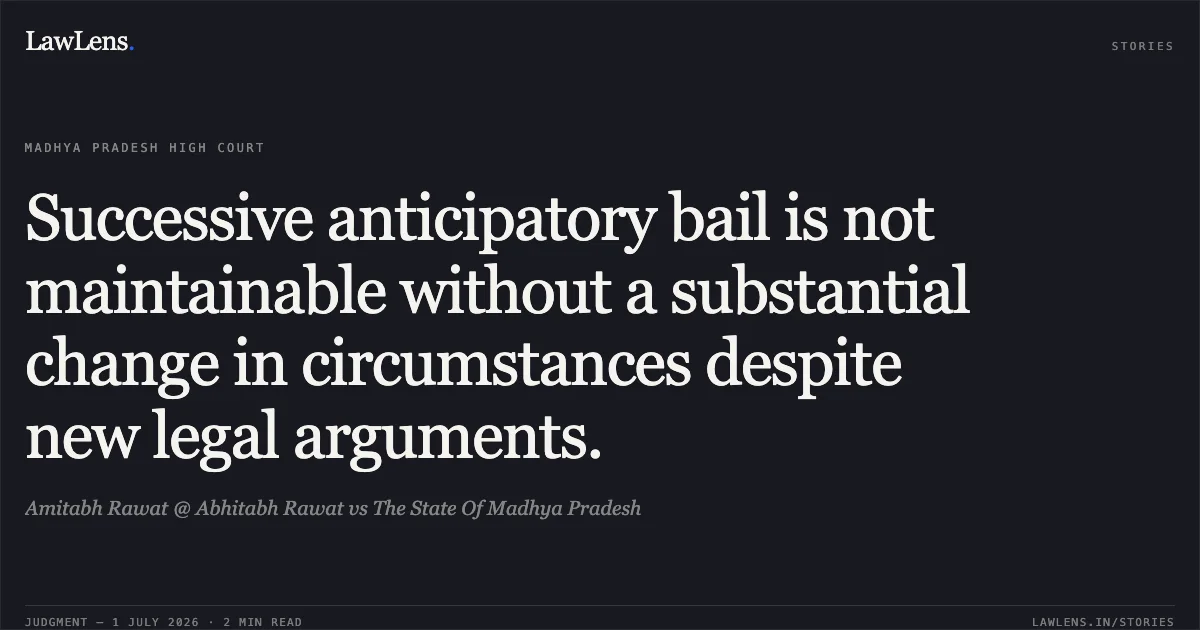
¶ 01Successive bail applications require a substantial change in circumstances rather than merely new arguments on existing facts.
¶ 08Doctrine from Arnesh Kumar v. State of Bihar mandates specific arrest procedures for offenses punishable by less than seven years of imprisonment, but has limited applicability where charges include offenses punishable by life imprisonment, such as Section 338 of the BNS.
¶ 05 & 07Provisions in the judgment · 8 · Linked ones open on LawLens
Bharatiya Nagarik Suraksha Sanhita, 2023 Section 482
Bharatiya Nyaya Sanhita, 2023 Section 238Section 318Section 319Section 336Section 338Section 340Section 61
04Reasoning
The court found that the applicant failed to demonstrate a "substantial change" in circumstances, noting that the dismissal of the first application already addressed the core merits of the case.
¶ 08In evaluating the "new" arguments regarding Aadhaar regulations and previous relief in other districts, the court held that those instances were fact-specific and did not bind the court in the present matter.
¶ 07The court emphasized the gravity of the allegations—specifically the manipulation of the Aadhaar database—characterizing the applicant as a "kingpin" whose custodial interrogation is necessary to uncover the modus operandi of the conspiracy.
¶ 06Since Section 338 of the BNS carries a potential life sentence, the court reasoned that the restrictive arrest guidelines of Arnesh Kumar did not apply.
¶ 0505Holding
A successive bail application cannot be entertained on a "specious plea" of changed circumstances.
¶ 08The court held that the applicant did not deserve the "rare and exceptional relief" of anticipatory bail and the application was dismissed.
¶ 06 & 08Original Court PDF
Amitabh Rawat @ Abhitabh RawatvsThe State Of Madhya Pradesh
Click to open original judgment
Original judgment, available to read, download and summarize on LawLens.in