01Facts
The petitioner, then SHO of P.S. Ramgarh Tal, Gorakhpur, led a police team that checked Room 512 of Hotel Krishna Palace on the night of 27–28.09.2021, where the deceased Manish Gupta was staying with two others.
¶ 3The CBI alleges the petitioner pushed the deceased's forehead against a wall, causing unconsciousness and death, and that he later had blood stains cleaned, dictated a false accidental-fall account to the hotel manager, and caused false General Diary entries.
¶ 4The FIR was registered under Section 302 IPC on 29.09.2021, and the petitioner was arrested on 10.10.2021.
¶ 6The CBI re-registered the case, and the chargesheet was filed against six police officials under Sections 302, 323, 325, 506, 218, 201 read with 34, 120-B and 149 IPC.
¶ 1–2, 7Charge under Section 302 was framed against the petitioner alone; this Court set aside that order on 31.07.2024, and charges were framed afresh on 19.05.2025.
¶ 7A coordinate Bench rejected the petitioner's earlier bail application on 15.01.2024.
¶ 8The trial court dismissed his second bail application on 19.05.2026, noting that all vulnerable witnesses, including PW-15 (Adarsh Pandey), had been examined and that PW-15 had turned hostile. It nonetheless refused bail on the apprehension of influence over remaining private witnesses in Uttar Pradesh and flight risk.
¶ 9–10At the time of hearing, 33 of 73 witnesses had been examined, the petitioner had been in custody for over five years without interim bail, he had no other pending case, and his jail conduct was satisfactory.
¶ 11This is the petitioner's second bail application before this Court.
¶ 202Issues
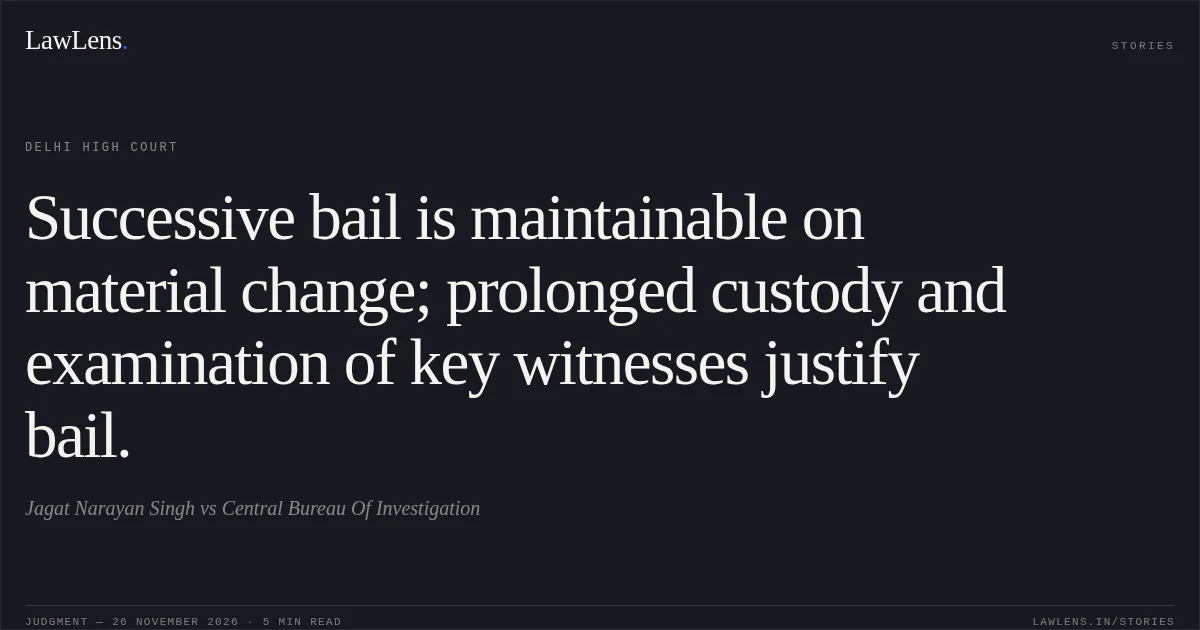
i.1. Whether a successive bail application is maintainable where there has been a material change in circumstances after the earlier rejection.
¶ 17(i)ii.2. Whether the petitioner, a police officer charged under Section 302 IPC, is entitled to regular bail after more than five years of custody, given the stricter approach to police accused in Ajay Kumar Yadav and the risk of influence over remaining witnesses.
¶ 14, 17(iv)–(vi)03Law Applied
Section 483 of the BNSS, which governs regular bail, and Section 302 IPC, the offence charged, were applied.
¶ 1, 7A successive bail application is maintainable only upon a material change in fact or law, and earlier rejections bind later courts absent such change, as laid down in Kalyan Chandra Sarkar v. Rajesh Ranjan.
¶ 17(i)Examination of eyewitnesses after an earlier rejection is a material change warranting consideration on merits, as held in Kamal @ Kamal Choudhary v. State of M.P. (Cr. A. No. 992/2025, decided 28.02.2025).
¶ 17(ii)Ajay Kumar Yadav v. State of U.P., (2024) 13 SCC 678, requires a stricter approach to bail for police officers accused of grave offences, due to their capacity to influence the case, but does not mandate denial of bail until trial conclusion.
¶ 14, 17(iv)Gobarbhai Naranbhai Singala v. State of Gujarat, (2008) 3 SCC 775, holds that long incarceration does not by itself entitle an accused to bail in capital or life-imprisonment offences where delay is attributable to the accused.
¶ 14, 17(v)Bail is the rule and jail the exception, as affirmed in Syed Iftikhar Andrabi v. NIA, 2026 INSC 503.
¶ 20The constitutional presumption of innocence and liberty under Articles 21 and 22 is explained in Dataram Singh v. State of U.P., (2018) 3 SCC 22.
¶ 21Provisions in the judgment · 9 · Linked ones open on LawLens
Bharatiya Nagarik Suraksha Sanhita, 2023 Section 483
Indian Penal Code, 1860 Section 302Section 323Section 325Section 506Section 218Section 201Section 34Section 149
04Reasoning
The earlier rejection ground, namely that the trial was at a nascent stage and witnesses were yet to be examined, no longer subsisted. Vulnerable witnesses including PW-15 had been examined, and PW-15 had turned partly hostile on the petitioner's role. This constituted a material change, making the successive application maintainable under Kalyan Chandra Sarkar and Kamal.
¶ 17(i), (iii)The court accepted that the allegation was grave and that Ajay Kumar Yadav demands a stricter approach to police accused. However, it distinguished that case, where bail had been granted within about one and a half years before any evidence was led. Here the petitioner had been in custody for over five years and the complainant and hotel staff had already deposed.
¶ 17(iv)Gobarbhai was distinguished because the delay there was caused by the accused's own absence, whereas here 40 witnesses remained, and the trial was unlikely to conclude soon.
¶ 17(v)The cited authorities turned on their own facts and did not establish a rule of denying bail irrespective of incarceration and stage of trial.
¶ 17(vi)The petitioner's lack of criminal antecedents and satisfactory jail conduct further weighed in favour of bail.
¶ 17(vii)To address the concerns of influence and delay, the court relied on the petitioner's undertakings not to seek adjournments, to cooperate in expeditious trial conclusion, and not to object to short or weekly hearing intervals.
¶ 18–19The court imposed stringent conditions, including restrictions on contacting witnesses and leaving India, to mitigate the trial court's concerns regarding influence and flight.
¶ 2205Holding
The successive bail application is maintainable because the examination of key witnesses, including the partially hostile PW-15, is a material change in circumstances.
¶ 17(i), (iii)Considering the more than five years of custody, the examination of material witnesses, and the petitioner's clean antecedents, the petitioner is entitled to regular bail despite the stricter standard for police accused under Ajay Kumar Yadav.
¶ 17(iv)–(vii)The application is allowed. The petitioner is to be released on a personal bond of ₹50,000 with two sureties of the same amount, subject to thirteen conditions, including: not leaving India without leave and surrendering his passport; not entering District Gorakhpur without permission; attending every hearing; not contacting the complainant or prosecution witnesses; not tampering with evidence; and reporting to the IO on the first Monday of each month.
¶ 22(i)–(xiii)The observations are confined to this bail application and express no opinion on the merits. The application stands disposed of, and a copy is to be sent to the Jail Superintendent.
¶ 23–25Original Court PDF
Jagat Narayan SinghvsCentral Bureau Of Investigation
Click to open original judgment
Original judgment, available to read, download and summarize on LawLens.in