Facts
The petitioners, claiming through predecessors who asserted kudiwaram rights, challenged the cancellation of a joint UDR patta issued to their predecessors and sought restoration of that patta and cancellation of a patta issued to the seventh respondent.
Source reference: para. 1–2The cancellation had been upheld in appeal and by the District Revenue Officer in a revision dismissed on 27 July 1991; the petitioners challenged that order in these writ petitions filed in 2018, alongside the rejection of their later representations.
Source reference: para. 1–2, 8The respondents relied on settlement proceedings and civil litigation, including a second appeal in which the sixth respondent’s predecessors’ rights were declared over the disputed lands except 17 acres and 53 cents, and a subsequent settlement order granting patta for that remaining extent.
Source reference: para. 4–7Issues
Whether the petitioners could challenge, in 2018, the 1991 order upholding cancellation of their predecessors’ UDR patta.
Source reference: para. 8Whether the petitioners established a basis to set aside the challenged revenue orders and obtain restoration of the UDR patta, in light of the settlement proceedings and civil-court decisions.
Source reference: para. 6–8Law Applied
The Court considered the Tamil Nadu Estates (Abolition and Conversion into Ryotwari) Act, 1948, under which the parties’ claims to ryotwari patta had been determined.
Source reference: para. 2, 4, 7It treated the final settlement determinations, the civil decree in S.A. No. 320 of 1976, and the subsequent settlement order as material to the parties’ competing claims.
Source reference: para. 7The Court also applied the principle that a party seeking relief under Article 226 must establish a legal basis for challenging the impugned orders; a revenue entry or UDR patta, without supporting entitlement in the face of prior adverse proceedings, was insufficient on the facts of this case.
Source reference: para. 7–8No specific judicial precedent was cited in the judgment.
Source reference: no citationReasoning
The Court found that the petitioners were not claiming through Perumal or Alazhan, whose claims alone had been remitted for further consideration in the earlier proceedings; the claims of other persons had been rejected and had attained finality.
Source reference: para. 7It further noted that the sixth respondent’s predecessors’ rights were declared over the lands, subject to the 17 acres and 53 cents later covered by the settlement order.
Source reference: para. 7The petitioners produced no ryotwari patta or other documents establishing their asserted entitlement, and the 1991 revision order had already recorded the failure of their predecessors to prove possession.
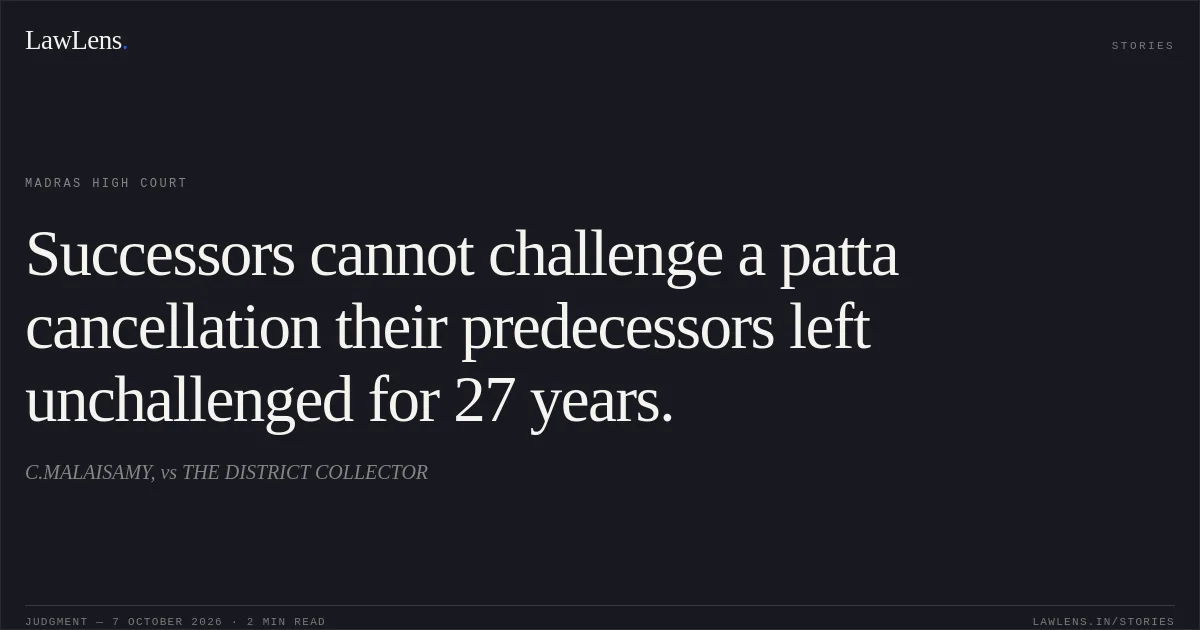
Source reference: para. 7–8The Court also held that the petitioners could not, after nearly 27 years, challenge an order their predecessors had not pursued further.
Source reference: para. 8Holding
The Court found no ground to interfere with the orders of 27 July 1991 and 20 February 2018.
It dismissed all six writ petitions, made no order as to costs, and closed the connected miscellaneous petitions.
Source reference: para. 8–9Acts & Sections Cited
1 provisions across 1 statute referred to in this judgment. Linked provisions open on LawLens.
Tamil Nadu Estates (Abolition and Conversion Into Ryotwari) Act, 19481
Original Court PDF
C.MALAISAMY,vsTHE DISTRICT COLLECTOR
Click to open original judgment
Original judgment, available to read, download and summarize on LawLens.in