Facts
The appellant and the deceased, Binod, worked as security guards at a hostel in Bengaluru and shared a room with other guards. The prosecution alleged that, on 15 October 2017, after the deceased refused to provide the appellant with liquor, the appellant assaulted and kicked him, causing his death.
Source reference: p.3The complainant reported the incident after being informed that the deceased was seriously injured; he found the deceased dead and the appellant at the hostel.
Source reference: p.4The trial court convicted the appellant under Section 302 IPC and sentenced him to life imprisonment.
Source reference: p.6In the appeal under Section 374(2) CrPC, the High Court noted that several material witnesses, including alleged eyewitnesses, had not been cross-examined because defence counsel was absent.
Source reference: pp.8–9Issues
1. Whether the prosecution evidence established the appellant’s guilt for the offence of murder under Section 302 IPC
Source reference: pp.9–102. Whether, having regard to the circumstances of the assault, the appellant’s act was culpable homicide not amounting to murder, punishable under Section 304 Part I IPC
Source reference: pp.10–113. Whether the failure to cross-examine material witnesses required the matter to be remitted for further proceedings
Source reference: p.9Law Applied
The appeal was brought under Section 374(2) CrPC. The Court considered the distinction between murder under Section 302 IPC and culpable homicide not amounting to murder under Section 304 Part I IPC, and determined the applicable offence by assessing the circumstances of the killing.
Source reference: no citationThe Court also considered the absence of cross-examination of material witnesses, but did not set out a separate procedural test governing that circumstance. No precedents were cited.
Source reference: no citationReasoning
The Court considered the prosecution evidence, including the eyewitness accounts, the medical evidence, and the evidence of injuries and bloodstains.
Source reference: pp.9–10Although it noted that material witnesses had not been cross-examined, it declined to remit the case, taking account of the appellant’s nearly nine years in custody, and proceeded to assess the record.
Source reference: p.9In classifying the offence, the Court relied on the absence of prior enmity, the quarrel over liquor, the trial court’s finding of sudden provocation, the use of hands and kicks rather than a weapon, and the appellant’s failure to flee after the incident. It concluded that these circumstances made the act culpable homicide not amounting to murder, rather than murder under Section 302 IPC.
Source reference: pp.10–11Holding
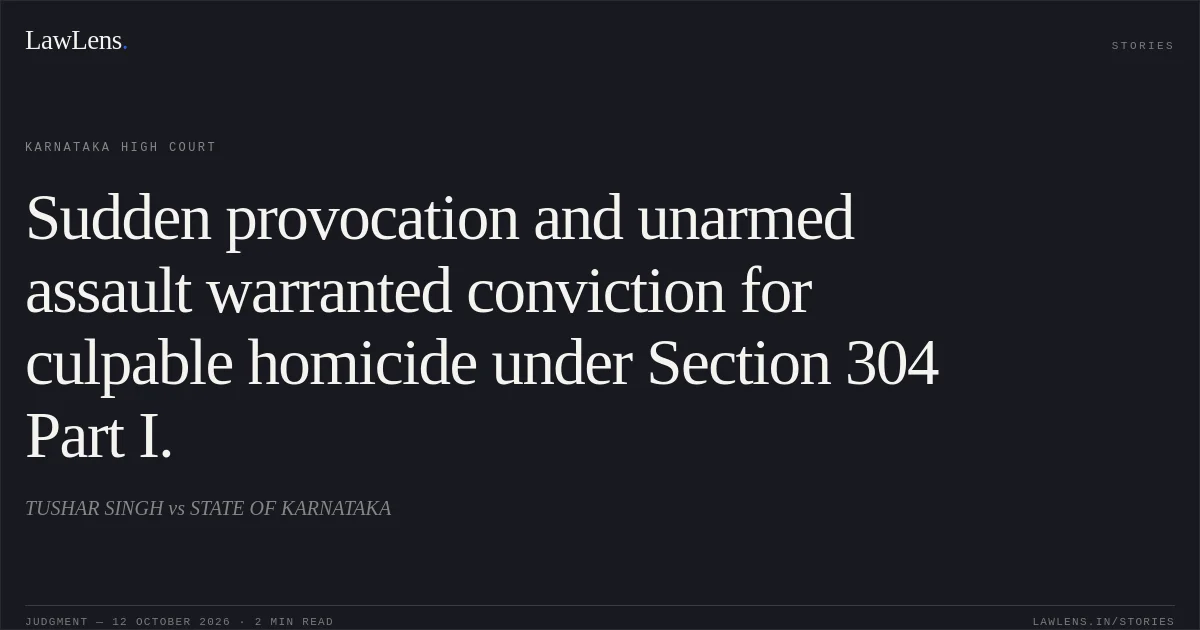
The appeal was allowed in part. The conviction and sentence under Section 302 IPC were set aside, and the appellant was instead convicted under Section 304 Part I IPC and sentenced to ten years’ rigorous imprisonment and a fine of ₹25,000, with one year’s imprisonment in default.
He was granted set-off for custody already undergone, and the trial court’s order concerning compensation under Section 357(A) CrPC was left undisturbed.
Source reference: p.12Acts & Sections Cited
3 provisions across 2 statutes referred to in this judgment. Each provision opens on LawLens.
Code of Criminal Procedure, 19731
Indian Penal Code, 18602
Original Court PDF
TUSHAR SINGHvsSTATE OF KARNATAKA
Click to open original judgment
Original judgment, available to read, download and summarize on LawLens.in


