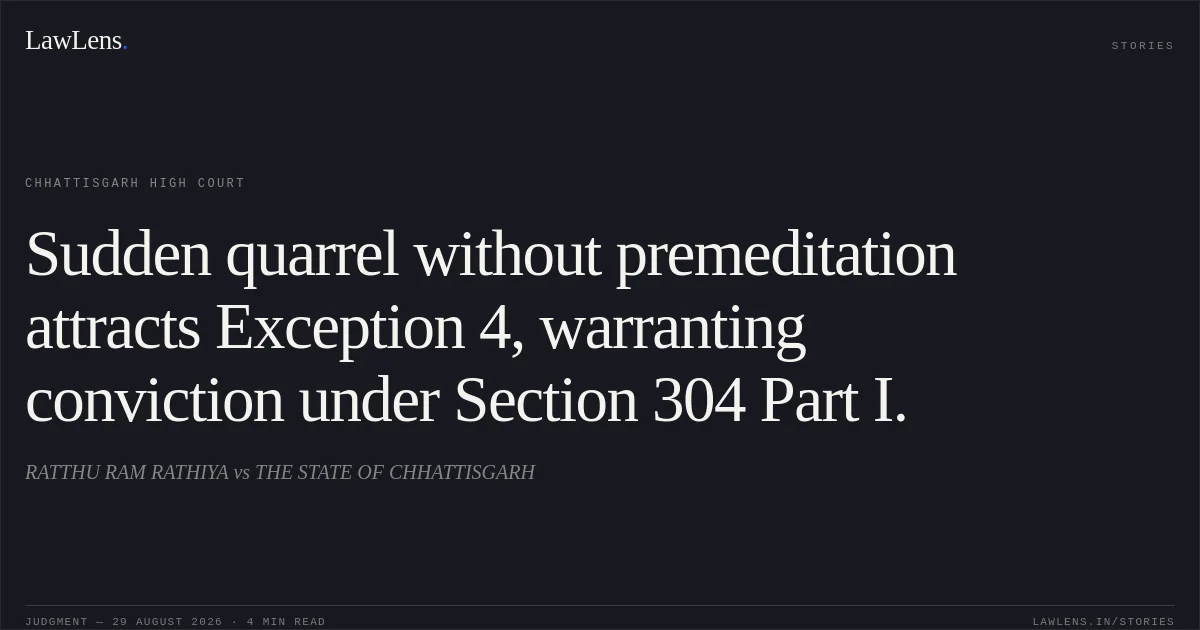
Facts
On 17 April 2019, following an altercation concerning pork/barha meat, the appellants allegedly dragged Shyamlal Rathiya from his house and assaulted him with bamboo sticks, fists, kicks and stones.
Source reference: para. 3Shyamlal was treated at various hospitals and died on 26 April 2019. The post-mortem disclosed multiple head injuries, skull fractures, intracranial blood clots and other injuries; the injuries were opined to have been caused by a hard and blunt object and to be sufficient in the ordinary course of nature to cause death.
Source reference: paras. 3, 10–11A bamboo stick was seized from Ratthuram pursuant to the investigation, and medical evidence indicated that the injuries could have been caused by it.
Source reference: paras. 16–21The Additional Sessions Judge convicted both appellants under Sections 302 read with 34 IPC and sentenced them to life imprisonment with fine.
Source reference: paras. 2, 5–6The appellants challenged the conviction under Section 415(2) of the Bharatiya Nagarik Suraksha Sanhita, 2023.
Source reference: para. 2Issues
Whether the prosecution proved beyond reasonable doubt that the appellants, in furtherance of their common intention, caused Shyamlal’s death so as to attract Sections 302 read with 34 IPC.
Source reference: paras. 9–22Whether the occurrence was covered by Exception 4 to Section 300 IPC—namely, whether it resulted from a sudden fight, without premeditation, in the heat of passion, and without the appellants taking undue advantage or acting cruelly—thereby warranting conversion of the conviction to Section 304 Part I read with Section 34 IPC.
Source reference: paras. 23–31Law Applied
The Court applied Sections 302 and 34 IPC concerning murder and acts done in furtherance of common intention, and Exception 4 to Section 300 IPC, which applies where death is caused in a sudden fight, without premeditation, in the heat of passion, and without the offender taking undue advantage or acting in a cruel or unusual manner.
Source reference: paras. 23, 27, 29Section 304 Part I IPC applies where the act amounts to culpable homicide not amounting to murder and is accompanied by intention to cause such bodily injury as is likely to cause death; Section 304 Part II applies where there is only knowledge that the act is likely to cause death.
Source reference: para. 28Relying on Sukhbir Singh v. State of Haryana, 2002 (3) SCC 327, Gurmukh Singh v. State of Haryana, 2009 (15) SCC 635, State v. Sanjeev Nanda, 2012 (8) SCC 450, Arjun v. State of Chhattisgarh, 2017 (3) SCC 247, and Rambir v. State (NCT of Delhi), 2019 (6) SCC 122, the Court held that the existence of a sudden quarrel, absence of premeditation, nature of the weapon, manner of assault, intention or knowledge, and whether undue advantage was taken are material considerations in distinguishing murder from culpable homicide not amounting to murder.
Source reference: paras. 24–29Reasoning
The Court accepted the consistent testimony of the eyewitnesses, finding that their relationship with the deceased did not by itself render their evidence unreliable.
Source reference: paras. 10–13, 22Their evidence was corroborated by the post-mortem and treatment records, which established that Shyamlal died from serious head injuries caused by a hard and blunt object.
Source reference: paras. 10–11, 19–20The seizure of the bamboo stick from Ratthuram and the medical opinion that the injuries could have been caused by it provided further corroboration, although the conviction did not depend solely on the recovery evidence.
Source reference: paras. 16–21However, the Court found no evidence of prior enmity, premeditation, or a predetermined intention to kill. The incident arose suddenly from an altercation over meat; the appellants had not come armed with a deadly weapon, and the deceased survived for several days before dying during treatment.
Source reference: para. 30Nevertheless, repeated blows with a bamboo stick on the head demonstrated knowledge that the act was likely to cause death. Since the circumstances satisfied all four requirements of Exception 4 to Section 300 IPC, the case fell within culpable homicide not amounting to murder, though the requisite intention for Section 304 Part I was inferred from the nature and manner of the assault.
Source reference: paras. 30–31Holding
The appeal was partly allowed. The conviction of both appellants under Section 302 read with Section 34 IPC was set aside and altered to conviction under Section 304 Part I read with Section 34 IPC.
Each appellant was sentenced to 10 years’ rigorous imprisonment and a fine of Rs. 1,000, with a further two months’ rigorous imprisonment in default of payment of fine.
Source reference: para. 32As the appellants were already in custody, they were directed to serve the remaining sentence.
Source reference: para. 33The Registry was directed to communicate the judgment to the concerned jail superintendent and transmit the judgment and original record to the trial court for compliance.
Source reference: paras. 34–35Acts & Sections Cited
6 provisions across 3 statutes referred to in this judgment. Each provision opens on LawLens.
Bharatiya Nagarik Suraksha Sanhita, 20231
Indian Penal Code, 18604
Code of Criminal Procedure, 19731
Original Court PDF
RATTHU RAM RATHIYAvsTHE STATE OF CHHATTISGARH
Click to open original judgment
Original judgment, available to read, download and summarize on LawLens.in
![A police constable cannot be removed for unauthorized absence without a Rule 359-compliant inquiry.. Mohammad Sidiq Khan vs D/o Home Ut Of Jammu & Kashmir. CAT - ['Srinagar']. LawLens](/stories/thumbnails/a-police-constable-cannot-be-removed-for-unauthorized-absence-without-a-rule-359-compliant-7b43fc316bd94f22a62676153bbc9d54.webp)
![A Review DPC lacks authority to determine or alter inter se seniority.. SAURABH KUMAR vs REVENUE. CAT - ['Patna']. LawLens](/stories/thumbnails/a-review-dpc-lacks-authority-to-determine-or-alter-inter-se-seniority-4b21640f20af46fcabdfc8273d2ce959.webp)