Facts
On April 19, 2012, at approximately 2:30 PM, the accused, Kamal Prasad, entered his home in an intoxicated state and engaged in a quarrel with his wife, Indravati, over demands for liquor money
Source reference: para. 3, 12, 14PW-1 (the couple's son) and PW-2 ( a neighbor) were sitting nearby and heard screams; upon rushing to the scene, they witnessed the accused fleeing the house
Source reference: para. 12, 14Inside, the deceased was found with her throat slit by an axe
Source reference: para. 14The Trial Court (Sessions Judge, Balrampur) convicted the appellant under Section 302 of the Indian Penal Code (IPC) and sentenced him to life imprisonment on March 29, 2016
Source reference: para. 2, 9The appellant challenged this conviction, arguing that the witnesses were "interested," the chain of circumstances was incomplete, and the medical evidence was inconsistent
Source reference: para. 10Issues
1. Whether the testimonies of PW-1 and PW-2, being related or acquainted with the deceased, are credible and sufficient to establish the presence and involvement of the accused
Source reference: para. 262. Whether the prosecution established a complete chain of circumstances pointing unerringly to the guilt of the accused
Source reference: para. 34-363. Whether the act of the accused amounts to "murder" under Section 302 IPC or "culpable homicide not amounting to murder" under Section 304 IPC, given the absence of premeditation
Source reference: para. 39Law Applied
The court primarily applied Section 300 IPC (Murder) and the exceptions therein, alongside Section 304 IPC regarding culpable homicide not amounting to murder
Source reference: para. 41-42It relied on M.C. Ali v. State of Kerala to establish that relationship is not a factor that inherently affects a witness's credibility
Source reference: para. 27For circumstantial evidence, the court applied the "Panchsheel" principles from Sharad Birdhichand Sarda v. State of Maharashtra
Source reference: para. 35Furthermore, it followed Surinder Kumar v. Union Territory of Chandigarh and Pundalik v. State of Maharashtra, which held that sudden quarrels without premeditation in the heat of passion may reduce a charge from murder to culpable homicide under Section 304 IPC
Source reference: para. 40, 44Reasoning
The Court first dismissed the challenge to the ocular evidence, noting that PW-1 was a natural witness (the son) and PW-2 was a consistent independent neighbor; their testimonies regarding the accused's intoxicated entry, the quarrel, and his immediate flight were found trustworthy
Source reference: para. 28-33While no witness saw the actual assault, the court found the chain of circumstances complete, particularly highlighting the accused's failure to provide an explanation for the death occurring inside his house under Section 313 Cr.P.C.
Source reference: para. 36-38However, regarding the nature of the offense, the court observed that the incident was triggered by a "sudden quarrel arising out of domestic discord" without prior planning or design
Source reference: para. 46-47Drawing a distinction between "intention" and "knowledge," the court held that while the accused must have known using an axe on the neck was likely to cause death, the prosecution failed to prove a premeditated intention to murder
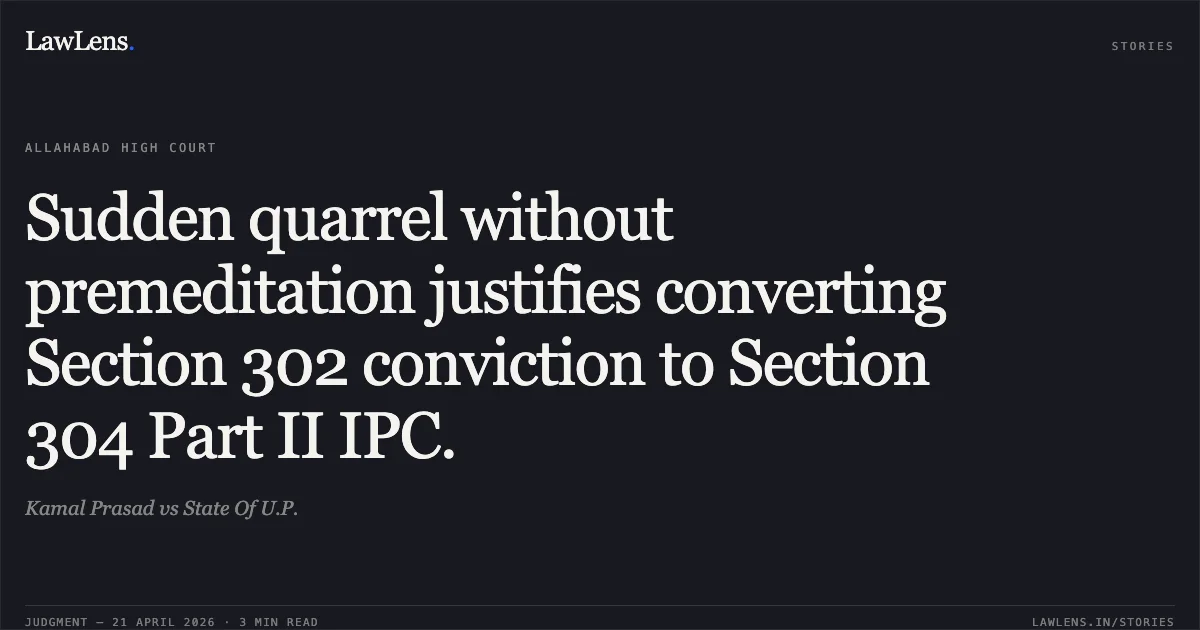
Source reference: para. 48-52Thus, the act fell under Section 304 Part II rather than Section 302 IPC
Source reference: para. 52, 55Holding
The Court partly allowed the appeal, affirming the accused's involvement but altering the conviction from Section 302 IPC to Section 304 Part II IPC
Regarding the sentence, the Court noted the appellant had already undergone incarceration for over 15 years as of February 2026, which exceeded the 10-year maximum term prescribed for Section 304 Part II
Source reference: para. 57-58Consequently, the period already undergone was deemed sufficient, and the Court ordered the appellant’s immediate release
Source reference: para. 58, 60Acts & Sections Cited
5 provisions across 2 statutes referred to in this judgment. Each provision opens on LawLens.
Indian Penal Code, 18604
Code of Criminal Procedure, 19731
Original Court PDF
Kamal PrasadvsState Of U.P.
Click to open original judgment
Original judgment, available to read, download and summarize on LawLens.in