Facts
On 5 July 2016, an altercation occurred between the deceased, Samandarsingh, and the appellants at Kalyanpura, District Ujjain, allegedly concerning an accusation involving Kanta, the daughter-in-law of appellant Banesingh.
Source reference: p.1; para.3During the quarrel, the deceased brought a sword from his house and allegedly injured Banesingh on his left thigh and knee. A scuffle followed in which the deceased fell into a ditch.
Source reference: p.1; para.3The prosecution alleged that Banesingh assaulted the deceased with a sword and Ghanshyam assaulted him with an axe, causing his death at the spot.
Source reference: p.1; para.3An FIR was registered under Sections 294 and 302/34 IPC, and the appellants were tried in Sessions Trial No. 435/2016.
Source reference: p.2; para.4The Additional Sessions Judge, Badnagar, convicted Banesingh and Ghanshyam under Section 302 IPC and sentenced each to life imprisonment with a fine of ₹2,000.
Source reference: p.3; para.7The appellants challenged the conviction, disputing the reliability of the eyewitnesses, the prosecution documents, the FSL evidence, and contending that the incident was covered by the right of private defence or, alternatively, Exception IV to Section 300 IPC.
Source reference: pp.3–4; paras.8–9Issues
1. Whether the conviction of the appellants under Section 302 IPC was sustainable on the evidence, particularly in view of the contradictions in the eyewitness testimony and the medical evidence.
Source reference: p.4; para.122. Whether the appellants were entitled to the protection of the right of private defence under Sections 97, 100 and 101 IPC.
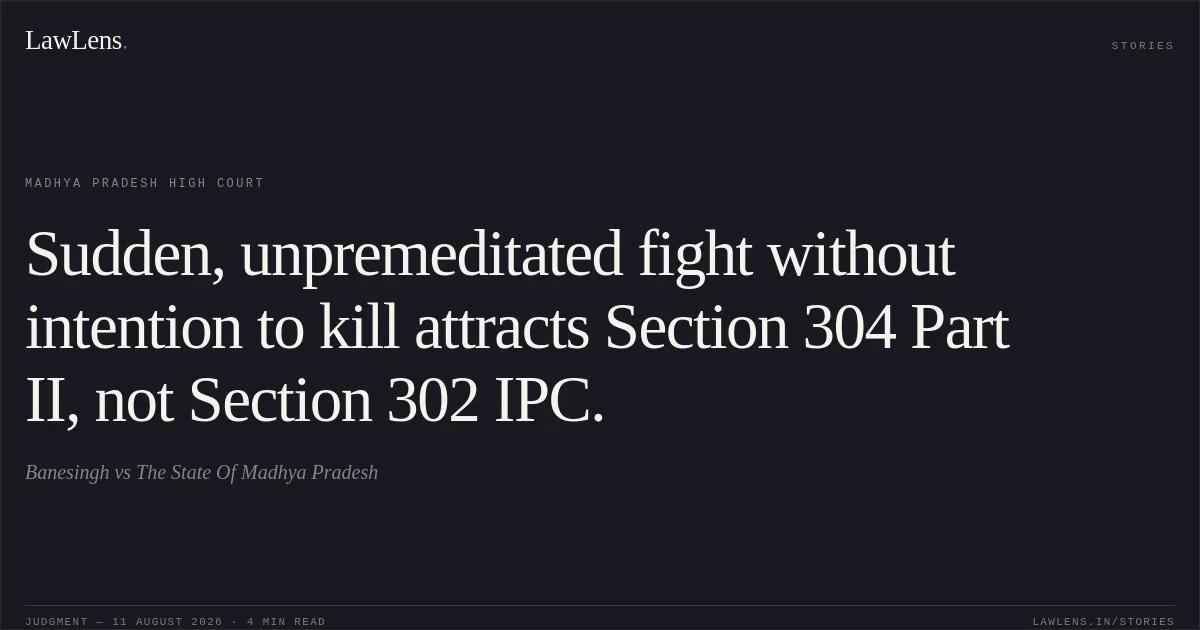
Source reference: p.6; paras.14–153. Whether, in the alternative, the occurrence was a sudden and unpremeditated fight falling within Exception IV to Section 300 IPC, warranting conversion of the conviction to Section 304 Part II IPC.
Source reference: pp.11–15; paras.25–32Law Applied
The Court applied Section 302 IPC concerning murder and Section 304 Part II IPC concerning culpable homicide not amounting to murder where the act is committed with knowledge that it is likely to cause death but without the requisite intention to cause death.
Source reference: pp.2–3, 12; paras.2, 27, 29Sections 97, 100 and 101 IPC recognise the right of private defence of the body, extending in appropriate circumstances to causing death where there is a reasonable apprehension of death or grievous hurt, subject to the statutory limitations.
Source reference: pp.9–10; para.24Exception IV to Section 300 IPC applies where death is caused without premeditation, in a sudden fight, in the heat of passion, and without the offender taking undue advantage or acting cruelly.
Source reference: pp.13–14; para.31Relying on Rajaram v. State of Rajasthan, (2005) 5 SCC 272, and Mukhtiar Ahmed v. State (NCT of Delhi), (2005) 5 SCC 258, the Court held that evidence favourable to the defence emerging from a prosecution witness cannot simply be ignored.
Source reference: p.7; para.18It also relied on George Dominic Varkey v. State of Kerala, (1971) 3 SCC 275, on the requirements of reasonable apprehension and proportionality in private defence.
Source reference: pp.7–8; para.22It also relied on Arjun v. State of Chhattisgarh, AIR 2017 SC 1150, on the requirements of Exception IV.
Source reference: pp.13–14; para.31Reasoning
The Court found material weaknesses in the prosecution case.
Source reference: no citationTarabai, the deceased’s wife and principal eyewitness, stated that the deceased had brought the sword and assaulted Banesingh, and she was not declared hostile despite departing from the prosecution version.
Source reference: p.6; para.15Other prosecution witnesses did not support the allegation that the appellants had assaulted the deceased, while Rajaram’s testimony contradicted Tarabai’s account of the assault occurring in her presence.
Source reference: pp.6–7; paras.17–19The medical evidence also did not establish any grievous or life-threatening injury: the post-mortem evidence indicated multiple injuries and bleeding, but none was independently sufficient to cause death, and several injuries could have resulted from the fall into the ditch.
Source reference: pp.5–6; para.13Banesingh’s medically documented injuries on his thigh and knee corroborated his plea that the deceased, armed with a sword, had initiated the assault.
Source reference: p.8; para.20Although the Court recognised that the evidence supported a claim of private defence, it ultimately treated the incident as a sudden, unpremeditated fight.
Source reference: pp.11–12; paras.25–29Banesingh had not brought the sword; it had been brought by the deceased, while Ghanshyam picked up an axe only after the altercation began.
Source reference: pp.11–12; paras.25–29These circumstances negated premeditation and the intention to commit murder, though the appellants could be attributed knowledge of the likely fatal consequences of their acts.
Source reference: pp.11–12; paras.25–29Holding
The appeal was partly allowed.
The Court maintained the appellants’ culpability but altered their conviction from Section 302 IPC to Section 304 Part II IPC by applying Exception IV to Section 300 IPC.
Source reference: p.16; para.33The sentence of life imprisonment was reduced to 10 years’ rigorous imprisonment for each appellant, along with the fine of ₹2,000.
Source reference: p.16; para.33In default of payment of fine, each appellant was directed to undergo 80 days’ simple imprisonment.
Source reference: p.16; para.33The Court directed that any appellant who had completed 10 years of actual imprisonment be released forthwith, unless required in another case.
Source reference: p.16; para.33Pending interlocutory applications were disposed of and the judgment was directed to be sent to the trial Court for compliance.
Source reference: p.17; paras.34–35Acts & Sections Cited
17 provisions across 5 statutes referred to in this judgment. Each provision opens on LawLens.
Bharatiya Nagarik Suraksha Sanhita, 20231
Code of Criminal Procedure, 19733
Indian Penal Code, 1860
Arms Act, 19591
Bharatiya Nyaya Sanhita, 20231
Original Court PDF
BanesinghvsThe State Of Madhya Pradesh
Click to open original judgment
Original judgment, available to read, download and summarize on LawLens.in