Facts
The Appellant was the highest bidder for a commercial plot lease offered by the Raipur Development Authority (RDA). After depositing the earnest money of ₹24,38,000/-, he failed to pay the remaining installments, leading to the cancellation of allotment and forfeiture of the deposit on 20-11-2023.
Source reference: p.3Following a writ petition where liberty was granted to invoke arbitration, an arbitral award was passed on 05-09-2024 dismissing the Appellant's claim.
Source reference: p.3The Appellant received the award on 18-09-2024. Under Section 34(3) of the Arbitration and Conciliation Act, the limitation for filing objections expired on 18-12-2024.
Source reference: p.3The Appellant filed the application on 06-01-2025—a delay of 18 days—attributing the delay to time spent consulting advocates.
Source reference: p.4The Commercial Court rejected the application, holding that "sufficient cause" was not shown.
Source reference: p.4Issues
1. Whether the delay of 18 days in filing the objection application under Section 34(1) of the Act of 1996 constitutes "sufficient cause" as required by the proviso to Section 34(3)
Source reference: p.5 / para. 102. Whether the Commercial Court was justified in strictly construing the limitation rules to reject the application despite it being filed within the absolute outer limit of 30 days beyond the initial three-month period
Source reference: p.12 / para. 18Law Applied
The Court applied Section 34(3) of the Arbitration and Conciliation Act, 1996, which mandates a three-month limitation period for setting aside an award, extendable by a maximum of 30 days upon showing "sufficient cause," but not thereafter.
Source reference: p.5-6It relied on Consolidated Engineering Enterprises v. Principal Secretary, Irrigation Department, which clarifies that Section 5 of the Limitation Act is excluded by Section 34(3), establishing an absolute outer limit of 120 days (3 months + 30 days).
Source reference: p.7-8It further relied on State of Himachal Pradesh v. Himachal Techno Engineers regarding the calculation of months vs. days
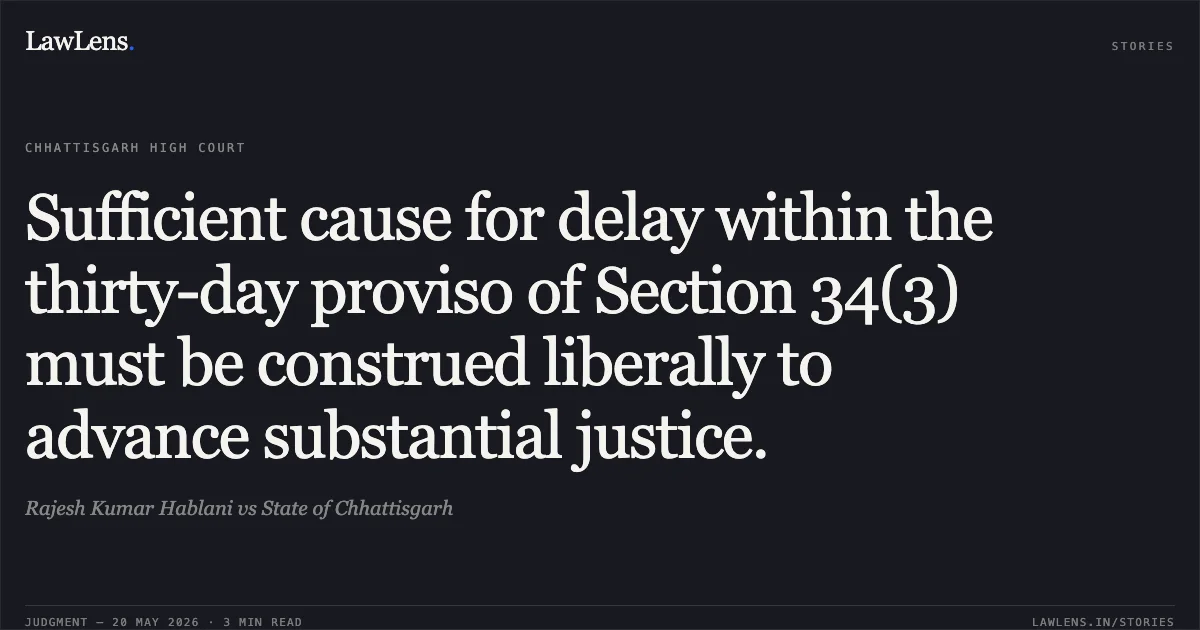
Source reference: p.9It further relied on N. Balakrishnan v. M. Krishnamurthy, which held that the words "sufficient cause" should receive a liberal construction to advance substantial justice and that rules of limitation are not meant to destroy rights.
Source reference: p.12-13Reasoning
The Court reasoned that while the limitation under Section 34(3) is stringent, the proviso expressly allows for a 30-day grace period if "sufficient cause" is shown. In this instance, the 18-day delay fell well within this 30-day discretionary window.
Source reference: p.14The Court found the Appellant’s explanation—time taken for legal consultation and perusal of documents by counsel—to be a plausible and sufficient cause.
Source reference: p.13The Division Bench emphasized that because the Appellant had a substantial financial stake (₹24,38,000/- forfeited), a technical or pedantic approach toward a short delay of 18 days would result in a "foreclosure of remedy" and "substantial injustice".
Source reference: p.14The Court observed that since the application was not filed beyond the absolute 120-day cutoff, the Commercial Court should have adopted a pragmatic view to allow the case to be heard on its merits.
Source reference: p.14Holding
The High Court set aside the Commercial Court's order dated 02-05-2025, holding that the 18-day delay was condonable as it was within the permissible extension period and backed by sufficient cause.
The Court condoned the delay and remitted the matter back to the Commercial Court, Raipur, with directions to decide the Section 34(1) objection application on its merits expeditiously.
Source reference: p.15Acts & Sections Cited
28 provisions across 3 statutes referred to in this judgment. Each provision opens on LawLens.
Arbitration and Conciliation Act, 19964
Limitation Act, 1963
General Clauses Act, 18971
Original Court PDF
Rajesh Kumar HablanivsState of Chhattisgarh
Click to open original judgment
Original judgment, available to read, download and summarize on LawLens.in