Facts
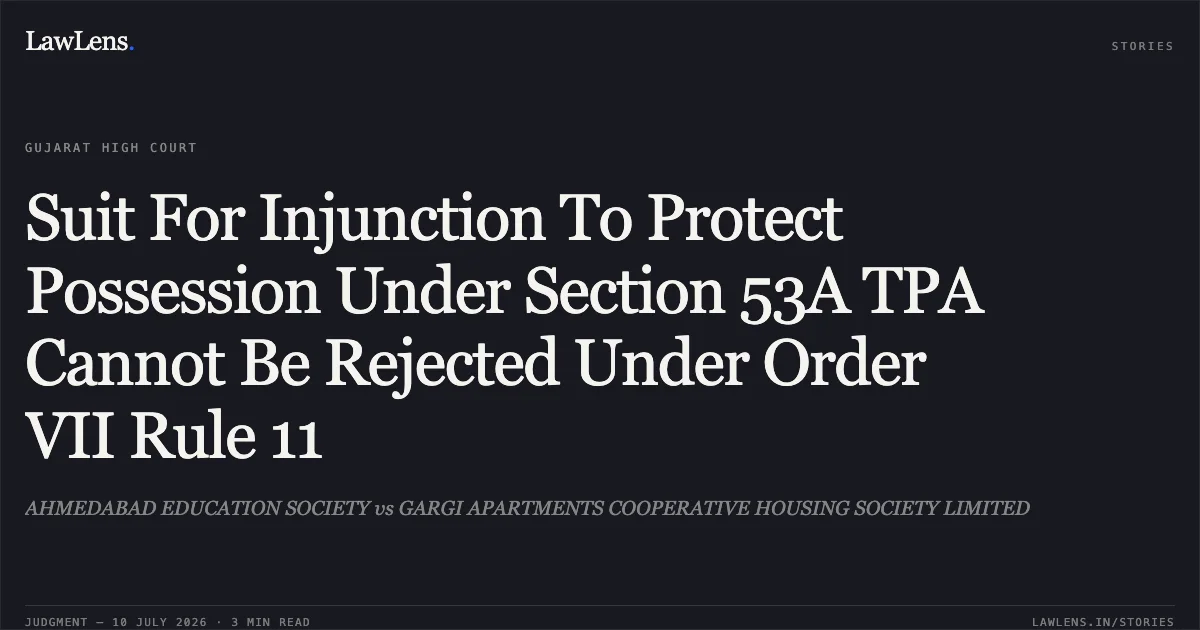
The Plaintiff (Respondent) entered into an Agreement to Sell with the Defendants (Applicants) on February 27, 1969, for 47 acres of land. The agreement stipulated a 24-month period for the Defendants to fulfill conditions, including obtaining Charity Commissioner permission
Source reference: p. 5On July 26, 1971, a Possession Agreement was executed, handing over property in part performance and extending the period to 36 months from the date of the Charity Commissioner's permission (which had been granted on June 5, 1971)
Source reference: p. 7The Plaintiff filed a suit for specific performance and permanent injunction in 1997, alleging they only learned of the definitive refusal to execute the sale deed in December 1996
Source reference: p. 7-8The Defendants filed an application under Order VII Rule 11 of the CPC in 2016, seeking rejection of the plaint on grounds of limitation and lack of cause of action for the injunction
Source reference: p. 8-9The Trial Court rejected the application, prompting this revision
Source reference: p. 3Issues
1. Whether the Suit for Specific Performance is ex facie barred by limitation under Article 54 of the Limitation Act, 1963
Source reference: para. 62. Whether a prayer for permanent injunction to protect possession can survive independently under Section 53A of the Transfer of Property Act (TPA) if the specific performance claim is barred
Source reference: para. 63. Whether the plaint can be rejected in part under Order VII Rule 11 of the CPC
Source reference: para. 50Law Applied
The Court applied Order VII Rule 11 of the CPC regarding the rejection of plaints that are barred by law or fail to disclose a cause of action
Source reference: para. 60It relied on Article 54 of the Limitation Act, distinguishing between the first limb (fixed date for performance) and the second limb (notice of refusal)
Source reference: para. 73The Court followed Ramzan v. Hussaini, establishing that a "fixed date" includes dates ascertainable by calculation from an event
Source reference: para. 83-84It applied Section 53A of the TPA, observing that while it is primarily a "shield," it can be used by a plaintiff to protect settled possession
Source reference: para. 116, 151Significant precedents included Dahiben v. Arvindbhai Kalyanji on the scope of Order VII Rule 11 [para. 66], Shrimant Shamrao Suryavanshi v. Prahlad Bhairoba regarding Section 53A surviving limitation [para. 142], and Sejal Glass Ltd. v. Navilan Merchants Pvt. Ltd. prohibiting part-rejection of a plaint
Source reference: para. 162Reasoning
The Court noted that while the 36-month period from the Charity Commissioner’s permission (June 1971) suggests a fixed date (June 1974) under the first limb of Article 54, the Plaint's success depends on the fulfillment of multiple other conditions (e.g., NA conversion, title clearance) and alleged representations by the Defendants that performance was deferred
Source reference: para. 101, 106These are triable issues of fact already framed in Issue No. 10 by the Trial Court
Source reference: para. 107Regarding the injunction, the Court reasoned that the right to protect possession under Section 53A of the TPA is distinct from the right to seek specific performance; thus, even if the latter is time-barred, the former remains available as a defense of possession
Source reference: para. 145, 149The Court followed Sri Biswanath Banik v. Sulanga Bose, holding that a suit for permanent injunction by a party in longstanding possession (since 1971) constitutes a "shield" use of Section 53A and cannot be dismissed at the threshold
Source reference: para. 156-159Finally, because the injunction prayer disclosed a valid cause of action, the entire plaint must proceed to trial, as part-rejection is impermissible under law
Source reference: para. 162Holding
The Court rejected the Civil Revision Application, upholding the Trial Court’s refusal to reject the plaint
It held that while the limitation argument under Article 54's first limb was substantial, it required evidentiary inquiry
Source reference: para. 164(i)-(ii)It further held that Section 53A of the TPA provides an independent basis for a plaintiff to protect settled possession, which does not lapse even if specific performance is barred
Source reference: para. 164(iii)-(v)The Ld. Trial Court was directed to dispose of the suit expeditiously within six months
Source reference: para. 167All observations were limited to the maintainability of the plaint and not the final merits
Source reference: para. 168Acts & Sections Cited
5 provisions across 5 statutes referred to in this judgment. Each provision opens on LawLens.
Arbitration and Conciliation Act, 19961
Bombay Public Trusts Act, 19501
Code of Civil Procedure, 19081
Bombay Tenancy and Agricultural Lands Act-19481
Limitation Act, 19631
Original Court PDF
AHMEDABAD EDUCATION SOCIETYvsGARGI APARTMENTS COOPERATIVE HOUSING SOCIETY LIMITED
Click to open original judgment
Original judgment, available to read, download and summarize on LawLens.in