Facts
The Appellant (plaintiff) filed a suit for permanent injunction regarding 74 cents of land in S.No.216/4A, claiming it as ancestral property partitioned via a registered deed dated 12.01.1987 (Ex.A1).
Source reference: p.3, 6The Respondents (defendants) contested, asserting title through a 1920 sale deed (Ex.B2) and alleging the plaintiff obtained patta through forgery.
Source reference: p.5The Trial Court decreed the suit in favor of the plaintiff, finding that while neither party proved absolute title, the plaintiff established settled possession from 1987 through revenue records.
Source reference: p.12, 16The First Appellate Court reversed this, holding that a suit for bare injunction was not maintainable without seeking a declaration of title given the dispute.
Source reference: p.12Issues
Whether the Lower Appellate Court was right in rejecting the claim for permanent injunction after accepting the continuous possession and enjoyment of the suit property by the plaintiff?
Source reference: p.6 / para. 7Law Applied
The Court applied Section 100 of the Civil Procedure Code regarding the scope of Second Appeals.
Source reference: p.2The principle from Anathula Sudhakar v. P. Buchi Reddy, which distinguishes between cases requiring a suit for declaration versus those where injunction simpliciter suffices based on the clarity of title and nature of possession.
Source reference: p.18The doctrine of "settled possession" from Rame Gowda (D) by LRs v. M. Varadappa Naidu, which mandates that even a rightful owner cannot forcibly evict a person in settled possession except by due process of law.
Source reference: p.14, 25Sections 64 and 65 of the Indian Evidence Act regarding the admissibility of secondary evidence (Ex.B2).
Source reference: p.8-10Reasoning
The High Court observed that the Trial Court correctly identified that neither party produced sufficient documentary evidence to prove ancestral title prior to their respective starting points (1987 for plaintiff; 1920 for defendants).
Source reference: p.23The plaintiff successfully demonstrated "settled possession" from 1987 through consistent revenue records, kist receipts (Ex.A7-A13), and mutation of patta.
Source reference: p.7, 26The Court noted that the defendants’ title claim was weakened by contradictions in their own documents; specifically, Ex.B8 revealed the existence of heirs for Muthu Kurumba Thevar, contradicting the defendants’ claim of inheriting via a brother due to lack of heirs.
Source reference: p.23-24The Court reasoned that since the defendants failed to establish superior title or their own possession, they could not interfere with the plaintiff’s established possession.
Source reference: p.24-26The High Court found the First Appellate Court erred by misapplying the Anathula Sudhakar rule, clarifying that when title is equally unproven/clouded on both sides, the party in settled possession is entitled to protection.
Source reference: p.24-26Holding
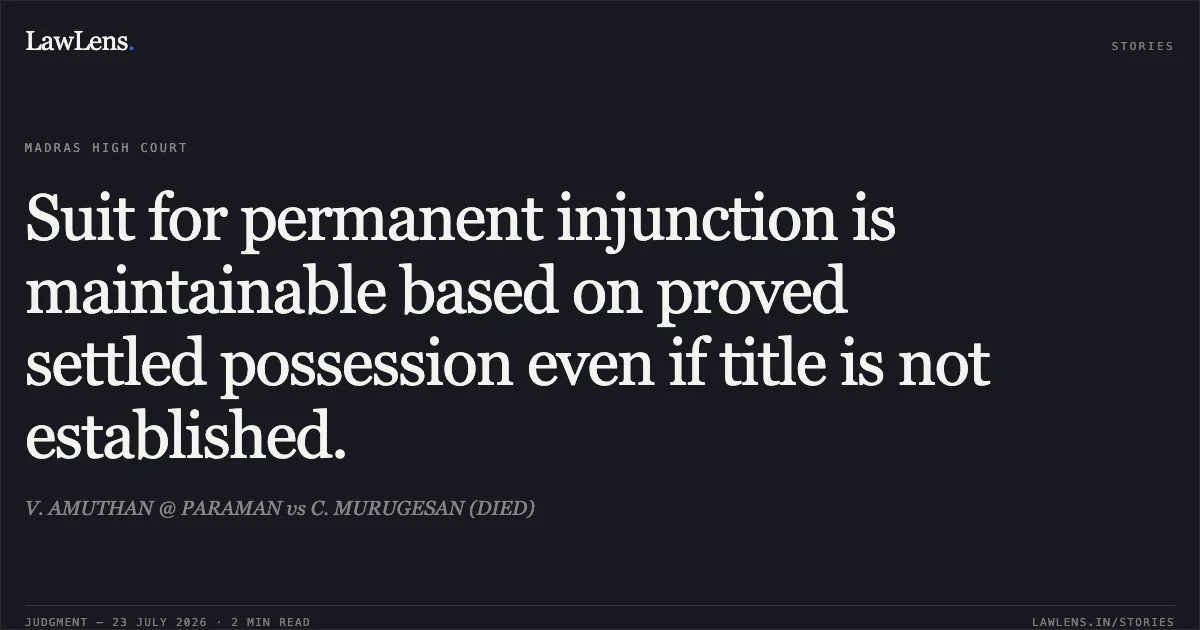
The High Court answered the substantial question of law in favor of the Appellant, holding that established possession must be protected against interference even if title is not perfectly proved.
The Court set aside the judgment of the First Appellate Court (A.S.No.83 of 2011) and restored the Trial Court's decree (O.S.No.160 of 2004) granting permanent injunction. The appeal was allowed with no costs.
Source reference: p.27Acts & Sections Cited
1 provisions across 1 statute referred to in this judgment. Each provision opens on LawLens.
Code of Civil Procedure, 19081
Original Court PDF
V. AMUTHAN @ PARAMANvsC. MURUGESAN (DIED)
Click to open original judgment
Original judgment, available to read, download and summarize on LawLens.in


