Facts
The Appellant (plaintiff) filed a civil suit for permanent injunction against Respondent No. 1, claiming to be the owner and in peaceful possession of 0.41 hectares of land in Village Achanakpur.
Source reference: para. 2He claimed title through a registered sale deed dated 22.07.2008 executed by one Gangaram Patel.
Source reference: para. 2Respondent No. 1 (defendant) contested the suit, asserting that the land was joint family property and that Gangaram (her son) had no exclusive right to sell the entire holding.
Source reference: para. 3The Trial Court dismissed the suit on 01.02.2010, finding the plaintiff was not in possession and had failed to seek recovery of possession.
Source reference: para. 4This was affirmed by the First Appellate Court on 12.02.2016, which noted that the plaintiff’s mutation had already been set aside by the SDO in 2009.
Source reference: para. 1, 9Issues
1. Whether a suit for a mere permanent injunction is maintainable when the plaintiff is found to be out of possession and fails to seek the consequential relief of recovery of possession?
Source reference: para. 4, 82. Whether the concurrent findings of fact regarding possession and title give rise to a substantial question of law under Section 100 of the CPC?
Source reference: para. 10, 12Law Applied
The Court applied the proviso to Section 34 of the Specific Relief Act, 1963, which bars a declaration where the plaintiff, being able to seek further relief than a mere declaration of title, omits to do so.
Source reference: para. 4Regarding the scope of second appeals, the Court relied on Section 100 of the Code of Civil Procedure, 1908, emphasizing that interference is restricted to "substantial questions of law".
Source reference: para. 10The Court cited State of Rajasthan v. Shiv Dayal (2019) to clarify that concurrent findings of fact are binding unless proven perverse or based on no evidence.
Source reference: para. 14Furthermore, it relied on the principles in Russi Fisheries Pvt. Ltd. v. Bhavna Seth (2026), established by the Supreme Court, stating that even erroneous findings of fact do not justify interference under Section 100 CPC in the absence of a clear error of law.
Source reference: para. 15Reasoning
The Court observed that the plaintiff essentially admitted during cross-examination that the defendant had been in possession, sowing and harvesting crops for four months prior to the suit.
Source reference: para. 4, 8Because the plaintiff was not in physical possession at the time of filing, a mere suit for permanent injunction was legally untenable without seeking recovery of possession.
Source reference: para. 8Regarding title, the Court noted that the vendor, Gangaram, could only transfer his own share as the property remained joint with his mother (Defendant No. 1), and the plaintiff's mutation entries had already been neutralized by the Sub-Divisional Officer.
Source reference: para. 9The High Court reasoned that since both lower courts had concurrently evaluated the evidence to find the plaintiff lacked exclusive title and possession, these were pure findings of fact.
Source reference: para. 11-12The Appellant failed to demonstrate any perversity or misreading of evidence that would elevate these factual disputes to a substantial question of law.
Source reference: para. 16-17Holding
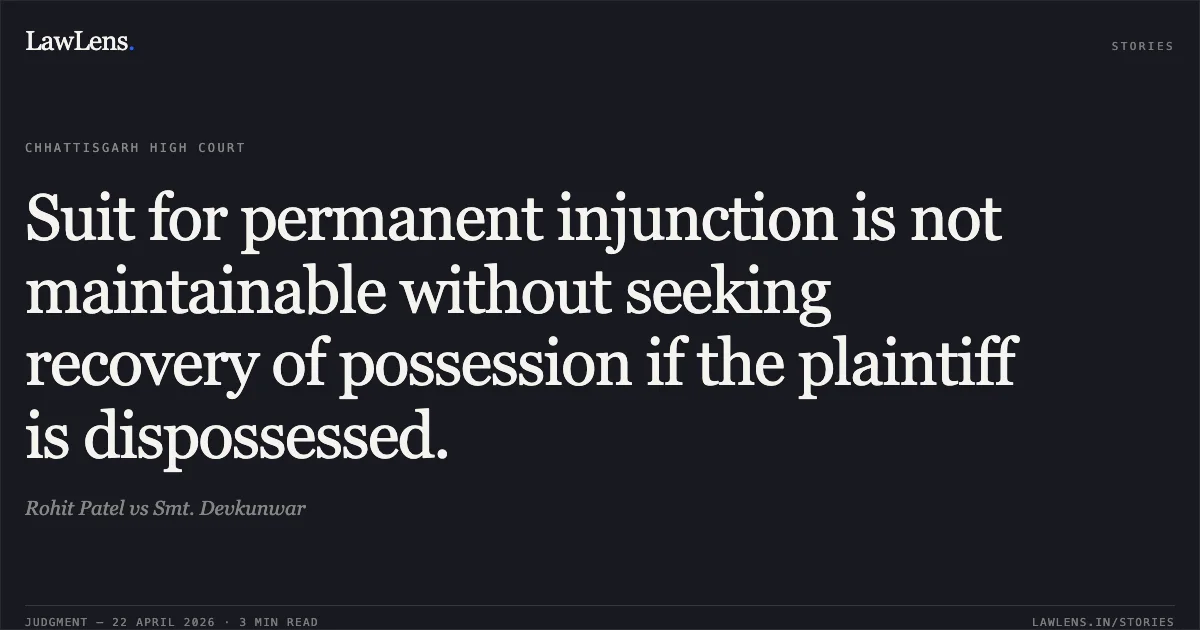
The Court held that a plaintiff out of possession cannot maintain a suit for permanent injunction without seeking the relief of possession.
It further held that concurrent findings of fact, in the absence of perversity, do not constitute a substantial question of law under Section 100 CPC.
Source reference: para. 12, 17The High Court dismissed the Second Appeal and upheld the judgment and decree of the First Appellate Court. All reliefs were denied.
Source reference: para. 18Acts & Sections Cited
3 provisions across 2 statutes referred to in this judgment. Each provision opens on LawLens.
Code of Civil Procedure, 19082
Specific Relief Act, 19631
Original Court PDF
Rohit PatelvsSmt. Devkunwar
Click to open original judgment
Original judgment, available to read, download and summarize on LawLens.in