Facts
The Plaintiff, a civil contractor, filed a Commercial Suit for the recovery of ₹18.58 Crores arising from a 2016 work order.
Source reference: para. 8.1The Plaintiff also sought to declare a "No Claim Certificate" signed in 2021 as void, alleging it was obtained under duress.
Source reference: para. 8.2Although the suit was filed in July 2024 with an application for "urgent" interim relief to restrain the Defendant from selling flats, the Plaintiff did not press for these reliefs for nearly a year.
Source reference: para. 11.4, 18The Defendant filed an application (IA (L) No. 340 of 2025) seeking rejection of the plaint under Order VII Rule 11 of the CPC, contending that the Plaintiff failed to undergo mandatory pre-institution mediation required by Section 12-A of the Commercial Courts Act, 2015.
Source reference: para. 2, 5Issues
1. Whether the suit is liable to be rejected under Order VII Rule 11 of the CPC for non-compliance with the mandatory pre-institution mediation requirement under Section 12-A of the Commercial Courts Act.
Source reference: para. 5, 142. Whether the Plaintiff established a genuine "urgency" sufficient to bypass the Section 12-A mandate.
Source reference: para. 15, 18Law Applied
The Court applied Section 12-A of the Commercial Courts Act, 2015, which mandates pre-institution mediation unless "urgent interim relief" is contemplated.
Source reference: para. 9.3It relied on the Supreme Court’s holding in Patil Automation Pvt. Ltd. v. Rakheja Engineers Pvt. Ltd., which established that Section 12-A is mandatory and its violation warrants rejection of the plaint under Order VII Rule 11.
Source reference: para. 11.2, 20The Court also applied principles from Yamini Manohar v. T.K.D Keerthi and Dhanbad Fuels Pvt. Ltd. v. Union of India, stating that "urgency" must be assessed by the court to ensure the provision is not bypassed through "camouflage" or "guise".
Source reference: para. 16, 19Reasoning
The Court found that the Plaintiff’s plea of urgency was a "product of profound thinking about the possibility of happening" rather than an actual immediate threat.
Source reference: para. 14On examining the timeline, the Court noted that the dispute traces back to 2021—and legal notices were exchanged in 2023—yet the suit was only filed in late 2024, with the interim application left unpressed for months. This "indolent" conduct indicated that the sense of urgency was lost, and the Plaintiff could not unilaterally decide that mediation would be "futile".
Source reference: para. 11.5, 17-18While the suit technically qualified for rejection under the Patil Automation rule, the Court observed that the parties had already attempted informal negotiations and the Plaintiff had performed substantial work under the contract. Therefore, instead of a harsh dismissal involving loss of court fees, the Court determined that the interests of justice favored keeping the suit in abeyance while compelling the parties to engage in the statutory mediation process.
Source reference: para. 10.6, 21Holding
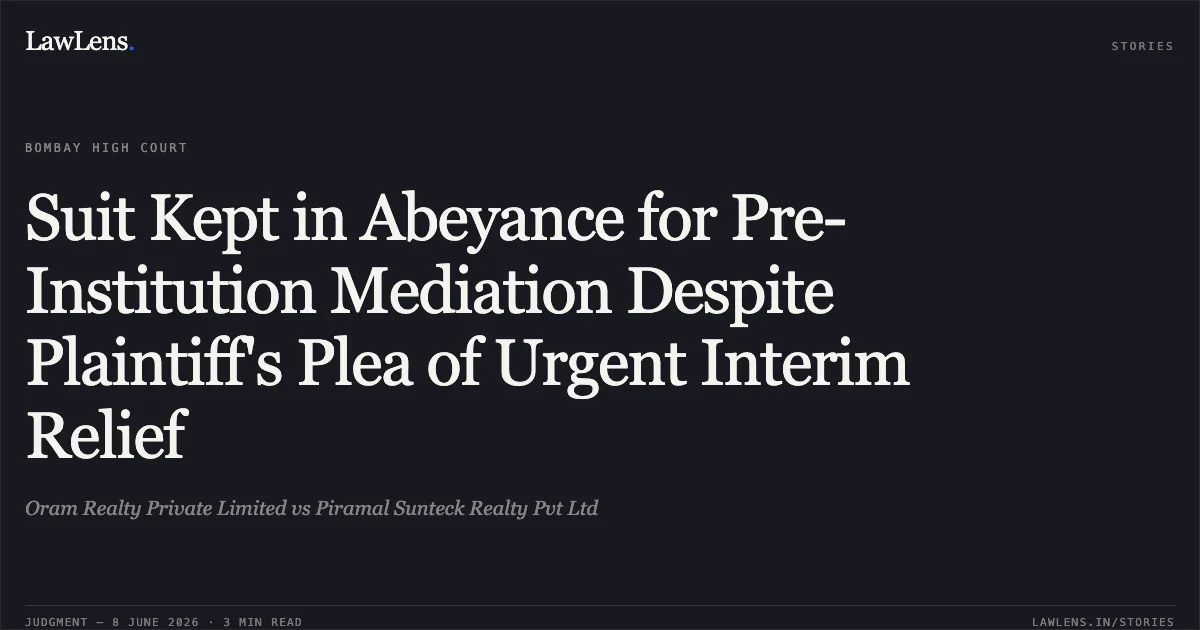
The Court held that the Plaintiff failed to establish genuine urgency to bypass Section 12-A.
However, rather than rejecting the plaint outright, the Court ordered Commercial Suit No. 3 of 2025 and all pending applications to be kept in abeyance. The parties were directed to explore the possibility of mediation as per Section 12-A, with the process to be completed within three months (extendable by two months with consent). IA (L) No. 340 of 2025 was disposed of with these directions.
Source reference: para. 22-25Acts & Sections Cited
3 provisions across 2 statutes referred to in this judgment. Each provision opens on LawLens.
Code of Civil Procedure, 19082
Indian Partnership Act, 19321
Original Court PDF
Oram Realty Private LimitedvsPiramal Sunteck Realty Pvt Ltd
Click to open original judgment
Original judgment, available to read, download and summarize on LawLens.in