Facts
The petitioners (defendants) challenged a trial court order dated 07.03.2025, which rejected their application under Order 7 Rule 11 of the CPC for the rejection of the plaint.
Source reference: para. 1The petitioners argued that the plaintiff’s suit, filed on 22.10.2024, was barred by res judicata as the subject matter was settled in a 2005 decree (Civil Suit No. 25-A/2002), which was upheld by the High Court in 2023 and the Supreme Court in 2024.
Source reference: para. 2They further contended the suit was barred by limitation, having been filed 19 years after the original 2005 decree.
Source reference: para. 3The respondent (plaintiff) asserted the suit was based on fraud and suppression of evidence, and since the 2005 decree was under continuous appeal until 2023, the limitation period had not expired.
Source reference: para. 7Issues
1. Whether the suit is barred by limitation under Order 7 Rule 11(d) of the CPC given that the decree sought to be set aside was passed 19 years prior.
Source reference: para. 3, 52. Whether the suit is hit by the doctrine of res judicata.
Source reference: para. 2, 113. Whether a judgment obtained by alleged fraud can be challenged in a subsequent suit despite the lapse of time.
Source reference: para. 10, 12Law Applied
The court applied Order 7 Rule 11 of the CPC regarding the rejection of a plaint.
Source reference: para. 1It relied on Dahiben v. Arvindbhai Kalyanji Bhanusali (2020) regarding the "right to sue" accruing when a clear threat to a right arises.
Source reference: para. 4For res judicata, it cited Srihari Hanumandas Totala v. Hemant Vithal Kamat (2021), which holds that res judicata is a triable issue that usually cannot be decided under Order 7 Rule 11.
Source reference: para. 11It applied the principle from S.P. Chengalvaraya Naidu v. Jagannath (1994) and Vipin Kumar v. Jaydeep (2025), establishing that a decree obtained by fraud is a nullity and can be challenged at any time, even in collateral proceedings.
Source reference: para. 10, 12Reasoning
The Court observed that while the original decree was passed in 2005, it remained sub-judice in appeal until the Supreme Court's dismissal in 2023; thus, limitation arguably did not run until the finality of that litigation.
Source reference: para. 8-9The Court reasoned that because the plaintiff alleged the prior decree was obtained via fraud and non-disclosure of material documents, the suit fell under the "nullity" exception where standard limitation periods may not strictly apply at the preliminary stage.
Source reference: para. 10, 12Regarding res judicata, the Court found that since the current plaintiff is a legal representative of a former defendant and is seeking a declaration of nullity based on fraud—rather than re-litigating the same reliefs—the issue requires a full trial and consideration of evidence, making it inappropriate for rejection under Order 7 Rule 11.
Source reference: para. 11, 13Holding
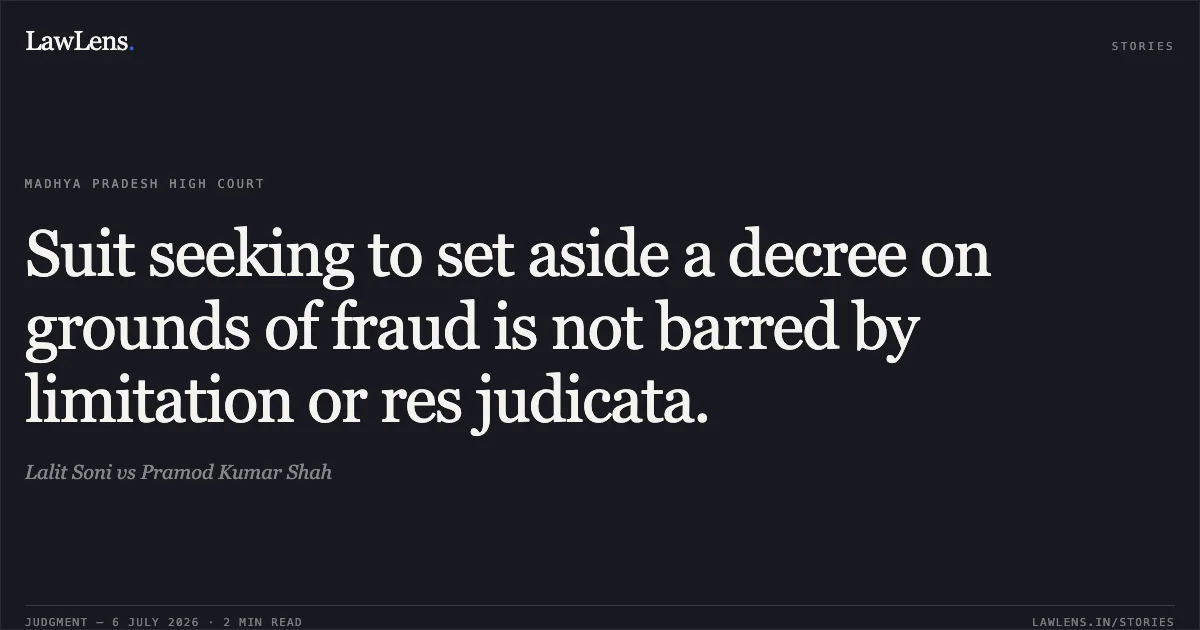
The Court held that allegations of fraud in procuring a decree render the decree a nullity and constitute a triable issue that cannot be summarily dismissed at the threshold.
The High Court dismissed the civil revision and upheld the trial court's refusal to reject the plaint, while granting petitioners liberty to raise legal objections during the trial.
Source reference: para. 13-14Acts & Sections Cited
1 provisions across 1 statute referred to in this judgment. Each provision opens on LawLens.
Code of Civil Procedure, 19081
Original Court PDF
Lalit SonivsPramod Kumar Shah
Click to open original judgment
Original judgment, available to read, download and summarize on LawLens.in