01Facts
The plaintiff filed a suit for specific performance of a Memorandum of Understanding (MOU) dated 15.08.2010, which envisaged a settlement regarding the management and shareholding of Kumudam Publications Private Limited (KPPL) and its affiliates.
¶ 1-2The MOU stipulated the transfer of 33.40% shares from the defendants to the plaintiff at a price to be based on professional valuations and subsequent mutual agreement.
¶ 6, 31Following the suit's designation as a commercial dispute, the 2nd Defendant (Applicant) filed an application under Order XIII-A of the CPC for summary judgment, seeking dismissal of the claims for specific performance and mandatory injunction (tower removal).
¶ 4-5Simple steps toward implementation, such as appointing statutory auditors and moving a broadcasting tower, occurred after the MOU, but no "Final Settlement Agreement" was executed.
¶ 20, 35, 4502Issues
i.1. Whether the plaintiff has "no real prospect of succeeding" on the claim for specific performance, thereby justifying a summary judgment under Order XIII-A.
¶ 27, 30ii.2. Whether the MOU is merely an unenforceable "agreement to agree" due to the lack of a fixed price and the requirement for a future final contract.
¶ 6, 36iii.3. Whether Section 9 of the Sale of Goods Act, 1930, can be applied to an agreement for the sale of shares to determine a "reasonable price" when the parties fail to agree.
¶ 12-14, 3703Law Applied
Order XIII-A, Rules 3 and 6 of the CPC (as amended by the Commercial Courts Act, 2015), which permits summary judgment only if a party has no "real prospect" of success and there is no other compelling reason for trial.
¶ 28-30Principles from Reliance Eminent Trading v. DDA (2026) and Godaddy.com LLC v. Puravankara Projects Ltd (2022) regarding the avoidance of "mini-trials" during summary proceedings.
¶ 29-30Section 4 and Section 9 of the Sale of Goods Act, 1930, defining "goods" to include shares and allowing for the payment of a "reasonable price" where a contract fails to determine price.
¶ 37-38, 39-40Section 12 of the Specific Relief Act, 1963, regarding part performance of contracts.
¶ 15, 47Provisions in the judgment · 5 · Linked ones open on LawLens
Sale of Goods Act, 1930 Section 2Section 4Section 9Section 8
Specific Relief Act, 1963 Section 12
04Reasoning
The Court rejected the Applicant’s argument that the MOU was an unenforceable "agreement to agree." It observed that while the MOU contemplated a "Final Settlement Agreement," several obligations—such as the withdrawal of criminal complaints and the appointment of joint auditors—were immediate and binding.
¶ 44-46Regarding the lack of a fixed price for shares, the Court reasoned that Section 9(2) of the Sale of Goods Act might allow the Court to determine a "reasonable price," and this possibility cannot be foreclosed at a summary stage.
¶ 41, 43The Court noted that the Applicant’s defense of "duress/coercion" in executing the MOU is a factual dispute that necessitates oral evidence.
¶ 50The fact that parties took steps toward implementation (e.g., removing the tower and corresponding with the Department of Company Affairs) suggested the MOU was acted upon beyond its initial 60-day window.
¶ 45Thus, the prospect of success was deemed "real" and not "fanciful".
¶ 5005Holding
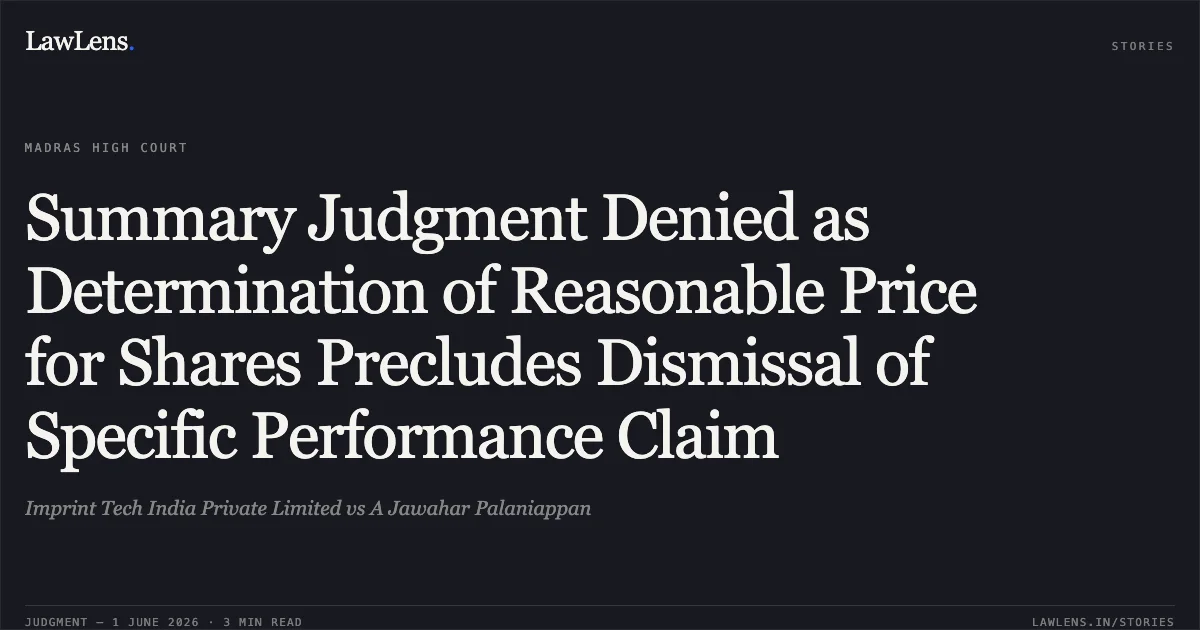
The High Court dismissed the application for summary judgment.
¶ 50It held that the Applicant failed to establish that the plaintiff had no real prospect of success, as the applicability of Section 9 of the Sale of Goods Act and the nature of the MOU as a concluded contract are triable issues.
¶ 43, 50The Court found that the presence of factual allegations regarding the absence of free consent (duress) and the partial implementation of the MOU required a full trial with oral evidence.
¶ 50All parties were directed to facilitate an/the expeditious adjudication of the main suit.
¶ 50Original Court PDF
Imprint Tech India Private LimitedvsA Jawahar Palaniappan
Click to open original judgment
Original judgment, available to read, download and summarize on LawLens.in