Facts
The petitioners are facing trial for murder under Section 302 of the IPC in S.T.No.61/2021
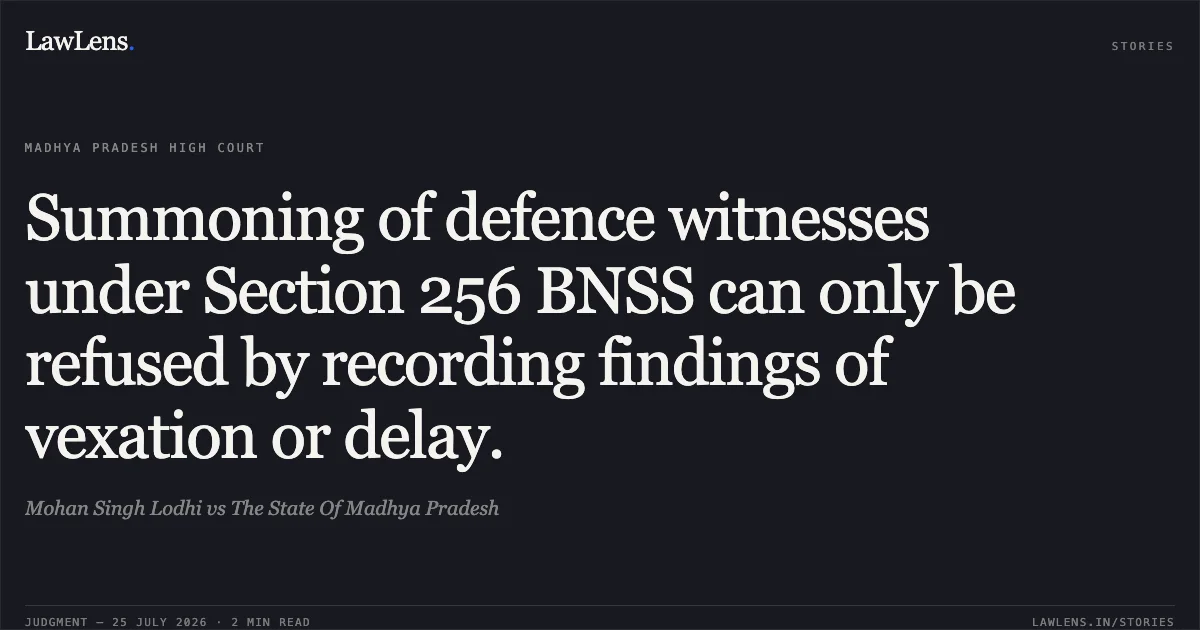
Source reference: para 2Following the conclusion of prosecution evidence and the recording of accused statements under Section 351 of the Bharatiya Nagarik Suraksha Sanhita (BNSS), the petitioners moved an application under Section 256 of the BNSS seeking to summon 24 defence witnesses
Source reference: para 2On 13.01.2026, the Second Additional Sessions Judge, Ganj Basoda, partly rejected the application, limiting the number of witnesses to one per fact to be established
Source reference: para 2, 11The petitioners challenged this order via a criminal revision
Source reference: para 1Issues
1. Whether the Trial Court can selectively restrict the number of defence witnesses under Section 256 of the BNSS without recording a finding of vexation or delay.
Source reference: para 7, 112. Whether the partial rejection of the application for summoning witnesses violates the accused’s right to a fair trial under Article 21 of the Constitution.
Source reference: para 9, 10Law Applied
The court applied Section 256 of the BNSS (corresponding to Section 243(2) of the Cr.P.C.), which mandates that a Judge shall issue process for summoning witnesses unless the application is refused for reasons to be recorded on grounds of vexation, delay, or defeating the ends of justice
Source reference: para 6, 7The court relied on the precedent of T. Nagappa v. Y.R. Muralidhar (2008) 5 SCC 633, which establishes that the right to adduce evidence is part of the fundamental right to a fair trial under Article 21 of the Constitution and that the court should not ordinarily interfere with the accused's discretion in proving their defence unless the prayer is bona fide
Source reference: para 8, 9, 10Reasoning
The High Court examined the Trial Court’s reasoning and found that the lower court had exceeded its jurisdiction by exercising discretion to "select" witnesses based on perceived sufficiency (limiting evidence to one witness per fact)
Source reference: para 11Under Section 256 of the BNSS, the Trial Court’s power to refuse a process is strictly contingent upon a written finding that the application is intended for "vexation or delay" or to "defeat the ends of justice"
Source reference: para 7, 10The High Court noted that the Trial Court failed to record any such finding
Source reference: para 11By restricting the defence evidence, the Trial Court effectively denied the accused a fair opportunity to rebut the prosecution’s case and prove their innocence
Source reference: para 10, 11Holding
The High Court held that the partial rejection of the application was not in accordance with the law because the mandatory statutory conditions for refusal were not met
The court allowed the criminal revision and set aside the impugned order dated 13.01.2026 regarding the rejection of the witness application. The application under Section 256 of the BNSS was allowed in full, and the Trial Court was directed to proceed with summoning the listed witnesses
Source reference: para 12Acts & Sections Cited
8 provisions across 3 statutes referred to in this judgment. Each provision opens on LawLens.
Bharatiya Nagarik Suraksha Sanhita, 20235
Indian Penal Code, 18601
Code of Criminal Procedure, 19732
Original Court PDF
Mohan Singh LodhivsThe State Of Madhya Pradesh
Click to open original judgment
Original judgment, available to read, download and summarize on LawLens.in