Facts
The applicant sought anticipatory bail under Section 482 of the BNSS in connection with Crime No. 43/2019, registered for offences under Sections 409 and 120(B) of the IPC and provisions of the Prevention of Corruption Act, concerning alleged irregularities in Kapildhara Wells under the MGNREGA scheme and an amount of ₹7,33,471.
Source reference: para. 1–2After the charge-sheet was filed, the trial court issued summons and subsequently a bailable warrant.
Source reference: para. 2–3The applicant apprehended arrest upon appearing before the trial court.
Source reference: para. 2–3He relied on bail orders granted to co-accused in connected matters and submitted that investigation was complete and that he had been granted bail in other cases arising from the same transaction.
Source reference: para. 2The State opposed the application, arguing that summons and a bailable warrant did not establish a reasonable apprehension of arrest.
Source reference: para. 3Issues
1. Whether the applicant had a reasonable apprehension of arrest, notwithstanding that the trial court had issued summons and a bailable warrant after the charge-sheet was filed.
Source reference: para. 3, 62. Whether, in the circumstances of the case, the applicant was entitled to anticipatory bail under Section 482 of the BNSS.
Source reference: para. 6–8Law Applied
Section 482 of the BNSS provides for anticipatory bail where an applicant has reason to believe that they may be arrested on an accusation of a non-bailable offence.
Source reference: para. 1, 6The Court considered Asheesh Kumar v. State of U.P., which held, in the context of a complaint case, that summons or a bailable warrant ordinarily does not establish an apprehension of arrest and detention; it also noted the stated exception for exceptional circumstances.
Source reference: para. 5The Court distinguished Asheesh Kumar and HDFC Bank Ltd. v. J.J. Mannan because they arose from private complaints, and treated Srikant Upadhyay v. State of Bihar as factually distinguishable.
Source reference: para. 6The Court also noted that Section 409 of the IPC is non-bailable and punishable with life imprisonment.
Source reference: para. 6Where investigation is complete and custodial interrogation is not required, those circumstances may support pre-arrest bail, subject to the facts of the case.
Source reference: para. 7Reasoning
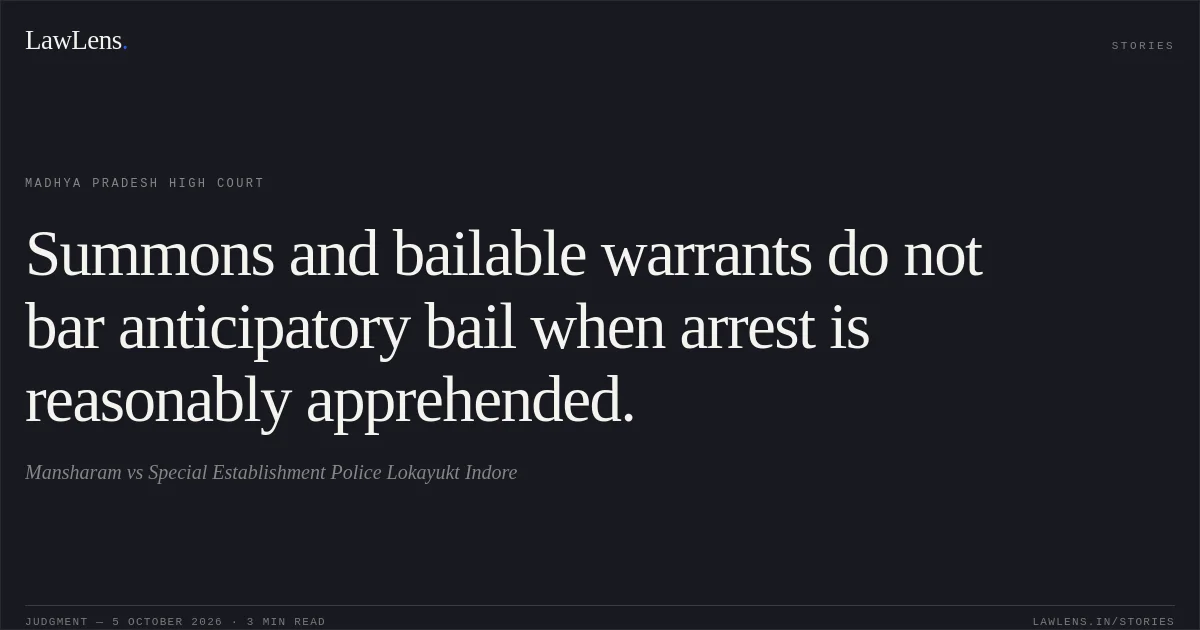
The Court held that the authorities concerning summons and bailable warrants in complaint cases did not determine the application, which arose from a police investigation by the Special Police Establishment and a charge-sheet alleging, among other offences, Section 409 IPC.
Source reference: para. 6Although only summons and a bailable warrant had issued, the Court found a reasonable apprehension of arrest on the facts, having regard to the seriousness of the alleged offence and the anticipatory bail granted to co-accused Baburam in a related matter.
Source reference: para. 6The investigation was complete, the charge-sheet had been filed, and custodial interrogation was not required; the applicant had also obtained bail or anticipatory bail in other cases arising from the same transaction.
Source reference: para. 7These circumstances supported granting relief.
Source reference: para. 7Holding
The Court allowed the application and directed that, in the event of arrest, the applicant be released on bail upon furnishing a personal bond of ₹50,000 with one solvent surety in the like amount.
The order was made subject to conditions requiring cooperation with interrogation and trial, non-interference with witnesses, no commission of a similar offence, avoidance of unnecessary adjournments, and prior permission before leaving India; breach would automatically terminate the order’s effect.
Source reference: para. 9–10Acts & Sections Cited
7 provisions across 4 statutes referred to in this judgment. Each provision opens on LawLens.
Bharatiya Nagarik Suraksha Sanhita, 20231
Indian Penal Code, 18601
Prevention of Corruption Act, 19882
Code of Criminal Procedure, 19733
Original Court PDF
MansharamvsSpecial Establishment Police Lokayukt Indore
Click to open original judgment
Original judgment, available to read, download and summarize on LawLens.in