Facts
The dispute concerns ancestral agricultural lands in Village Nawagarh and Madanpur
Source reference: para. 2(a)The plaintiffs (three daughters of late Sahban Khan) filed a suit for declaration of title, 1/5th share, partition, and permanent injunction against the defendants (the LRs of Sahban Khan's two sons, Nawab Khan and Arman Khan)
Source reference: para. 2(a)-(b)The plaintiffs alleged the suit property was joint family property, while Defendant No. 1 claimed exclusive ownership over "Schedule B" property and asserted that a prior partition occurred in 1992
Source reference: para. 2(b), 3The Trial Court partly decreed the suit, awarding a 1/9th share to each daughter and a 1/3rd share to each son's branch
Source reference: para. 5The First Appellate Court dismissed the defendants' appeal, confirming the Trial Court's judgment
Source reference: para. 6The legal representatives of Defendant No. 1 subsequently filed this Second Appeal under Section 100 of the CPC
Source reference: para. 1Issues
Whether the lower courts correctly applied the principles of Sunni Hanafi law in the apportionment of shares between male and female heirs
Source reference: para. 5, 9Whether the concurrent findings of fact regarding the joint nature of the property and the absence of a prior partition warrant interference in a second appeal under Section 100 of the CPC
Source reference: para. 13, 18Law Applied
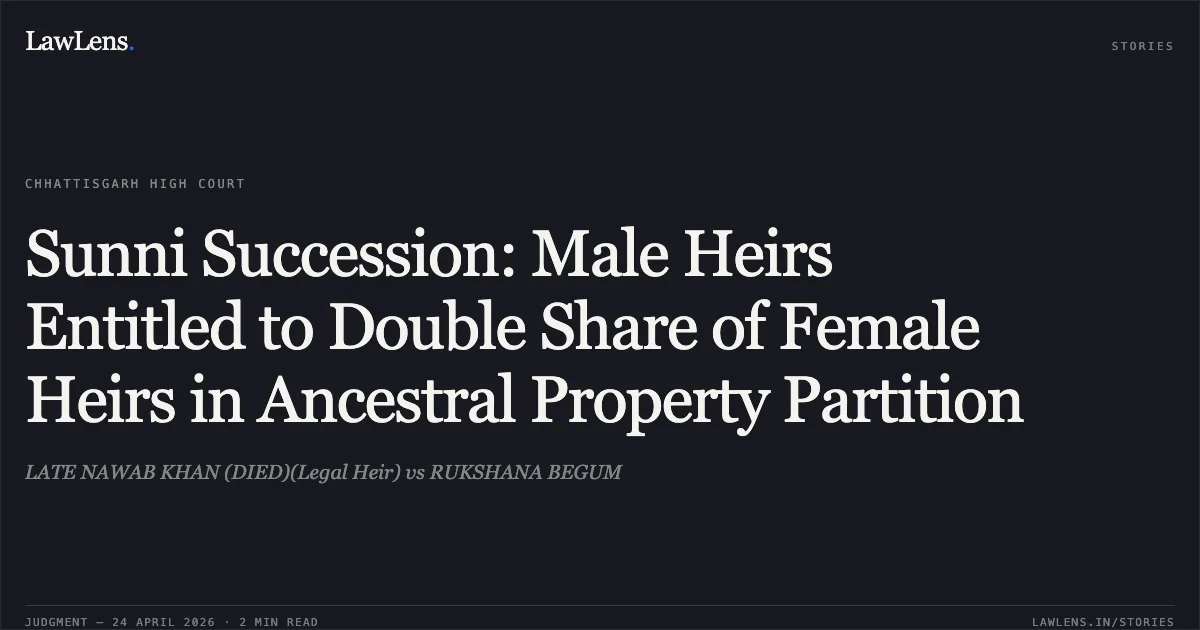
Sunni Hanafi school of Muslim Law, which mandates that where there are both male and female heirs, a male heir receives a share equal to twice that of a female heir (residuary status)
Source reference: para. 5, 9Section 100 of the Code of Civil Procedure (CPC), which restricts the High Court’s jurisdiction in second appeals to "substantial questions of law"
Source reference: para. 1, 13Bholaram v. Ammerchand (1981) and Russi Fisheries Pvt. Ltd. v. Bhavna Seth (2026), establishing that concurrent findings of fact, even if erroneous, cannot be disturbed unless they are found to be perverse or based on no evidence
Source reference: para. 12, 15, 17Reasoning
Since the deceased left two sons and three daughters, the estate was divided into seven units (two units for each son and one for each daughter). Consequently, the sons collectively receive 2/3 (split as 1/3 each), and the daughters effectively receive 1/3 (split as 1/9 each)
Source reference: para. 9, 11The court found this calculation strictly consistent with the "double share for males" principle of Sunni law
Source reference: para. 9Regarding the procedural challenge, the Court observed that the appellants’ arguments essentially sought a re-appreciation of oral and documentary evidence—specifically the claim of prior sale and mutation—which is impermissible under Section 100 CPC
Source reference: para. 7, 15The court noted that because the defendants attempted to unilaterally alienate the property, the grant of a permanent injunction was a necessary legal safeguard for the co-sharers
Source reference: para. 10Holding
The High Court answered both issues in the negative against the appellants, holding that the lower courts' determination of shares was legally sound and that no substantial question of law arose
The Second Appeal was dismissed, and the judgment and decree of the lower courts were maintained
Source reference: para. 19Acts & Sections Cited
1 provisions across 1 statute referred to in this judgment. Each provision opens on LawLens.
Code of Civil Procedure, 19081
Original Court PDF
LATE NAWAB KHAN (DIED)(Legal Heir)vsRUKSHANA BEGUM
Click to open original judgment
Original judgment, available to read, download and summarize on LawLens.in