Facts
The petitioners, a 100% Export Oriented Unit (EOU), filed three rebate claims in 2011 for export of goods under Rule 18 of the Central Excise Rules, 2002.
Source reference: para. 3These claims were rejected by the Adjudicating Authority and subsequently by the Appellate Authority on 28.02.2013, holding that EOUs cannot claim rebates on finished products.
Source reference: para. 3The petitioners filed a Revision Application on 22.04.2013.
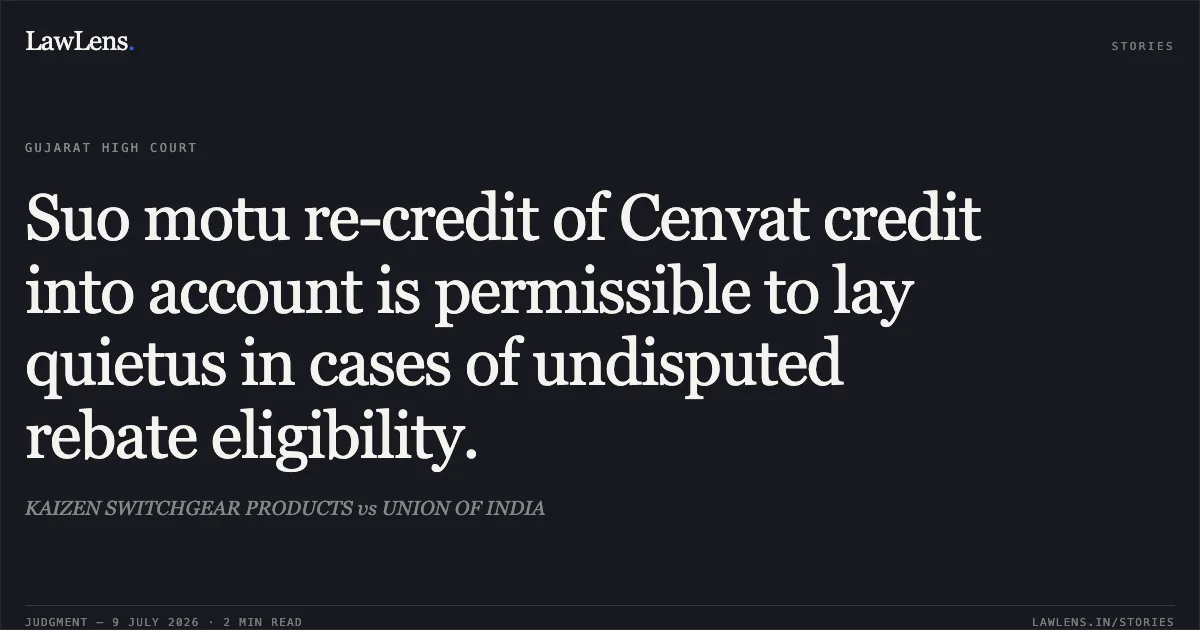
Source reference: para. 4Due to a five-year delay in deciding the Revision Application, and after sending eleven reminders, the petitioners suo motu re-credited the disputed amount to their Cenvat Account in May 2018.
Source reference: paras. 5, 8The Revenue subsequently rejected the Revision Application and issued a communication dated 27.08.2018 demanding recovery of the suo motu credit.
Source reference: paras. 2, 5Issues
1. Whether the action of the petitioners in suo motu re-crediting the Cenvat account during the pendency of a Revision Application is legally sustainable despite the absence of express statutory provisions.
Source reference: para. 12Law Applied
The court examined Rule 18 of the Central Excise Rules, 2002, and Section 11B of the Central Excise Act, 1944, regarding rebate claims and refund procedures.
Source reference: para. 3ICMC Corporation Limited v. CESTAT, Chennai (2014), which suggested that certain account entry reversals (technical adjustments) might not strictly fall under the rigorous refund procedures of Section 11B if there is no actual "outflow of funds" from the assessee.
Source reference: para. 11Reasoning
The Court noted that there is no specific statutory provision allowing an assessee to suo motu re-credit amounts to a Cenvat Account without prior authorization.
Source reference: para. 10However, the Court observed the "peculiarity of the facts," specifically that the petitioners were a 100% EOU whose entitlement to the credit was not fundamentally disputed by the Revenue.
Source reference: paras. 8, 12The Court found that the petitioners’ action was driven by frustration due to the Revisionary Authority’s five-year delay in adjudicating the matter despite numerous reminders.
Source reference: paras. 8, 10While the Court distinguished the ICMC Corporation precedent because the petitioners had not obtained a prior tribunal order, it determined that in the interest of "laying quietus to the litigation" and "salvaging the situation," the technical lapse of suo motu entry should be overlooked given the undisputed merit of the underlying rebate claim.
Source reference: para. 12Holding
The Court "approved" the action of the petitioner in taking suo motu credit under these specific circumstances but explicitly clarified that this order is based on "peculiar facts" and shall not be treated as a legal precedent for future cases.
The High Court allowed the writ petition and quashed the recovery communication dated 27.08.2018. Amount already refunded to the petitioner under interim orders was allowed to be retained.
Source reference: para. 13; para. 1Acts & Sections Cited
1 provisions across 1 statute referred to in this judgment. Each provision opens on LawLens.
Central Excise Act, 19441
Original Court PDF
KAIZEN SWITCHGEAR PRODUCTSvsUNION OF INDIA
Click to open original judgment
Original judgment, available to read, download and summarize on LawLens.in