01Facts
Shankar Mishra was recorded as the Bhumiswami of 0.805 hectares comprised in Khasra No. 906/18, Village Kailod Kartal, Indore.
¶ 3The petitioner purchased the land through a registered sale deed dated 23 August 2007, following which his name was mutated as Bhumiswami in the revenue records on 13 December 2007.
¶ 3In 2015, the Collector initiated proceedings alleging that the land was Chargaah/service land and that the petitioner had acquired it without obtaining the permission required under Section 165(7-b) of the Madhya Pradesh Land Revenue Code, 1959.
¶ 3Notices allegedly issued to the petitioner were not served, and proceedings proceeded through newspaper publication.
¶ 4The Collector thereafter passed an ex parte order dated 8 February 2016 cancelling the petitioner’s mutation and directing that the land be recorded as Government land.
¶ 4The petitioner claimed that he first became aware of the order in March 2018 and challenged it under Article 226 of the Constitution, seeking quashing of the order and removal of the remarks regarding non-transferability from the revenue records.
¶ 402Issues
i.Whether the Collector could exercise suo motu revisional or corrective jurisdiction after approximately ten years from the mutation and related revenue proceedings, notwithstanding the absence of an express limitation period?
¶ 5–7, 13ii.Whether the impugned order was invalid for violation of natural justice when the petitioner was not effectively served and was proceeded against ex parte?
¶ 12iii.Whether the existence of an alternative statutory remedy barred the High Court from exercising jurisdiction under Article 226 of the Constitution in the circumstances of the case?
¶ 4, 9, 12–1303Law Applied
Section 165(7-b) of the Madhya Pradesh Land Revenue Code prohibits a person acquiring Bhumiswami rights in land held from the State or otherwise covered by the provision from transferring it without prior permission of a Revenue Officer not below the rank of Collector, for reasons recorded in writing.
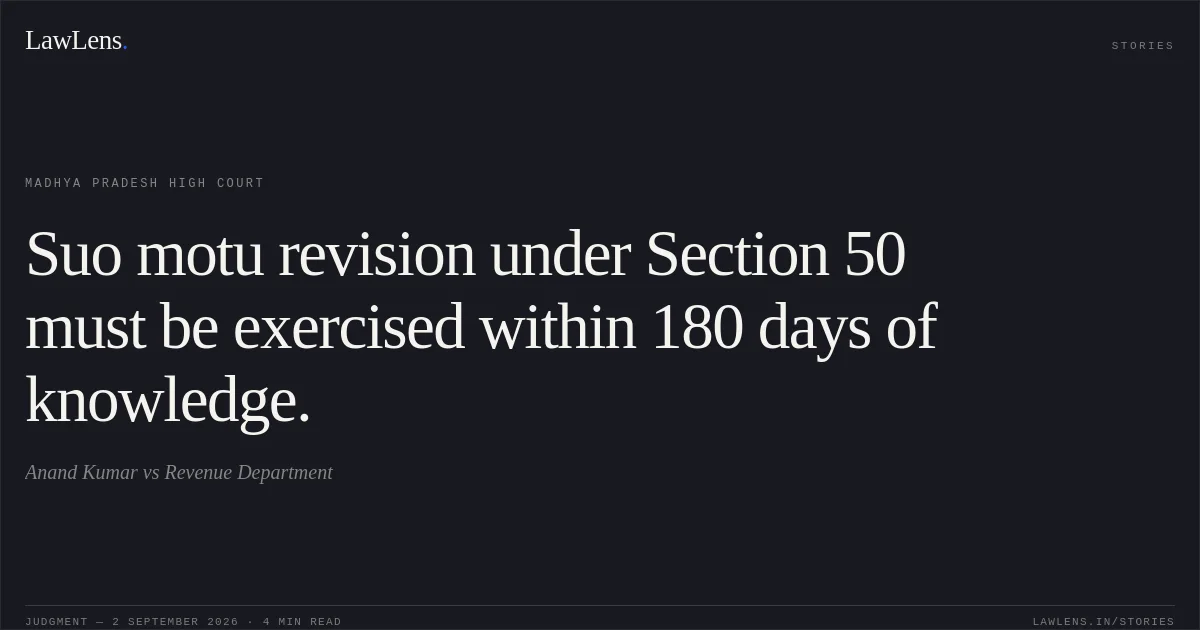
¶ 11Section 50 confers revisional jurisdiction upon the appropriate revenue authorities, but such jurisdiction must be exercised within a reasonable period; relying on Ranveer Singh v. State of Madhya Pradesh, 2010(4) MPLJ 178, the Court held that 180 days from the date of knowledge of the alleged illegality, impropriety or irregularity is the reasonable period for exercising suo motu revisional power.
¶ 6The same principle was applied in Revenue Department v. Chaitanya Realcon Pvt. Ltd., W.A. No. 23 of 2016, decided on 22 April 2017, where delayed suo motu action was set aside.
¶ 7Section 50(5) also requires notice and an opportunity of hearing before an order is varied or reversed.
¶ 11Under Whirlpool Corporation v. Registrar of Trade Marks, (1998) 8 SCC 1, an alternative remedy does not ordinarily bar writ jurisdiction where there is violation of natural justice, lack of jurisdiction, or infringement of fundamental rights.
¶ 9Although Mulayam Singh v. Budhwa Chamar, 2002(2) MPLJ 480, recognises that a transfer contrary to Section 165(7-b) is void, and Murari Lal v. State of M.P., 1994 MPLJ 378, permits action within a reasonable time when the illegality comes to the authority’s notice, such power cannot be exercised after an unreasonable delay.
¶ 8, 10Provisions in the judgment · 4 · Linked ones open on LawLens
MP Land Revenue Code 1959 Section 50Section 158Section 165Section 210
04Reasoning
The Court found that the petitioner’s ownership and mutation had been reflected in the revenue records since 2007, with subsequent official acts—including development permission in 2010 and demarcation proceedings in 2014—indicating that the revenue authorities had knowledge of the transaction and the petitioner’s recorded status.
¶ 5 · ¶ 13Applying Ranveer Singh and Chaitanya Realcon, the Court held that the Collector’s action initiated nearly ten years after mutation was beyond the permissible reasonable period for suo motu intervention; the State’s interest in protecting Chargaah or Government land could not justify exercising revisional power after an indefinite delay.
¶ 6 · ¶ 7Independently, the Court held that the proceedings were conducted in breach of natural justice because the notices were not effectively served and the petitioner was denied a meaningful opportunity to defend himself before the ex parte order was passed.
¶ 12In view of the alleged lack of jurisdiction, excessive delay and violation of natural justice, the alternative remedy objection did not bar the writ petition under the exceptions recognised in Whirlpool.
¶ 9 · ¶ 1305Holding
The High Court allowed the writ petition and quashed the Collector’s order dated 8 February 2016 cancelling the petitioner’s mutation and directing that the land be recorded as Government land.
¶ 13It further directed the concerned revenue authorities to remove the remarks regarding non-transferability from the relevant P-II and B-I revenue records concerning Khasra No. 906/18, Village Kailod Kartal, and to update the records within fifteen days of receiving the order.
¶ 13The Court consequently held that the delayed and ex parte exercise of authority was arbitrary, contrary to natural justice and inconsistent with the settled limitation principle governing suo motu revisional powers.
¶ 6, 12–14Original Court PDF
Anand KumarvsRevenue Department
Click to open original judgment
Original judgment, available to read, download and summarize on LawLens.in