Facts
The petitioner, a police constable appointed on 30 June 1998, was promoted to Head Constable and subsequently to Assistant Sub-Inspector.
Source reference: p.2While posted at Police Station Manasa, Neemuch, he intercepted a vehicle on 9 February 2012 and recovered 8.040 kilograms of opium after following the procedure under the NDPS Act; a criminal case was registered and a charge-sheet was filed.
Source reference: p.2A complaint alleging that the petitioner had illegally taken ₹21,00,000 from the complainant’s house was found false in an inquiry conducted by the Additional Superintendent of Police.
Source reference: p.2Nevertheless, a departmental charge-sheet was issued, and after a joint inquiry the Superintendent of Police, Neemuch, imposed the punishment of stoppage of one increment with cumulative effect for one year on 31 October 2014.
Source reference: pp.3, 13–14Thereafter, the matter was examined by the Additional Director General of Police (Vigilance), who considered the punishment inadequate and directed initiation of proceedings under Regulation 270 of the M.P. Police Regulations.
Source reference: p.3Pursuant to that direction, the Deputy Inspector General of Police, Ratlam Range, issued a show-cause notice and, after considering the petitioner’s reply, enhanced the punishment to dismissal from service by order dated 30 March 2015.
Source reference: pp.3, 13–15Issues
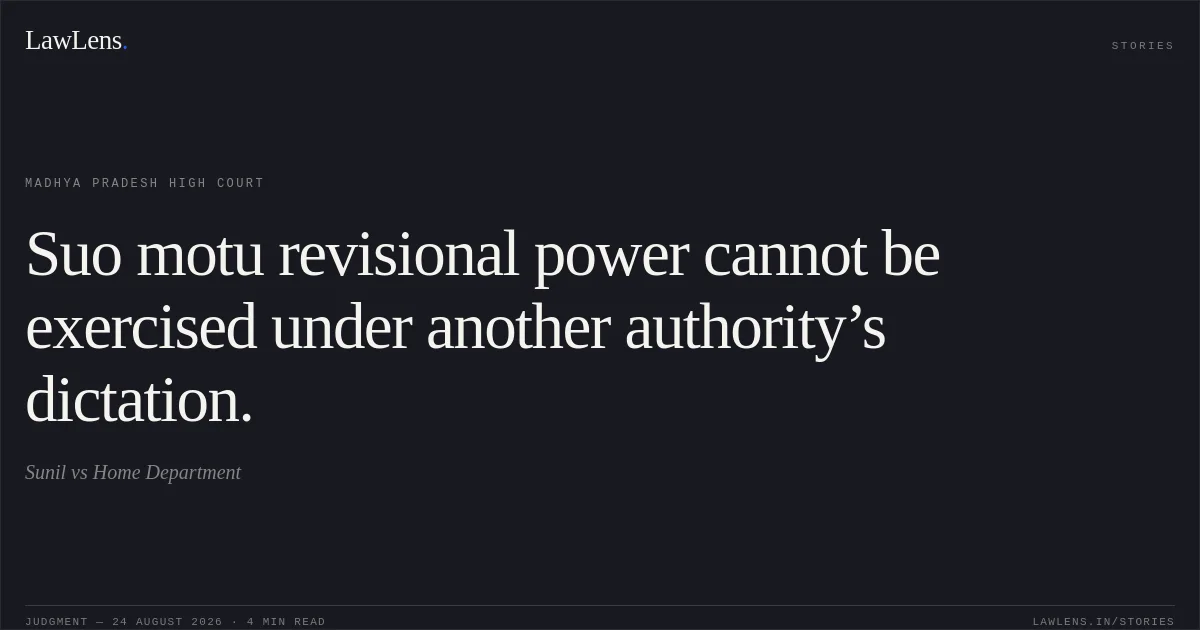
Whether the Deputy Inspector General of Police could validly exercise suo motu revisional power under Regulation 270 of the M.P. Police Regulations pursuant to the direction or dictate of the Additional Director General of Police (Vigilance) and the Inspector General of Police, rather than upon his own independent satisfaction?
Source reference: pp.13–17Whether the issuance of a show-cause notice and consideration of the petitioner’s reply could cure an invalid assumption or exercise of revisional jurisdiction?
Source reference: pp.17–18Whether the consequential appellate orders dated 31 August 2015 and 6 January 2016 could independently sustain the dismissal once the revisional order was found jurisdictionally defective?
Source reference: p.18Law Applied
Regulation 270(1) of the M.P. Police Regulations permits every order of punishment or exoneration to be revised suo motu by an authority superior to the authority that passed the order; this power must be exercised by the competent authority independently and upon its own satisfaction.
Source reference: p.14Regulation 270(4) permits the revising authority, for recorded reasons, to remit, vary or enhance punishment, but requires notice and an opportunity of hearing before any adverse variation or reversal.
Source reference: p.18A statutory or quasi-judicial authority cannot exercise its discretion under the dictation of an authority not vested with the relevant statutory power.
Source reference: p.16The Court relied on Anil Soni v. State of Madhya Pradesh, 2008 (3) MPLJ 378, and Vikram Singh Rana v. State of Madhya Pradesh, 2006 (2) MPLJ 563, concerning the competent superior authority’s exercise of suo motu revisional power, and Suresh Pal Singh v. State of Madhya Pradesh, 2012 (4) MPLJ 415, concerning impermissible review by different authorities in the same matter.
Source reference: p.16Reasoning
The DIG was hierarchically superior to the Superintendent of Police and was therefore the competent authority under Regulation 270.
Source reference: pp.14–15However, the record and the impugned order showed that the proceedings were initiated after the Additional DGP (Vigilance) examined the matter and directions were issued by higher authorities to invoke Regulation 270.
Source reference: pp.14–15The Court distinguished between merely placing material before the competent authority—which may be permissible—and directing that authority to exercise its statutory revisional jurisdiction—which impermissibly controls its discretion.
Source reference: p.15Because the DIG acted pursuant to such direction instead of independently deciding whether revision should be undertaken, the statutory requirement of a genuine suo motu exercise was not satisfied.
Source reference: pp.16–17The subsequent show-cause notice and hearing complied only with the procedural requirement under Regulation 270(4); they could not cure the fundamental defect in the assumption of jurisdiction.
Source reference: p.18Since the dismissal order was void in its initiation and exercise, the appellate orders founded upon it could not validate or independently sustain the dismissal.
Source reference: p.18Holding
The Court held that the DIG’s enhancement of punishment from stoppage of one increment with cumulative effect to dismissal was an invalid exercise of revisional jurisdiction under Regulation 270 because it was undertaken pursuant to the direction or initiative of the Additional DGP (Vigilance), rather than independently and suo motu.
The dismissal order dated 30 March 2015 and the consequential appellate orders dated 31 August 2015 and 6 January 2016 were quashed.
Source reference: p.20The petitioner was directed to be reinstated with continuity of service and consequential service benefits admissible under law.
Source reference: p.20The competent authority was directed to determine monetary benefits, including back wages, in accordance with the applicable service rules, within three months of receiving the certified order.
Source reference: p.20The writ petition was allowed without costs.
Source reference: p.20The Court clarified that the original punishment dated 31 October 2014 was not disturbed and remained final.
Source reference: p.19Acts & Sections Cited
3 provisions across 1 statute referred to in this judgment. Linked provisions open on LawLens.
Narcotic Drugs and Psychotropic Substances Act, 19853
Original Court PDF
SunilvsHome Department
Click to open original judgment
Original judgment, available to read, download and summarize on LawLens.in