Facts
The applicant, a qualified medical professional in Unani medicine, was appointed as an Assistant Professor in the Department of Amraz-e-Niswan wa Qabalat (Gynaecology & Obstetrics) at the Government Unani Medical College, Ganderbal.
Source reference: para. 02His appointment was made under the J&K Medical and Dental Education (Appointment on Academic Arrangement Basis) Rules, 2020 (S.O. 364), which stipulates a tenure of six years.
Source reference: para. 03Under Rule 4 of S.O. 364, the retirement age for faculty in Unani Medical Colleges is set at 65 years.
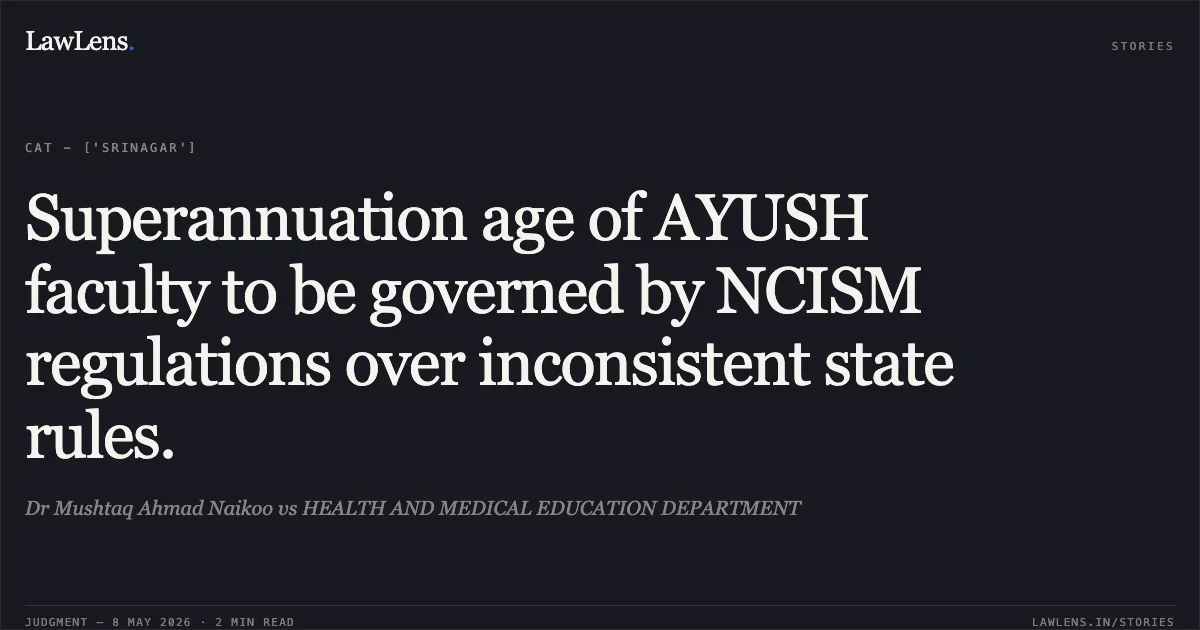
Source reference: para. 04However, the National Commission for Indian System of Medicine (NCISM) issued a notification on 15-01-2026 amending Regulation 16(e) of the MSE-2022, enhancing the superannuation age of teaching faculty to 70 years.
Source reference: para. 05The applicant approached the Tribunal seeking parity with Allopathic Medical College faculty and the implementation of the 70-year retirement age.
Source reference: para. 01Issues
1. Whether the NCISM Notification dated 15-01-2026, enhancing the superannuation age to 70 years, prevails over the age limit of 65 years prescribed under S.O. 364 of the J&K Medical and Dental Education Rules, 2020.
Source reference: para. 01, 052. Whether the applicant is entitled to continue in service until the age of 70 years based on the amended Regulations and judicial precedents.
Source reference: para. 01, 05Law Applied
Rule 4 of the J&K Medical and Dental Education (Appointment on Academic Arrangement Basis) Rules, 2020 (S.O. 364), which prescribes 65 years as the termination age for faculty in Ayurvedic and Unani Medical Colleges.
Source reference: para. 04Regulation 16(e) of the NCISM Minimum Essential Standards Regulations (MSE-2022), as amended on 15-01-2026, which enhanced the superannuation age to 70 years.
Source reference: para. 05Precedent set in North Delhi Municipal Corporation v. Dr. Ram Naresh Sharma and others (AIR 2021 SC 3795), which addresses parity in retirement ages for different categories of medical doctors.
Source reference: para. 05Reasoning
The Tribunal analyzed the conflict between the UT’s specific service rules (S.O. 364) and the central regulatory standards set by the NCISM.
Source reference: no citationThe applicant argued that the NCISM Regulations, being the minimum essential standards for Indian systems of medicine, should prevail over inconsistent state/UT provisions.
Source reference: para. 01The court observed that the petitioner was a "meritorious medical professional" selected via a "transparent and lawful process".
Source reference: para. 02Rather than adjudicating the finality of the age limit immediately, the court focused on the petitioner's prayer for a time-bound administrative review, noting that the respondents did not object to treating the petition as a representation for extension in light of the new NCISM guidelines.
Source reference: para. 06, 08Holding
The Tribunal disposed of the petition by directing the respondents to treat the O.A. as a formal representation on behalf of the applicant.
The respondents are ordered to consider the applicant’s case for extension of service in light of Regulation 16(e) of MSE-2022 and the cited Supreme Court law within six weeks.
Source reference: para. 08As an interim measure, the Tribunal directed that the applicant's current service position shall not be disturbed until a decision is taken on the representation.
Source reference: para. 08The applicant is bound to abide by the final decision taken by the respondents.
Source reference: para. 08Acts & Sections Cited
1 provisions across 1 statute referred to in this judgment. Each provision opens on LawLens.
Administrative Tribunals Act, 19851
Original Court PDF
Dr Mushtaq Ahmad NaikoovsHEALTH AND MEDICAL EDUCATION DEPARTMENT
Click to open original judgment
Original judgment, available to read, download and summarize on LawLens.in