Facts
The appeal was filed by Ram Niwas, who had taken the offending Jeep No. HR-36A-5174 on superdari and claimed to be its subsequent purchaser, although ownership had never been transferred to him in the registration certificate.
Source reference: p.1The vehicle was allegedly involved in a fatal accident on 02.04.1999 due to the rash and negligent driving of respondent-driver Desh Raj, resulting in the death of Dharambir.
Source reference: p.1The Motor Accident Claims Tribunal, Narnaul, awarded compensation of ₹8,68,000 to the claimants and held the driver and Ram Niwas, described as the subsequent owner/superdar, jointly and severally liable.
Source reference: pp.2–3During the criminal proceedings, Ram Niwas obtained custody of the vehicle on superdari after representing himself as its owner, but he did not surrender the vehicle after the Tribunal’s award and continued retaining it for approximately 24 years.
Source reference: pp.4–6Issues
1. Whether a person who is merely a superdar and whose name is not recorded as the registered owner can be held liable to pay the entire compensation awarded in a motor accident claim.
Source reference: pp.3–4, 7–82. Whether a superdar who retains the offending vehicle after an award of compensation is liable to surrender the vehicle, or otherwise account for its value/security, in order to protect the claimants’ lien over the vehicle.
Source reference: pp.4–6, 9–123. Whether the registered owner and the driver remain jointly and severally liable for payment of the awarded compensation.
Source reference: pp.6–7, 14Law Applied
The Court applied the principle that, under the motor accident liability regime, the registered owner—not an unregistered subsequent purchaser or superdar—is ordinarily liable, along with the driver, for the compensation payable to the claimants.
Source reference: pp.3–4, 8–9It relied on the ratio of Naveen Kumar v. Vijay Kumar, Brij Bihari Gupta v. Manmet, and the other authorities cited by the appellant, accepting that a superdar cannot be made liable in place of the registered owner for the entire compensation.
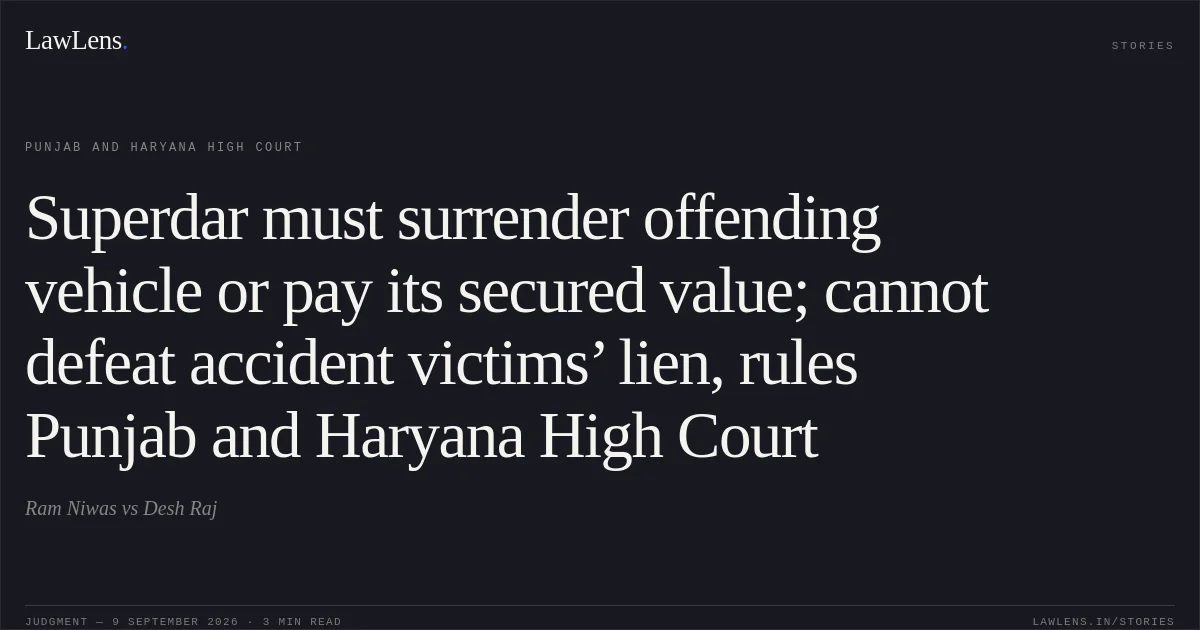
Source reference: pp.3–4, 8–9However, the Court held that custody on superdari carries an obligation to preserve and surrender the vehicle, because the claimants have a lien over it for recovery of the compensation; failure to surrender the vehicle may result in liability limited to the vehicle’s value or the amount secured by the superdari bond.
Source reference: pp.4–5, 9–10Reasoning
Although Ram Niwas was not the registered owner and therefore could not be treated as liable for the entire compensation, he had obtained and retained possession of the offending vehicle under a superdari arrangement.
Source reference: pp.5–6The vehicle was consequently subject to the claimants’ lien as an asset available for recovery of the award.
Source reference: pp.5–6Despite being a party to the claim proceedings and being aware of the 2002 award, Ram Niwas neither surrendered the vehicle nor paid any amount, thereby defeating the claimants’ right to recover against it.
Source reference: pp.5–6, 11–12The Court therefore distinguished between primary liability for the compensation, which remained with the registered owner and driver, and the superdar’s separate liability to the extent of the vehicle’s value or the security furnished under the superdarinama.
Source reference: pp.6–7, 13–14Holding
The appeal was partly allowed.
The Court held that the registered owner and the driver were jointly and severally liable to pay the entire compensation of ₹8,68,000.
Source reference: pp.6–7, 13–14Ram Niwas, as superdar and non-registered owner, was not liable to pay the compensation in full; however, his liability was restricted to the amount secured under the superdarinama, representing the value of the vehicle over which the claimants had a lien.
Source reference: pp.6–7, 13–14The Court further directed that courts, particularly Magistrates releasing vehicles on superdari, should impose conditions requiring immediate surrender of the vehicle if a claim petition is filed and allowed against the owner or driver, and should require an undertaking to pay the vehicle’s assessed value if permission to sell it is granted during the pendency of the proceedings.
Source reference: p.7, para. 15Original Court PDF
Ram NiwasvsDesh Raj
Click to open original judgment
Original judgment, available to read, download and summarize on LawLens.in