Facts
The petitioner, initially appointed as a Constable in 1997, was promoted to Assistant Sub-Inspector (ASI) in 2013
Source reference: para. 3In 2019, while posted at Dhongargaon Chowki, a complaint was lodged alleging he demanded illegal gratification during an investigation
Source reference: para. 4-5Following a departmental enquiry, the Inquiry Officer found the charges proved
Source reference: para. 7Consequently, Respondent No. 4 (Deputy Inspector General of Police) issued a show-cause notice and subsequently passed an order on July 16, 2020, removing the petitioner from service
Source reference: para. 8The petitioner’s statutory appeal, mercy petition, and second appeal were all rejected
Source reference: para. 8The petitioner challenged these orders via a writ of certiorari, contending that the removal order was issued by an authority lacking jurisdiction and that the enquiry violated principles of natural justice
Source reference: para. 9-10Issues
1. Whether Respondent No. 4 (Deputy Inspector General of Police) had the legal competence and jurisdiction under the M.P. Police Regulations to pass the impugned order of removal
Source reference: para. 232. Whether the departmental enquiry was vitiated by a breach of natural justice due to the Inquiry Officer assuming the role of the Presenting Officer
Source reference: para. 10, 26Law Applied
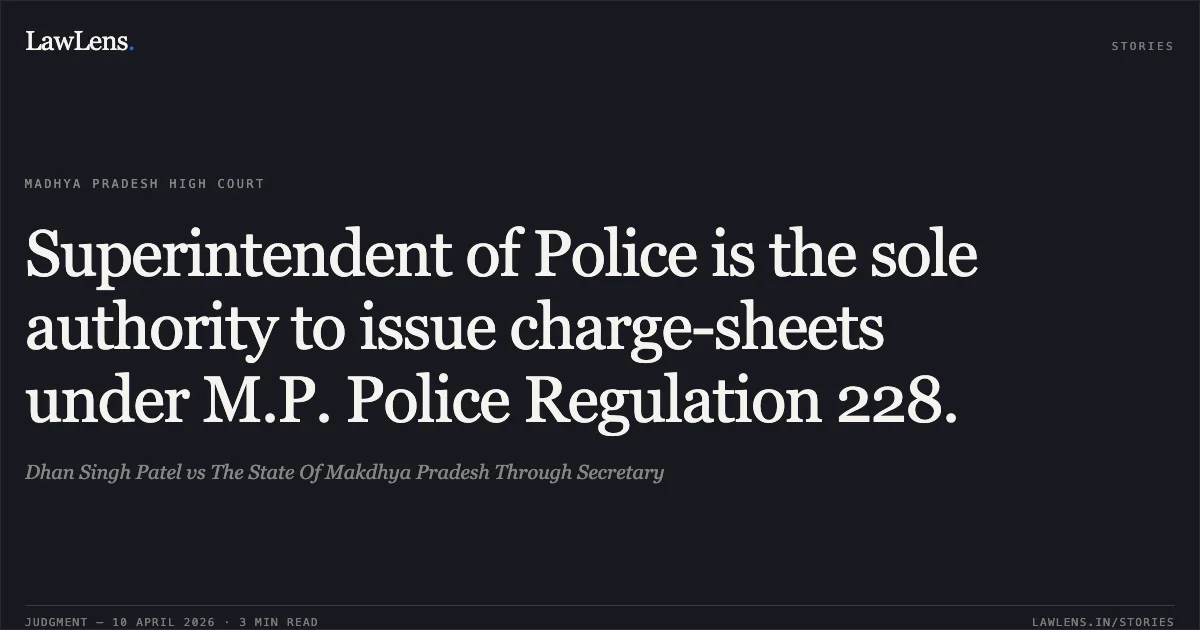
The court primarily applied Regulation 228 of the M.P. Police Regulations, which stipulates that formal proceedings for major penalties must be recorded and finalized by the Superintendent of Police (SP)
Source reference: para. 24It relied on the Division Bench ruling in Arun Prakash Yadav v. State of M.P. & Others [2013 (3) MPLJ 508 (DB)], which clarified that Regulation 228 exclusively empowers the SP as the sole disciplinary authority for subordinates, to the exclusion of both superior and inferior authorities
Source reference: para. 24Additionally, the court applied the principles of natural justice established in Union of India v. Mohd. Naseem Siddiqui (2005) and affirmed by the Supreme Court in Union of India v. Ram Lakhan Sharma (2018), which prohibit an Inquiry Officer from acting as a prosecutor by cross-examining the delinquent official
Source reference: para. 26Reasoning
Regarding jurisdiction, the court noted that under Regulation 228, the Superintendent of Police is the "sole competent authority" to institute disciplinary proceedings and issue final orders for ranks subordinate to the SP
Source reference: para. 24Although the respondents argued that Respondent No. 4 (DIG) was competent because he was the appointing authority for the petitioner's promotion, the court held that the specific language of the Police Regulations overrides general administrative hierarchies, rendering the DIG’s order coram non judice
Source reference: para. 24-25Regarding procedural fairness, the court observed that the Inquiry Officer had actively cross-examined the petitioner, thereby conflating the roles of judge and prosecutor
Source reference: para. 26This dual role was held to have severely vitiated the proceedings as it violated the fundamental requirement of an impartial inquiry
Source reference: para. 26Finally, the court noted that the appellate and mercy petition orders were passed mechanically without proper application of mind
Source reference: para. 27Holding
The court allowed the writ petition and quashed the order of removal dated July 16, 2020, along with the subsequent appellate and mercy petition orders
The court held that the removal was issued without jurisdiction and in violation of natural justice
Source reference: para. 25-27The respondents were directed to reinstate the petitioner as Assistant Sub-Inspector with all consequential and monetary benefits within 60 days
Source reference: para. 29, 31However, the court granted liberty to the competent authority to initiate fresh disciplinary proceedings in accordance with the law and principles of natural justice
Source reference: para. 30Original Court PDF
Dhan Singh PatelvsThe State Of Makdhya Pradesh Through Secretary
Click to open original judgment
Original judgment, available to read, download and summarize on LawLens.in