Facts
The Respondent (Competition Commission of India/CCI) received information under Section 46 of the Competition Act, 2002, read with the Lesser Penalty Regulations, 2024, regarding alleged anti-competitive labour-related coordination in the Appellant’s industry
Source reference: para 3(i)On August 13, 2025, the CCI initiated Suo Motu Case No. 02/2025, finding a prima facie contravention of Section 3 of the Act and directing the Director General (DG) to investigate under Section 26(1)
Source reference: para 3(iii)The CCI condoned the delay for information older than three years, citing the applicant’s internal investigation following international dawn raids and the need to protect worker interests
Source reference: para 14The Appellant challenged this order via a writ petition, which was dismissed by a Single Judge on February 23, 2026
Source reference: para 3(v-vi)The Appellant then filed this Letters Patent Appeal (LPA) challenging the condonation of delay and the subsequent investigation.
Source reference: no citationIssues
1. Whether the CCI failed to record "sufficient cause" as mandated by the first and second provisos of Section 19(1) of the Competition Act, 2002, while entertaining information filed beyond the three-year limitation period.
Source reference: para 4-6, 92. Whether the High Court should exercise its appellate jurisdiction to interfere with the discretionary power exercised by the CCI and the Single Judge in condoning the delay.
Source reference: para 21-22Law Applied
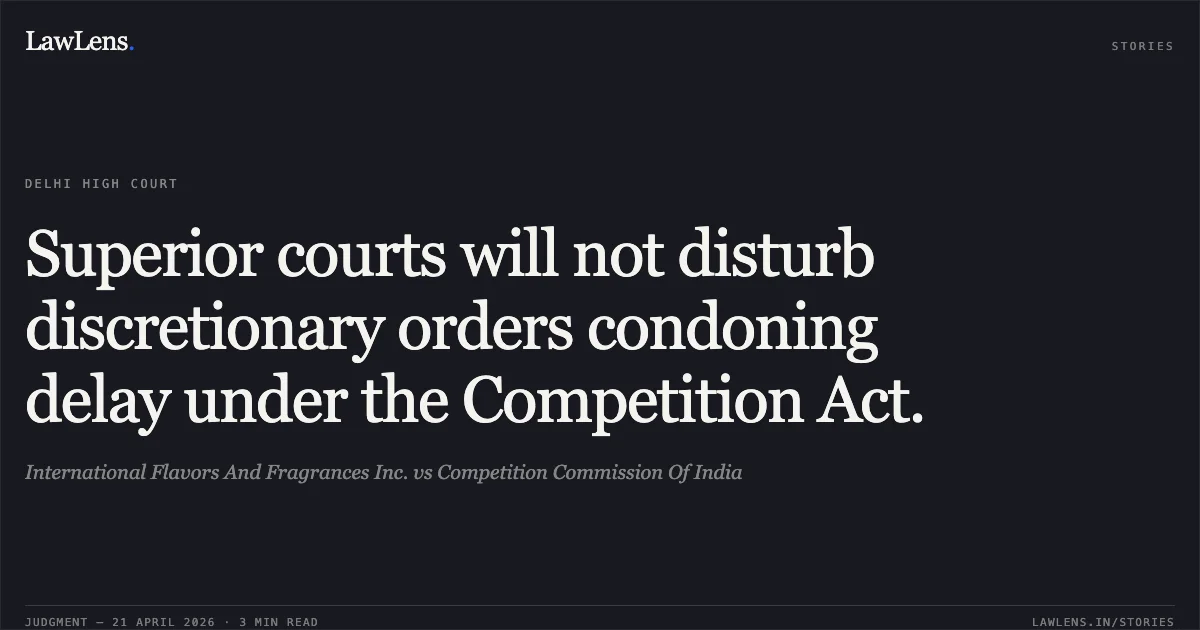
The Court applied Section 19(1) of the Competition Act, 2002, noting that the first proviso bars information filed after three years from the cause of action, while the second proviso allows for condonation if the Commission is satisfied there is "sufficient cause" and records its reasons
Source reference: para 9It relied on CCI v. Steel Authority of India (SAIL) (2010) 10 SCC 744, regarding the administrative nature of Section 26(1) orders
Source reference: para 7, 19Furthermore, it applied the principles from Collector Land Acquisition, Anantnag v. Mst. Katiji (1987) 2 SCC 107 and N. Balakrishnan v. M. Krishnamurthy (1998) 7 SCC 123, which establish that a liberal and justice-oriented approach must be adopted in matters of condonation of delay
Source reference: para 20Reasoning
The Court examined the CCI’s reasoning for condoning the delay, which included the fact that the applicant initiated internal investigations only after global dawn raids in March 2023 and approached the CCI promptly after the notification of the 2024 Regulations
Source reference: para 14The CCI had also considered the persistence of the cause of action and the broader economic implications of labour-related coordination, such as declining earnings among workers identified in the Economic Survey 2024
Source reference: para 14The Court found that the CCI was "sensitive" to the statutory mandate and had recorded specific reasons for its satisfaction regarding "sufficient cause"
Source reference: para 14-18The Court reasoned that once an authority exercises its discretion to condone delay positively, superior courts should generally respect that view unless a patent error of law exists
Source reference: para 21It concluded that the initiation of an investigation under Section 26(1) is an administrative step and the procedural aspects of condonation did not violate the Appellant's substantive rights in a manner requiring interference
Source reference: para 19-22Holding
The Court held that there was no error of law in the findings of the CCI or the Single Judge regarding the condonation of delay
The Division Bench refused to exercise its appellate jurisdiction to upset the discretionary orders and dismissed the appeal along with all pending applications
Source reference: para 23, 29The Court further recorded a "word of protest" regarding the conduct and "body language" of the Appellant’s Senior Counsel during the proceedings
Source reference: para 28Acts & Sections Cited
5 provisions across 1 statute referred to in this judgment. Each provision opens on LawLens.
Competition Act, 20025
Original Court PDF
International Flavors And Fragrances Inc.vsCompetition Commission Of India
Click to open original judgment
Original judgment, available to read, download and summarize on LawLens.in