Facts
Opposite party no. 2 filed an FIR against the appellants under the IPC and the SC/ST Act.
Source reference: para 2-3Initially, the Investigating Officer (IO) prepared a "final report" (FR) on June 9, 2016, concluding no offense was made out.
Source reference: para 3A superior police officer (Additional S.P.) returned the case diary/FR to the IO with instructions.
Source reference: para 6Following these directions, the IO conducted further investigation and submitted Charge Sheet No. 27/2017.
Source reference: para 3The Special Judge (SC/ST Act), Jaunpur, took cognizance and summoned the appellants via order dated 16.01.2019.
Source reference: para 2The appellants challenged this order, arguing that superior police officers lack the power to direct further investigation under Section 173(8) CrPC.
Source reference: para 5Issues
1. Whether a superior police officer is empowered to direct an Investigating Officer to conduct further investigation before the police report is filed in court.
Source reference: para 9, 132. Whether the judicial requirement for "seeking leave of the court" for further investigation applies to the pre-submission administrative stage or only after a report has been filed under Section 173(2).
Source reference: para 14, 21Law Applied
Section 36 of the CrPC (now Section 30 BNSS), which grants superior police officers co-extensive powers of investigation as an officer-in-charge of a police station.
Source reference: para 7, 9The doctrine derived from Vinay Tyagi v. Irshad Ali regarding the distinction between "further investigation" and "reinvestigation".
Source reference: para 8The principle in Peethambaran v. State of Kerala, which clarified that the power to order further investigation after a court filing rests with the Magistrate.
Source reference: para 8The precedent in State of Bihar v. J.A.C. Saldanha establishing that superior officers can supervise investigations to ensure the discovery of truth.
Source reference: para 12The rule in Bohatie Devi v. State of Uttar Pradesh, which bars executive interference once a matter enters the judicial domain.
Source reference: para 16-17Reasoning
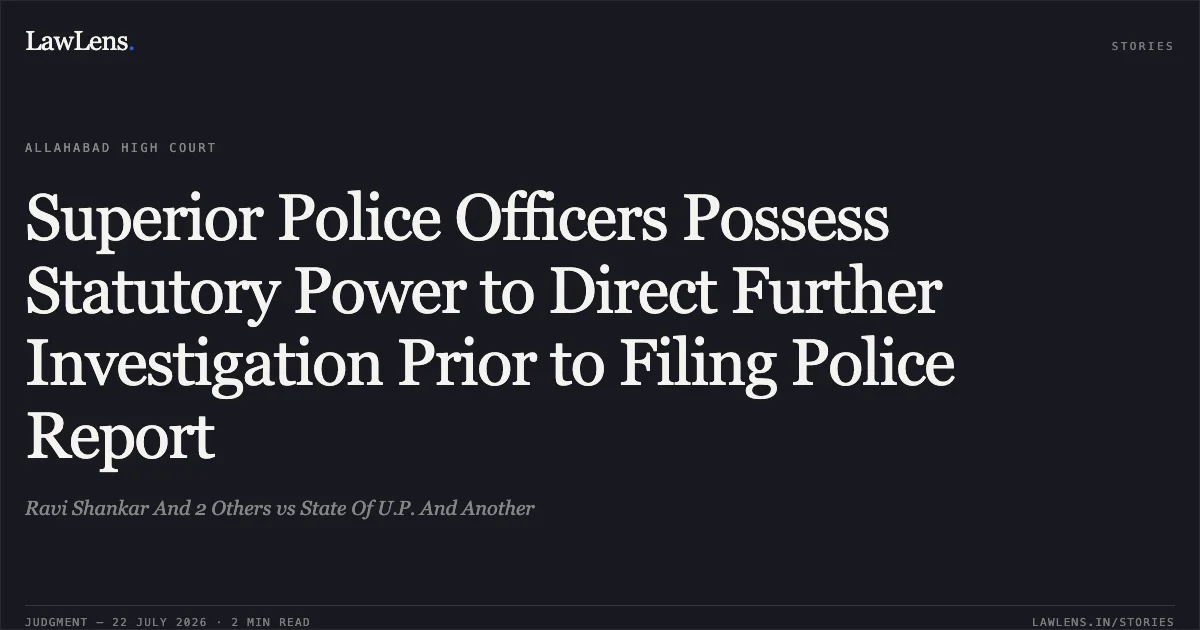
The Court reasoned that until a police report is submitted under Section 173(2) CrPC, the investigation remains under the "statutory and administrative supervision" of superior officers.
Source reference: para 13, 18Under Section 36 CrPC and U.P. Police Regulations, a superior officer may scrutinize the case diary, identify deficiencies, and return the record to the IO with directions to collect omitted evidence.
Source reference: para 11, 19The Court distinguished this "pre-submission" stage from the "post-submission" stage; while a court's permission is required for further investigation once a report is filed (to satisfy Section 173(8)), a superior officer can exercise "departmental supervision" to ensure a complete investigation before the report reaches the Magistrate.
Source reference: para 14, 20, 21In this case, since the initial FR was never submitted to the court, the Additional S.P.’s return of the diary was a valid exercise of administrative power, not a violation of Section 173(8).
Source reference: para 22-23Holding
The Court held that the superior police officer exercised valid "administrative power" by returning the case diary for proper investigation before any report was filed in court.
The Court dismissed the appeal and affirmed the trial court's order dated 16.01.2019, concluding that the police report submitted after this process contained sufficient prima facie material to proceed.
Source reference: para 24-25Acts & Sections Cited
12 provisions across 4 statutes referred to in this judgment. Each provision opens on LawLens.
Scheduled Castes and the Scheduled Tribes (Prevention of Atrocities) Act, 19891
Indian Penal Code, 18603
Code of Criminal Procedure, 19736
Bharatiya Nagarik Suraksha Sanhita, 20232
Original Court PDF
Ravi Shankar And 2 OthersvsState Of U.P. And Another
Click to open original judgment
Original judgment, available to read, download and summarize on LawLens.in