Facts
The Petitioners, members of the Managing Committee (MC) of the Delhi Union Cooperative House Building Society Ltd., challenged an order dated April 28, 2026, passed by the Registrar of Cooperative Societies (RCS).
Source reference: p. 1-2The RCS had superseded the MC and appointed an Administrator under Section 37 of the Delhi Co-operative Societies Act, 2003, citing persistent violations.
Source reference: p. 1-2These included charging exorbitant penalty interest (365% p.a.) on maintenance dues, failing to reinstate an expelled member despite RCS orders, and non-compliance with an arbitral award dated February 29, 2024.
Source reference: paras. 7, 15The MC appealed to the Financial Commissioner, who dismissed the appeal on July 3, 2026, leading to the present writ petition.
Source reference: paras. 4, 9Issues
1. Whether the supersession of an elected Managing Committee was legally justified under Section 37 of the Delhi Co-operative Societies Act, 2003, in light of the alleged non-compliances.
Source reference: p. 6 / para. 102. Whether the Managing Committee should be granted a further opportunity to rectify the defects before being permanently ousted.
Source reference: p. 10 / para. 18Law Applied
Section 37 of the Delhi Co-operative Societies Act, 2003, which empowers the RCS to supersede a committee for persistent default or negligence.
Source reference: para. 17State of M.P. and Ors. v. Sanjay Nagayach and Ors. (2013), which establishes that supersession of an elected body is an exception and should only occur after granting reasonable time (at least six months) to rectify defects, unless there is deliberate inaction.
Source reference: para. 13The Managing Committee of Vallapuzha Service Co-op. Bank Ltd. vs. The Joint Registrar Co-operative Societies (2009) regarding the autonomy of cooperative societies against excessive state control.
Source reference: para. 14Reasoning
The Court observed that while the RCS serves as the supervisory authority and the MC has a legal obligation to comply with its directions, the supersession of an elected body—whose term ends in 2027—is a drastic measure.
Source reference: paras. 9, 16, 17Applying the Sanjay Nagayach principles, the Court found that although the MC failed to comply with previous orders regarding membership reinstatement and interest rates, it should typically be allowed to complete its term.
Source reference: paras. 10, 13However, the Court acknowledged the RCS's findings of "conscious disregard of statutory obligations".
Source reference: para. 7Balancing these positions, the Court reasoned that the MC should be given a final, time-bound opportunity to undertake remedial actions under the supervision of the existing Administrator rather than being immediately and finally superseded.
Source reference: paras. 18, 19Holding
The Court disposed of the petition by directing three members of the MC to appear before the RCS on July 16, 2026, to receive a list of required compliances.
The Holding is that the MC shall be granted 30 days to rectify the violations with the cooperation of the Administrator.
Source reference: para. 19If the RCS records satisfaction with the compliances within one month thereafter, the MC shall be restored to office; however, if the MC fails to comply, the original supersession order shall stand.
Source reference: paras. 20-21The Administrator was directed to cooperate in facilitating this compliance.
Source reference: para. 22Acts & Sections Cited
3 provisions across 2 statutes referred to in this judgment. Linked provisions open on LawLens.
Delhi Co-Operative Societies Act, 20032
KERALA CO-OPERATIVE SOCIETIES (AMENDMENT) ACT, 20211
Original Court PDF
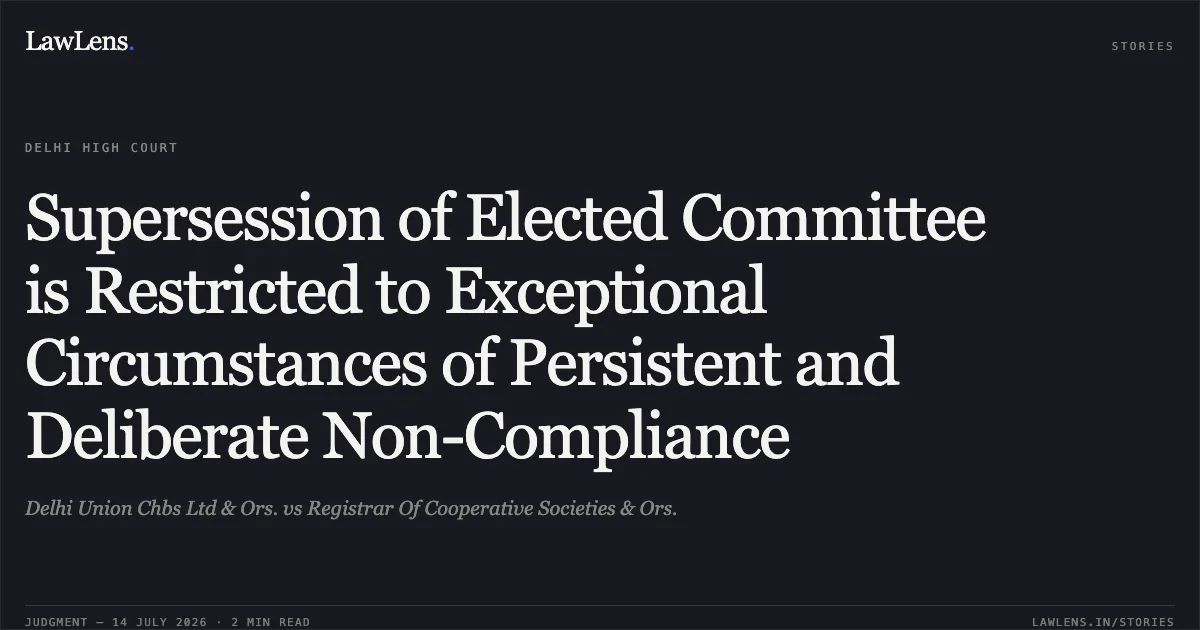
Delhi Union Chbs Ltd & Ors.vsRegistrar Of Cooperative Societies & Ors.
Click to open original judgment
Original judgment, available to read, download and summarize on LawLens.in