Facts
Respondent No. 2, Anil Kumar Sharma, claimed that he was employed by the petitioner as an “Area Supervisor Training Operation” from 19 December 2011 at a last-drawn salary of ₹8,048 per month. He alleged that his services were illegally terminated on 10 April 2013, without notice or payment of wages for 1–10 April 2013. On his demand notice and proceedings before the Labour Department, the following dispute was referred to the Labour Court: whether he had voluntarily absented himself from duty or had been illegally and unjustifiably terminated, and to what relief he was entitled.
Source reference: p. 2, para. 2–3Despite service, the petitioner did not appear before the Labour Court and was proceeded ex parte on 15 July 2015. It entered appearance only on 22 December 2017 and filed an application under Order IX Rule 7 CPC, which was dismissed on 8 August 2018. The Labour Court thereafter passed an ex parte Award dated 9 August 2018 directing reinstatement with full back wages, continuity of service and consequential benefits, relying on the workman’s oral and documentary evidence, including his identity card, appointment letter and attendance-punching card.
Source reference: p. 4, para. 8–9The petitioner’s subsequent application for setting aside the Award was dismissed on 5 October 2018, as it repeated the grounds raised in the earlier application.
Source reference: p. 5, para. 10The petitioner challenged these orders and the Award under Articles 226 and 227 of the Constitution.
Source reference: p. 1, para. 1Issues
Whether the Labour Court erred in refusing to set aside the ex parte proceedings under Order IX Rule 7 CPC when the petitioner claimed that its non-appearance was neither deliberate nor intentional.
Source reference: p. 3–4, paras. 4, 8Whether the ex parte Award directing reinstatement, full back wages, continuity of service and consequential benefits suffered from a jurisdictional error, perversity, or violation of natural justice warranting interference under Articles 226 and 227.
Source reference: p. 3–5, paras. 7, 9–14Whether the Labour Court at Dwarka lacked territorial jurisdiction because the workman allegedly worked at Gurgaon.
Source reference: p. 2–3, para. 4; p. 5–6, para. 13Whether the petitioner could raise, for the first time in writ proceedings, factual contentions that the workman had voluntarily abandoned employment and had worked at Gurgaon.
Source reference: p. 5, para. 12Law Applied
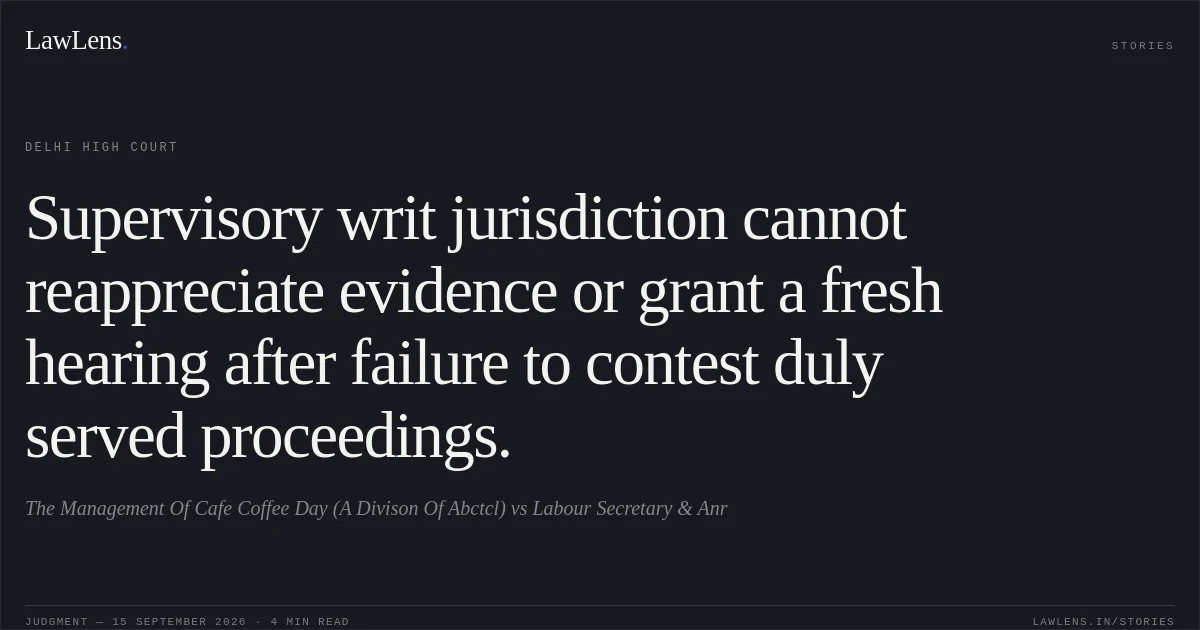
The Court applied the supervisory jurisdiction under Articles 226 and 227 of the Constitution, under which the High Court does not act as an appellate court or reappreciate evidence; interference is justified only for an error of law apparent on the face of the record, a finding based on no evidence, improper exclusion of material evidence, or reliance on inadmissible evidence.
Source reference: p. 3, para. 7This principle was drawn from Syed Yakoob v. K.S. Radhakrishnan, AIR 1964 SC 477.
Source reference: p. 3, para. 7The Court also applied Order IX Rule 7 CPC concerning setting aside an order proceeding against a defendant or party ex parte before final adjudication.
Source reference: p. 3–4, paras. 4, 8A party duly served with proceedings must raise its factual and jurisdictional objections before the competent tribunal at the appropriate stage and cannot ordinarily seek a fresh factual adjudication in writ proceedings.
Source reference: p. 5–6, paras. 12–13Reasoning
The Court found that the petitioner had been duly served and had failed to appear despite repeated calls; it then allowed the proceedings to continue for more than two years without seeking recall of the ex parte order.
Source reference: p. 4, para. 8The Labour Court had considered and rejected the petitioner’s explanation, including the absence of an authority letter for the person who signed the application.
Source reference: p. 4, para. 8The subsequent application to set aside the Award raised the same grounds and was therefore correctly dismissed.
Source reference: p. 5, para. 10On the merits, the Award was not based merely on uncontroverted oral testimony: the Labour Court also relied on documentary evidence establishing the employment relationship, including the identity card, appointment letter and attendance record.
Source reference: p. 4–5, paras. 9, 11The petitioner’s assertions of abandonment and employment at Gurgaon constituted disputed questions of fact that could and should have been proved before the Labour Court; they could not be examined for the first time under the High Court’s limited supervisory jurisdiction.
Source reference: p. 5, para. 12The territorial-jurisdiction objection also failed because it had not been properly raised or established before the Labour Court, and the bare assertion regarding Gurgaon did not justify interference with the Award.
Source reference: p. 5–6, para. 13Holding
The High Court held that there was no jurisdictional error, perversity, or violation of natural justice in the orders dated 8 August 2018 and 5 October 2018 or in the Award dated 9 August 2018.
The writ petition was dismissed, and the petitioner was denied a fresh opportunity to contest the workman’s claim on merits after failing to participate in the Labour Court proceedings.
Source reference: p. 6, paras. 14–15The amount deposited by the petitioner with the Registry, together with accrued interest, was directed to be released to respondent No. 2, and the remaining amount payable under the Award was directed to be paid within four weeks.
Source reference: p. 6, paras. 16–17Original Court PDF
The Management Of Cafe Coffee Day (A Divison Of Abctcl)vsLabour Secretary & Anr
Click to open original judgment
Original judgment, available to read, download and summarize on LawLens.in