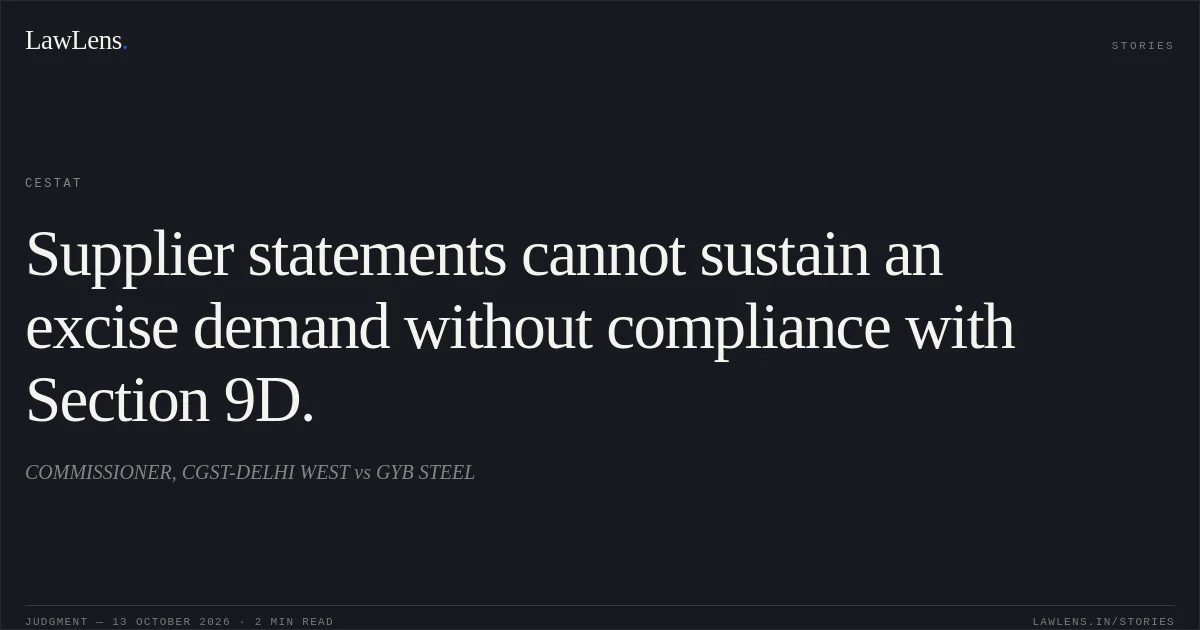
Facts
GYB Steel, a proprietorship manufacturing G.I. Channels, claimed SSI exemption and was not registered with the department.
Source reference: p. 2Following a search on 4 April 2013, the department alleged that GYB Steel had used unaccounted raw materials to manufacture and clandestinely clear goods, resulting in central excise duty evasion of ₹69.86 lakh.
Source reference: p. 2The demand was calculated by combining clearances attributed to GYB Steel and Snowhite Plaster Industries, a separate firm owned by the proprietor’s father.
Source reference: p. 2The adjudicating authority confirmed the demand, interest and penalty and confiscated seized goods.
Source reference: p. 2The Commissioner (Appeals) set aside the demand and related amounts, finding insufficient grounds to club the firms’ clearances, and reduced the confiscation-related penalty to ₹5,000.
Source reference: p. 2–4The Revenue appealed to the Tribunal.
Source reference: p. 2–4Issues
Whether the statements of the raw-material suppliers could be relied upon to establish that Snowhite Plaster Industries was a dummy unit and that its clearances should be clubbed with those of GYB Steel, when the statutory procedure under Section 9D had not been shown to be followed.
Source reference: p. 4–6Whether the fact that GYB Steel’s proprietor placed orders for goods supplied to Snowhite Plaster Industries established that Snowhite was a dummy unit.
Source reference: p. 5Law Applied
Section 9D of the Central Excise Act, 1944, read with subsection (2), governs the relevance of statements made before a Central Excise Officer in proceedings under the Act.
Source reference: p. 4–6The Tribunal treated the statutory conditions for admitting such statements as requiring proof on the record that the statement-makers had been examined as witnesses by the adjudicating authority; absent that, the statements could not support the Revenue’s case.
Source reference: p. 4–6The Tribunal also applied the principle that common ordering or payment arrangements, without further evidence, do not by themselves establish that a separately constituted firm is a dummy unit or justify clubbing its clearances.
Source reference: p. 4–6Reasoning
The Revenue relied on suppliers’ statements to argue that goods attributed to Snowhite were actually supplied to GYB Steel and that the two firms’ clearances should be combined.
Source reference: p. 4–6The Tribunal found no record showing that the suppliers had been examined as witnesses by the adjudicating authority, and therefore rejected the Revenue’s assertion that Section 9D had been complied with.
Source reference: p. 4–6Independently, even accepting the statements, the fact that GYB Steel’s proprietor placed orders for goods supplied to his father’s firm did not establish that Snowhite was a dummy unit.
Source reference: p. 4–6The Revenue’s reliance on those statements consequently did not displace the Commissioner (Appeals)’s finding against clubbing.
Source reference: p. 4–6Holding
The Tribunal dismissed the Revenue’s appeal and upheld the Commissioner (Appeals)’ order.
The demand, interest, penalty and redemption fine set aside by the Commissioner (Appeals) remained set aside, and the confiscation-related penalty remained reduced to ₹5,000.
Source reference: p. 6Acts & Sections Cited
1 provisions across 1 statute referred to in this judgment. Linked provisions open on LawLens.
the Act (alias, unresolved)1
Original Court PDF
COMMISSIONER, CGST-DELHI WESTvsGYB STEEL
Click to open original judgment
Original judgment, available to read, download and summarize on LawLens.in
![Authorities must individually assess similarly situated employees’ eligibility for benefits under an affirmed precedent.. Swapan Das vs POSTS. CAT - ['Kolkata']. LawLens](/stories/thumbnails/authorities-must-individually-assess-similarly-situated-employees-eligibility-for-benefits-79605d4f38f347acb73daa832fe2a358.webp)
![Competent authority must reconsider the compassionate allowance claim, including limitation, by a reasoned order.. VINAY KUMAR vs DEPTT OF POSTS. CAT - ['Allahabad']. LawLens](/stories/thumbnails/competent-authority-must-reconsider-the-compassionate-allowance-claim-including-limitation-ca3eb833b95c48bba16e267d27ef2dca.webp)